Thursday, August 27, 2009

The three essential ingrients to gain wisdom ...


The three essential ingrients to gain wisdom are, the right effort, a clear comprehention and the right mindfulness. It is just like a plant needs sunlight, water and soil for it to grow to it's full potential.

Saturday, August 22, 2009

How can clinging survive ?


Why do we cling to what we see? This is because of craving. If thre is no more craving how can clinging survive ? It is like a tree that always needs water to survive.

Friday, August 21, 2009

There is pressure in what we see...


Sure...there is pressure in what we see. This is why we cling to it. This same clinging will lead to our own suffering... at the end. Same goes to our other senses.

Thursday, August 20, 2009

Build the house from the bottom up...


"Monks, if anyone were to say, 'Without having broken through to the noble truth of stress as it actually is present, without having broken through to the noble truth of the origination of stress... the cessation of stress... the path of practice leading to the cessation of stress*, as it actually is present, I will bring about the right ending of stress,' that would be an impossibility.

Just as if someone were to say, 'Without having built the lower story of a gabled building, I will put up the upper story,' that would be an impossibility; in the same way, if anyone were to say, 'Without having broken through to the noble truth of stress as it actually is present, without having broken through to the noble truth of the origination of stress... the cessation of stress... the path of practice leading to the cessation of stress, as it actually is present, I will bring about the right ending of stress,' that would be an impossibility.

*The Four Noble Truths (see labels)


-Kuta Sutta: Gabled
http://www.accesstoinsight.org/tipitaka/sn/sn56/sn56.044.than.html

Grow "flowers" not "weeds" in the mind


Consider your mind as your garden. It is very easy to grow weeds but it is hard to grow nice flowers. You need constant effort and mindfulness to keep the garden free from weeds. Weeds are like our defilements in the mind. Flowers are like the good moral values and virtues of the mind.

Tuesday, August 18, 2009

Just as a man with good eyes.....


"Now how, Ananda, in the discipline of a noble one is there the unexcelled development of the faculties?

There is the case where, when seeing a form with the eye, there arises in a monk what is agreeable, what is disagreeable, what is agreeable & disagreeable. He discerns that 'This agreeable thing has arisen in me, this disagreeable thing... this agreeable & disagreeable thing has arisen in me. And that is compounded, gross, dependently co-arisen. But this is peaceful, this is exquisite, i.e., equanimity.' With that, the arisen agreeable thing... disagreeable thing... agreeable & disagreeable thing ceases, and equanimity takes its stance.

Just as a man with good eyes, having closed them, might open them; or having opened them, might close them, that is how quickly, how rapidly, how easily, no matter what it refers to, the arisen agreeable thing... disagreeable thing... agreeable & disagreeable thing ceases, and equanimity takes its stance. In the discipline of a noble one, this is called the unexcelled development of the faculties with regard to forms cognizable by the eye.


Friday, July 31, 2009

Not even if it rained gold coins...


Not even if it rained gold coins would we have our fill of sensual pleasures.
'Stressful, they give little enjoyment' — knowing this, the wise one finds no delight even in heavenly sensual pleasures. He is one who delights in the ending of craving, a disciple of the Rightly Self-Awakened One.

-Dhammapada

Thursday, July 30, 2009

Characteristic of consciousness...


The king asked: "Venerable Nagasena, what is the distinguishing characteristic of consciousness?"

"The distinguishing characteristic of consciousness, your majesty, is cognizing."

"Give me an analogy."

"Just as, your majesty, a city-superintendent sitting at the crossroads in the middle of the city could see a person coming from the eastern direction, could see a person coming from the southern direction, could see a person coming from the western direction, and could see a person coming from the northern direction, then indeed, your majesty, does a person cognize with consciousness a form he sees with the eye, cognize with consciousness a sound he hears with the ear, cognize with consciousness a scent he smells with the nose, cognize with consciousness a taste he savors with the tongue, cognize with consciousness a touch he feels with the body, and cognize with consciousness a mental state he cognizes with the mind. Indeed thus, your majesty, the distinguishing characteristic of consciousness is cognizing."

"You are clever, venerable Nagasena."

http://www.accesstoinsight.org/tipitaka/kn/miln/miln.2x.kell.html#miln-2-3-08-cymbals

Tuesday, July 28, 2009

Like a water bead on a lotus...


Not to gain or loss not to status or honor,
not to praise or blame,
not to pleasure or pain:
everywhere they do not adhere — like a water bead on a lotus.
Everywhere they are happy, the enlightened, everywhere un- defeated.

Sunday, July 26, 2009

Just as if a man were to grasp a branch with his hand ...


"There is the case where a monk enters & remains in a certain peaceful awareness-release. He attends to the cessation of self-identification*, but as he is attending to the cessation of self-identification his mind doesn't leap up, grow confident, steadfast, or firm in the cessation of self-identification. For him the cessation of self-identification is not to be expected.

Just as if a man were to grasp a branch with his hand smeared with resin, his hand would stick to it, grip it, adhere to it; in the same way, the monk enters & remains in a certain peaceful awareness-release. He attends to the cessation of self-identification, but as he is attending to the cessation of self-identification his mind doesn't leap up, grow confident, steadfast, or firm in the cessation of self-identification. For him the cessation of self-identification is not to be expected.

"Now, there is the case where a monk enters & remains in a certain peaceful awareness-release. He attends to the cessation of self-identification, and as he is attending to the cessation of self-identification his mind leaps up, grows confident, steadfast, & firm in the cessation of self-identification. For him the cessation of self-identification is to be expected.

Just as if a man were to grasp a branch with a clean hand, his hand would not stick to it, grip it, or adhere to it; in the same way, the monk enters & remains in a certain peaceful awareness-release. He attends to the cessation of self-identification, and as he is attending to the cessation of self-identification his mind leaps up, grows confident, steadfast, & firm in the cessation of self-identification. For him the cessation of self-identification is to be expected
* First fetter
(to understand fetters see lables below)


Tuesday, June 23, 2009

Just as a hen expects...


"Suppose a hen has eight, ten, or twelve eggs: If she doesn't cover them rightly, warm them rightly, or incubate them rightly, then even though this wish may occur to her — 'O that my chicks might break through the egg shells with their spiked claws or beaks and hatch out safely!' — still it is not possible that the chicks will break through the egg shells with their spiked claws or beaks and hatch out safely.

Why is that?

Because the hen has not covered them rightly, warmed them rightly, or incubated them rightly.

In the same way, even though this wish may occur to a monk who dwells without devoting himself to development — 'O that my mind might be released from (Taints) effluents through lack of clinging!' — still his mind is not released from the (Taints) effluents through lack of clinging.

Why is that?

From lack of developing, it should be said.

Lack of developing what?

The four frames of reference, the four right exertions, the four bases of power, the five faculties, the five strengths, the seven factors for Awakening, the noble eightfold path.


Nava Sutta: The Ship
translated from the Pali by
Thanissaro Bhikkhu

http://www.accesstoinsight.org/tipitaka/sn/sn22/sn22.101.than.html#hen

So hard to see the mind...


So hard to see,
so very, very subtle,
alighting wherever it likes: the mind.
The wise should guard it.
The mind protected brings ease.

-Dhammapada

Monday, June 22, 2009

Sensuality is like picking fruits off a tree...


"Now suppose that, not far from a village or town, there were a dense forest grove, and there in the grove was a tree with delicious fruit, abundant fruit, but with no fruit fallen to the ground. A man would come along, desiring fruit, looking for fruit, searching for fruit. Plunging into the forest grove, he would see the tree... and the thought would occur to him, 'This is a tree with delicious fruit, abundant fruit, and there is no fruit fallen to the ground, but I know how to climb a tree. Why don't I climb the tree, eat what I like, and fill my clothes with the fruit?' So, having climbed the tree, he would eat what he liked and fill his clothes with the fruit. Then a second man would come along, desiring fruit, looking for fruit, searching for fruit and carrying a sharp ax. Plunging into the forest grove, he would see the tree... and the thought would occur to him, 'This is a tree with delicious fruit, abundant fruit, and there is no fruit fallen to the ground, and I don't know how to climb a tree. Why don't I chop down this tree at the root, eat what I like, and fill my clothes with the fruit?' So he would chop the tree at the root. What do you think: If the first man who climbed the tree didn't quickly come down, wouldn't the falling tree crush his hand or foot or some other part of his body, so that he would meet with death from that cause, or with death-like pain?"


"Yes, lord."


"In the same way, householder, a disciple of the noble ones considers this point: 'The Blessed One has compared sensuality to the fruits of a tree, of much stress, much despair, & greater drawbacks.' Seeing this with right discernment, as it actually is present, then avoiding the equanimity coming from multiplicity, dependent on multiplicity, he develops the equanimity coming from singleness, dependent on singleness, where sustenance/clinging for the baits of the world ceases without trace.


Thursday, June 4, 2009

Hidden treasures of this city...


A city made of bones,
plastered over with flesh & blood,
whose hidden treasures are:
pride & contempt,
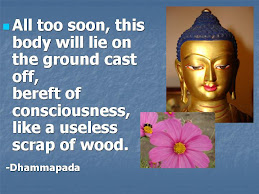
aging & death.
-Dhammapada

Tuesday, June 2, 2009

Store the "weapons of Dhamma"...


"Just as the royal frontier fortress has many weapons stored, both arrows & things to be hurled, for the protection of those within and to ward off those without; in the same way...


.....the disciple of the noble ones has heard much, has retained what he has heard, has stored what he has heard. Whatever teachings are admirable in the beginning, admirable in the middle, admirable in the end, that — in their meaning & expression — proclaim the holy life that is entirely complete & pure: those he has listened to often, retained, discussed, accumulated, examined with his mind, and well-penetrated in terms of his views.


With learning as his weapons, the disciple of the noble ones abandons what is unskillful, develops what is skillful, abandons what is blameworthy, develops what is blameless, and looks after himself with purity.
http://www.accesstoinsight.org/tipitaka/an/an07/an07.063.than.html#learning

Tuesday, May 26, 2009

Sorrows grow like wild grass if....


If this sticky, uncouth craving
overcomes you in the world,
your sorrows grow like wild grass
after rain.


-Dhammapada

Thursday, May 21, 2009

A simple whish for Sri Lanka at this time of crisis...


I wish all Sri Lankan's will contemplate these beautiful words of the Buddha at this time of crisis...

"Hatred is never appeased by hatred in this world. By non-hatred alone is hatred appeased. This is a law eternal."

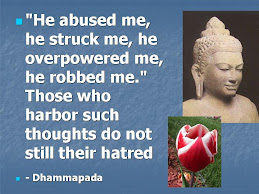
"He abused me, he struck me, he overpowered me, he robbed me." Those who harbor such thoughts do not still their hatred."


"He abused me, he struck me, he overpowered me, he robbed me." Those who do not harbor such thoughts still their hatred."


"There are those who do not realize that one day we all must die. But those who do realize this settle their quarrels."

-Dhammapada

May all beings be well, happy and live peacefully in Sri Lanka.

Friday, May 15, 2009

Contemplation of the body...as a cave


Staying attached to the cave,
covered heavily over,
a person sunk in confusion
is far from seclusion —
for sensual pleasures
sensual desires
in the world
are not lightly let go.

Guhatthaka Sutta-The Cave of the Body
http://www.accesstoinsight.org/tipitaka/kn/snp/snp.4.02.than.html

Contemplation of the body...as a boil


"Monks, it's just as if there were a boil that had been building for many years with nine openings, nine un-lanced heads. Whatever would ooze out from it would be an uncleanliness oozing out, a stench oozing out, a disgust oozing out. Whatever would be discharged from it would be an uncleanliness discharging, a stench discharging, a disgust discharging.

"'A boil,' monks, is another word for this body composed of the four properties*, born of mother & father, fed on rice & porridge, subject to inconstancy, rubbing & massaging, breaking-up & disintegrating. It has nine openings, nine un-lanced heads. Whatever would ooze out from it would be an uncleanliness oozing out, a stench oozing out, a disgust oozing out. Whatever would be discharged from it would be an uncleanliness discharging, a stench discharging, a disgust discharging. For that reason, you should become disenchanted with this body."

Ganda Sutta-A Boil
http://www.accesstoinsight.org/tipitaka/an/an09/an09.015.than.html

*
See labels