Friday, March 22, 2013

The Five Spiritual Faculties

"Monks, there are these five faculties. Which five? The faculty of faith, the faculty of energy, the faculty of mindfulness, the faculty of concentration, the faculty of wisdom.  These are the five faculties.

"One who has completed and fulfilled these five faculties is an arahant. If they are weaker than that, one is practicing for the realization of the fruit of arahantship; if still weaker, one is a nonreturner; if still weaker, one is practicing for the path for the realization of the fruit of nonreturning; if still weaker, one is a once-returner; if still weaker, one is practicing for the realization of the fruit of once-returning; if still weaker, one is a stream-enterer; if still weaker, one is practicing for the realization of the fruit of stream-entry.

"But monks, I say that one in whom these faculties are completely and totally absent is' an outsider, one standing amid the worldlings"

(SN 48:18; V202), Translated by Bhikkhu Bodhi: In the Buddhas' Words, An Anthology of the Discourses from Pali Canon, 2005, Wisdom Publications, Inc., Page 385.

(Also read Indriya-vibhanga Sutta: Analysis of the Mental Faculties.)

The five spiritual faculties  are faith (conviction), effort (vigor/energy), mindfulness, concentration and wisdom.   Here we use a simile of a hand (see the figure above) and the strongest digit is the thumb and that it should be like the faith in the ptactice. The role of mindfulness in the center as the middle finger balancing the other four factors. It is important to have some amount of faith about the path to arrive at  wisdom one day.  Therefore the first goal of the Buddhist partitioner is to develop faith (on Buddha, Dhamma and the Sangha) through investigation of the path. There are two different forms of faith. Investigative faith (Akarawathi saddha) and blind faith/without proper beginning (Amulika saddha).  In Buddhism we use the investigative faith (Akarawathi saddha).

There are two who are practicing for the realization of stream entry. They are the Faith follower and Dhamma follower The faith follower has strong faith on the path and its results.  He is the one who knows the arising and falling away of the five aggregates. The Dhamma follower has developed more wisdom than the faith follower.  He sees the arising and passing away of the five aggregates.  One who  both knows and sees the arising and passing away of the five aggregates is a stream enterer.  The stream enterer  also has all the components of all the five faculties developed to some degree.  The higher the degree of development of these faculties, the higher the stage of enlightenment. (see the above passage form the sutta).  Buddha has discussed many advantages of being a stream entererPlease read the links below (Click on the title).

Who is a stream-winner ?

The stream-winner...three fetters are abandoned in him

The suffering that is remaining for a stream-winner is like ...the water drawn out with the tip of the blade of grass

For the stream-winner... suffering remaining is just like a little bit of dust on a fingernail


Stream Winner.. a great mass of merit that is unreckonable, immeasurable

More rewards...for the stream winner


The fruit of stream-entry excels...Sole dominion over the earth


More rewards of stream-winner, here-and-now...


Suffering remaining for a stream-winner is just like... two or three remaining drops of water


Stream-winner is fearless at death

The five groups of clinging

The number of rebirths remaining for the stream-winner...


Also read :

The four stages of enlightenment

Seven types of individuals ...

The five rewards of conviction (faith)


Friday, February 8, 2013

The four kinds of kamma...


 (Please click on the figure to enlarge)

Kamma is the result of our will or intention.  We discussed before that we have no absolute free will. But we have a will. Therefore we can change our kamma.

Lets take an illustration and see how we make our kamma.

When a person sees an object the person can react or respond in four different ways (See the illustration in the figure above). In this example here it is the identical object comes to their visual field ("A", "B" and "C").

1. The person "A" may react in an unskilful way making "dark kamma" resulting in "dark results."
2. Person "B"  may react with "bright kamma" resulting in "bright result."
3. Their could be a person ("A" or "B" or both) with mix of "dark and bright kamma" resulting in mixed results ("dark and bright results").
4. Their is the person "C" is awakened (fully enlightened). This person may respond with kamma that ends kamma (extinguish kamma). This person knows this is a mere flow of Nama Dhamma arising and passing away in the individual's own mind. This is also will be last mental action at death resulting in no future births.  All the previous kamma dark or bright does not come to fruit. They end all their kamma with  the last kamma that ends kamma.  

The above illustration is for eye and object only. The exact same mechanism applies to other senses too, including mind and mind objects. At the time of death mostly mind and mind objects (memories retrieved) as discussed in the mind works model come into play. The awaked has no more taints and therefore flow of thoughts from the mind does not happen.  We have discussed this in detail a previous post on taints.

(Please click on the hyperlinked words or phrases to read the previous posts related to this topic if you wish).


Further reading from previous posts.
"... there are four kinds of kamma proclaimed by me after realization myself with direct knowledge.

What are the four?

1.There is dark kamma with dark ripening,
2. There is bright kamma with bright ripening,
3. There is dark-and-bright kamma with dark-and-bright ripening,
4. There is kamma that is not dark and not bright with neither-dark-nor-bright ripening that conduces to the exhaustion of kamma.

Kukkuravatika Sutta: The Dog-duty Ascetic


translated from the Pali by Ñanamoli Thera

Saturday, January 26, 2013

Four skillful ways of answering questions


In this post I will examine the different methods of answering questions skilfully based on Buddhist wisdom. As I was searching for this in the Buddhist literature, I came across a very short but a fascinating disclosure by the Buddha. This was called Pañha Sutta.


This sutta explains four skillful ways of answering questions:


1. There are questions that should be answered categorically, for example, yes or no answer.


2. There are questions that should be answered with an analytical (qualified) answer. You explain the answer in detail defining and redefining the terms.


3. There are questions that should be answered with a counter questions.


4. There are questions that should be put aside.


Buddha went on to say that "any persons who is practicing Dhamma (Buddha's teachings) will be skilled in the four types of questions: hard to overcome, hard to beat, profound, hard to defeat. He will know what is worthwhile and what is not, and will be proficient in recognizing both. He will reject what is worthless, and will grasps what is worthwhile. He is called who is prudent and wise"

Could we apply this to our daily lives? It will not be easy, but we can try. Let me share with you some of my personal experience. A common mistake I make is trying to answer questions analytically when the answer should be a simple yes or no. This was an old habit of my mine that came with my training. This has got me in to lot of trouble in the past. Now I am a little more mindful on this. The other problem was I often failed to recognize the questions that should be put a side. This still happens and I have to be more mindful on this.

Now how can we use the above outlined methods of answering questions practically? Most people ask question genuinely because they don't no the answer. You can choose method one or two outlined above to answer them according to the knowledge you already have. Some people ask questions when they already know the answers. The reason is they want to test you. If you mindfully listen (see previous posting below) you may be be able to catch this early enough. In this case you may want to use method number three or four. Yet another group of people asks questions to get you to start an argument. Be very mindful with these questions. You definitely want to use the method number four here. Where else could you use the method number three? This could be used when you want to avoid answering a question. A simple example is when somebody ask a question like; how old are you? You may want to ask a counter question like, how old you think I am? But the real question may be more complex than this.


If you are mindful enough you will soon realize whenever we get in trouble trying to answer questions it is because we are not skilled in the above methods. You may not be able to see this or practice this at once as your mind has already been conditioned over time. As we know humans are creatures of habit and it will take a some practice and effort before we become fully skillful in answering questions wisely. Therefore don't be afraid to make mistakes. Always try to contemplate on the mistakes you have just made. Please don't dwell on it. Acknowledge the mistake, forgive yourself and lean from it. There isn't always a "perfect answer". It is how we approach the question which more important than the answer itself.


1. Pañha Sutta 
2. Also read: "Pañha Sutta: Questions" (AN 4.42), translated from the Pali by Thanissaro Bhikkhu. Access to Insight, 3 July 2010,http://www.accesstoinsight.org/tipitaka/an/an04/an04.042.than.html . Retrieved on 27 January 2013.

Wednesday, January 23, 2013

Advice on mindful speech: Before you speak...

Here is Buddha's advice on right speech. This is very valuable in our daily lives as we become more mindful in our speech.


Summary of "Abhaya Sutta: To Prince Abhaya" (MN 58), translated from the Pali by Thanissaro Bhikkhu. Access to Insight, 12 February 2012,http://www.accesstoinsight.org/tipitaka/mn/mn.058.than.html . Retrieved on 23 January 2013.

Abhaya Rajakumara sutta discussed by Ajahn Brahm

Monday, December 31, 2012

"Ruts" in the mind


Imagine a stream of water flowing over a large rock. Over time it will make small tracks on the rock that will gradually become grooves and eventually become big ruts.  It is similar to what happens in the mind.  The mind learns patterns though our habitual ways of thinking. As we discussed in the last post (How can we train ourselves to be kind and compassionate?what we keep thinking and pondering about becomes the inclination of our minds. If we have thoughts of sensual desires, ill will and harm all the time, that will become the inclination of our mind. The result will be greed, anger and hatred.  If the ruts we have made are deep no matter how we try to pour water on the rock the water will travel only in the direction of the ruts. However the good news is that in the mind we can wipe all these old ruts and make new ones. This requires work. This is the training of the mind through meditation, specifically loving-kindness meditation.  When we have thoughts of non-sensuality (less greed), loving-kindness and compassion that will become the inclination of our mind. This will result in more generosity, loving-kindness, compassion and altruistic joy. Now these "ruts of the mind" will benefit you and people around you.

There is now much evidence in neuroscience to show that we can form new neural pathways according to how we train our minds. This is known as  Neuroplasticity.  Here is some of the latest research to  show how compassion meditation can change your neural pathways in the brain:Imaging finds different forms of meditation may affect brain structure Meditation’s positive residual effects.

Also see:

Two Kinds of Thoughts

Monday, December 17, 2012

The five hindrances: Like a "bowl of water" (mind) with different contaminants


The Five Hindrances- Like a "clear a bowl of water" (still mind) with different contaminants or situations. 
(Please click on the picture to enlarge)

The five hindrance obstuct the path to our right concentration or stillness of the mind. So it is good to identify these as we meditate and be mindful when they come to our mind. In Sangarava sutta (SN 46.55) Buddha give 5 beautiful similes to illustrate the mind obstructed by the five hindrances.  The mind when covered with the five hinderances is like clear a bowl of water (still mind) with different contaminants or situations.

1. Sensory desire kāmarāga: - Imagine a bowl of water mixed with lac, turmeric, dark green or crimson dye. If a man with good eyesight were to look at the reflection of his own face in it, he would not know or see it as it really was.

2. Ill will -vyāpāda - Imagine a bowl of water, heated on a fire, boiling up and bubbling over. If a man with good eyesight were to look at the reflection of his own face in it, he would not know or see it as it really was

3. Sloth and torpor - thīnamiddhā - Imagine a bowl of water covered over with slimy moss and water-plants. If a man with good eyesight were to look at the reflection of his own face in it, he would not know or see it as it really was 

4. Restlessness and remorse - uddhaccakukkucca - Imagine a bowl of water ruffled by the wind, so that the water trembled, eddied and rippled. If a man with good eyesight were to look at the reflection of his own face in it, he would not know or see it as it really was. 

5. Doubt - vicikicchā - Imagine a bowl of water, agitated, stirred up muddied, put in a dark place. If a man with good eyesight were to look at the reflection of his own face in it, he would not know or see it as it really was.
Sangarava sutta (SN 46.55)

What gets in the way of our right concentration or stillness: The Five hindrances


The five hindrance obstuct the path to our right concentration or stillness of the mind. So it is good to identify these as we meditate and be mindful when they come to our mind. We have to use the antidotes for each one of them as and when they come up during meditation.

According to the book "Mindfulness bliss and beyond" (page 47),


Type of Hindrance and How to overcome it:

1. Sensory desire - Just take the attention away from the five senses little by little and apply it to the breath or the mind.

2. Ill will - Do some loving- kindness.

3. Sloth and torpor - Remember to “give value to awareness.”

4. Restlessness and remorse - “Contentment, contentment, contentment” or practice forgiveness.

5. Doubt - Be confident and be inspired by the teachings.


The  "Mindfulness bliss and beyond"  book also says: "Whenever you meditate, apply the solutions methodically. That way, the obstacles you experience won’t create long- term barriers. They’re things that you can recognize, overcome, and move beyond. 

Monday, November 26, 2012

Samatha (tranquillity) and Vipassana (insight) Meditation: The bottom line is don't debate, just do it!


There has been so much discussions and debates between Samatha (tranquillity) and Vipassana (insight) meditation methods. Ajahn Brahm says "it is like the two sides of the same hand."  Ajahn Chah once said it is like "two ends of the same stick, if you pull from one end the other end invariably moves." This means they are closely related and hard to separate as two distinct techniques. Buddha briefly talks about these two paths in Yuganaddha Sutta. In this post I propose a map to show how they are intricately related. I have used the stages as shown in Ajahn Brhams book "Mindfulness bliss and beyond" to outline path of breath meditation that leads to The Right Concentration (Jhanas, 1-4). The Last two factors of The Noble Eightfold Path after The Right Concentration, The Right Wisdom (knowledge) and The Right Release is also shown here to complete the tenfold path as shown in Maha-chttarisaka (The great Forty) Sutta.

The bottom line is don't debate, Just do it!

P.S. Here is a related podcast from Ajahn Brahm from his recent visit to Toronto, in November 2012.

November 6, 2012 – Public Talk: “Samatha and Vipassana meditation practices: Are these two different methods or two aspects of the same technique?”

Sunday, June 24, 2012

Further investigation of the second Noble Truth: The Craving

We discussed the first noble truth in a previous post. Here we will try to explore the second noble truth, the cause of suffering or stress. This is nothing other than our craving. There are three types of cravings. Craving for sensual desires, craving for existence and craving for non-existence. In this post we will focus on craving for sensual desires. In a previous post we discussed where craving arises and is abandoned as discussed in Maha-satipattana sutta.  However it is not clear what craving is in terms of five aggregates as it has to belong to one of them.


Figure 1: "The eye is not the fetter of forms, nor are forms the fetter of the eye, but whatever desire & ; passion arises in dependence on the two of them: That is the fetter there." -"Kotthita Sutta:


It seems like craving is a just another mental formation (fabrication) or a thought. Although it is said that craving arises dependent on the eye and the object it actually arises in the mind as thoghts.  It does not arise at the eye or at the object (Figure 1). Nor dose it arise at the level of eye conciseness or contact.  When Buddha said this where craving arises and is abandoned in each point of cognitive process as discussed in Maha-satipattana sutta, it is likely what he really meant that craving was the result of this series of dependently arisen processes on the cognitive path. So when you see an object you will generate perceptions, feelings, and thoughts about the object (Figure 2: blue, purple, yellow lines). This is the initial cognitive series and this is how we get our basic information about the object. This requires minimum of four or more cognitives series. This is the bare awareness* necessary for us to function. If this is a pleasing object pleasant feelings thoughts and perceptions will arise. These will lead to more thoughts and the mind keeps feeding on these thoughts of lust or unskilful desires. This is what is called craving.  Previous memory about the object will influence this.  Stronger the past memory of craving and clinging to the object we have stronger the craving to the present object we see. The cognitive series here is similar to how the mind feeds on the thoughts from the memory of the object as shown in a previous post (Figure 2: green lines). They become our thoughts of craving and we cling to them as it feeds the mind. This complex patterns of thoughts intertwined between thoughts about the object and craving can repeat itself as long as there is an object in the sight (attention) or mind (attention and memory).

Figure 2: This figure shows two sets of series of cognitive paths which are basically mental formations (sankara/fabrications) received by the mind. The first set is the initial cognitive series that brings in the basic information necessary to recognize the object. These are shown here as thoughts about the object. The second set of cognitive series are thoughts of craving influenced by previous memories are shown here as thoughts of craving.

Lets look at this in more detail in terms of the five aggregates. We now know the multiple thoughts of craving will lead to clinging.  So when we say we cling to the five aggregates we are really NOT clinging to the objects, feelings, perceptions or mental formations (thoughts) directly.  What really happens is we create multiple thoughts of craving and we cling with our thoughts.  Obviously the feeling is greatly influenced by our perceptions and previous memories about the object.  This feeling is expressed by initial thoughts and  followed by thoughts of craving as discussed above.  So when we say "feeling leads to craving and craving leads to clinging" the dependent origination formula,  this is what happens at the level of the mind.


It is also important to remember that ALL these processes happen EXCLUSIVELY within our mind (the aggregates arise and pass away rapidly) and it has nothing to do with the object (or the person) we saw, except it was only a trigger.  You only like dislike your own feelings.  That is all! The object or the person has no idea of what happened within your mind and will not be affected by it (unless you decide to express verbally or physically).

So if we examine carefully with wise attention wee can see how we create our own suffering and stress.  This is the second noble truth.  It is also important to note here that the five aggregates arise and pass away very quickly and are not permanent entities of the mind as discussed in a previous post. This is called instant impermanence of aggregates.  If we try to see this from moment to moment with insight  we begin to see how long we have been deluded in this samsaric journey.  With practice of insight meditation one penetrates in to this direct knowledge within oneself.  The application of this in day to day life can lead to disenchantment (distaste), dispassion and eventually to release. 

The craving therefore is nothing but a mental formation (fabrication) arisen dependently on an sensual object and sense organ. 


(In this post we examined  the craving for sensuality. The same applies to other sense organs and their respective stimuli as well. Same principal applies to craving for existence and craving for non-existence.)


*The bare awareness with the initial cognitive series with no craving to generate further  influxes of thoughts (taitns) may be the an Arahant's mind works. They have no craving, no mental proliferation's (no re-feeding) of the mind, therefore no clinging and no more future births. They may therefore function with only the primary cognitive series of thoughts.  This may be what the brief instructions Buddha gave to Bahiya in Bahiya sutta.  Here is a brief extract "...Bahiya, you should train yourself thus: In reference to the seen, there will be only the seen. In reference to the heard, only the heard. In reference to the sensed, only the sensed. In reference to the cognized, only the cognized. That is how you should train yourself... "

 "Bahiya Sutta: About Bahiya" (Ud 1.10), translated from the Pali by Thanissaro Bhikkhu. Access to Insight, 8 July 2010,http://www.accesstoinsight.org/tipitaka/kn/ud/ud.1.10.than.html . Retrieved on 25 June 2012.


Friday, March 23, 2012

Its a feeding frenzy! Not only the mind feeds on thoughts, it also regurgitates and chews on them.


The mind always likes to feed on thoughts. Sometimes this happens even when sleeping. Not only the mind feeds on thoughts it also regurgitates and chews on them. Just like a cow that chews on old grass that has been eaten before (Figure 1).


Figure 1

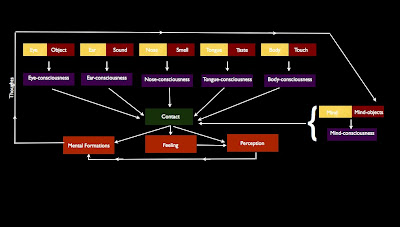
Lets see how it works. Mind gets the basic information about the external world from our five senses. This is shown in the mind works model. All the information that arrives is finally channeled to the mind as thoughts (Figure 2). They are stored as memory. They become mind objects and and can be retrieved and fed to the mind again and again. This become a continuous loop of feeding of thoughts to the mind (figure 4). This is what was meant by regurgitation and chewing of them again. This is also referred to as mental proliferation. We will explore this further in the next step.

Figure 2: This figure shows how the information from the senses flow to the mind. Mind eventually receives all the information from the senses. It can then retrieve them making a continuous loop.

In the Figure 3 it is shown how the mind feeds on thoughts. The eye is taken as the sense organ and an object taken as the sense stimulus in the example. We hang on to these thoughts triggered by the object with craving and this is what we call clinging to sensuality. The information that flows to the mind as thoughts are called the taints. As long as there is craving and clinging, mind is not free from taints. This is the pattern seen in an ordinary person (untrained mind). The Arahants have no craving or clinging. They therefore are free from all taints. There are no spontaneous flow of thoughts triggered by craving and clinging after the object is seen. These thoughts stop after its purpose is done. There are no spontaneous flow of thoughts. This is what is meant when said "in reference to the seen, there will be only the seen" in Bahiya sutta. These thoughts therefore do not generate any kamma (positive or negative) as they are free from taints (please see the post on taints for further discussions).

Figure 3: This figure shows the flow of thoughts in a ordinary person looking at an object.

In Figure 4 it shows that the visual object is no longer present. However the memory of the object already stored can be retrieved as mental objects and fed back into to the mind. This is how we feed the mind about the past objects we have seen. This is a type of mental nutriment (mano-sancetanaa). This process is called mental proliferation and in this case it is about the past. This is what was meant when it was said that the "mind chews on the regurgitated thoughts." Just like "a cow chews on old grass it has eaten before."

Figure 4: This figure shows how memory about the object is retrieved by the mind (craving is not shown in this figure).

We now know that the mind has to be fed. It is always hungry by nature. At least it is better to feed the mind with healthy food and not with junk food. Not only we feed on our old food we also have this habit of feeding on food scarps that other people throw at us. Sometimes we can get mentally sick or depressed feeding on them. There is an interesting story in Akkosa sutta how Buddha refused to feed on another persons words of abuse. So if you decide to feed on mental food at least feed on healthy food. Healthy food can generate good kamma. These are thoughts of your generosity, virtue and practice of meditation. Buddha compared higher mental absorptions (The four Rupa Jhanas) experienced through meditations like the internal food and medicine to the mind. However the ultimate goal is to stop feeding on all thoughts. This is the mind of an Arahant. This is when the feeding frenzy finally stops.


If you want to explore more on this subject please listen to these talks on "mental food" by Thanissaro Bhikkhu: