Saturday, December 29, 2007

Row your boat "mindfully" down the stream


Imagine you are trying to get to the ocean using a boat along a stream or river. This is a very rough river with rapids, currents and large rocks and this is the only chance for your "survival". You also need to load the boat with just the right amount of food and water for your use during this journey. If you try to load too much food and water, the weight of the boat will be heavy and it may be too difficult for you to maneuver the raft in the water. If by chance you become too greedy and load the boat with too much food and water, you might even sink. After launching the boat: in the initial part of the journey you will have to overcome at least five large waves. After you negotiate this part of the journey you then have to gently row your boat across the rapids. Sometimes when the waves are too high you just can't do anything other than ride the waves. If you try too hard the boat will capsize. If you are too slow you may not be able to go across strong currents. You just have to find the right amount of effort with much practice. From time to time if you are not mindful your boat will drift to the banks and may get entangled in weeds and branches on either side of the river. Sometimes it is necessary to push the boat back into the main stream, away from these obstacles. The only good thing in this journey to the sea is once you launch the boat and get through the initial rough waters of the river, the chances are that you are eventually going to end up in the sea. If by chance your boat gets tangled in the river banks, then you are assured to get to the sea in the next seven tries.

In this simile the stream or the river is the Samsara and the ocean is the ultimate freedom from suffering, Nirvana. The meaning of survival is the "deathless state" of Nirvana. The river with rapids, currents, and large rocks are the greed, hatred and delusion. The boat is the The Noble Eightfold Path . The food and water is the knowledge of Dhamma. Too much of it and mainly it's wrong grasping may be harmful or some times may become a hindrance to your journey. This may lead to what is called "Dhamma Vittaka," the constant pondering, of Dhamma.The maneuvering of the boat through the rough waters is gaining wisdom thorough this path. It is important here to emphasize the careful balance between knowledge of Dhamma and its practical application to gain wisdom, through the practice of meditation. It is said that trying to gain too much knowledge of Dhamma without much practice may be a hindrance to the progress of this path. However it is ironic that slow and steady practice of this path of Dhamma with mindfulness, may lead to your destination faster than rushing through this path and trying to find short cuts. The initial five waves in this simile are the five hindrances.* The obstacles such as weeds and trees along the bank are unforeseen desires or taints in our mind. In this simile the one who has actually entered the main part of the stream or the river after overcoming the initial obstacles is called the "stream winner" or the one who has entered the first stage of enlightenment.

*The Five Hindrances:
1. sensual desire (kamacchanda),
2. Ill-will (byapada),
3. Sloth and torpor (thina-middha),
4. Restlessness and remorse (uddhacca-kukkucca),
5. Sceptical doubt (vicikiccha).
Related Posts:


Friday, December 28, 2007

What is everything?


If we can investigate our 6 senses DEEPLY* using our mind as the lab, this is "everything" in a nutshell.

*impermanence,suffering and non-self

Sabba Sutta -The All

Tuesday, December 25, 2007

Christmas... it is time for unconditional giving


Christmas is finally here. This is the time for giving. Two days ago we participated in a soup kitchen organised by Ven. Saranapala, from the Buddhist Monastery at the Mississauga, Canada. This was held at Good Shepperd Centre,Toronto. It was so wonderful to see young people with so much kindness and compassion in hearts serving food to the homeless people in Toronto. There was so much positive energy in that place and it is so hard to put all that in to words. While this was happening one of parents in the room asked me "Do you think all these people here deserve this?" I said to myself that this would be a very good question to be explored later.

What is the Buddhist view on giving and who deserves to receive?

Buddhists believe in unconditional giving. This means giving without any judgement on the person who is receiving it. It does not matter what the person's race, religion or social background is and you should give without expecting anything in return. Some people may not agree with this kind of giving. They will only want to give to some one who they think truly deserves receiving. It may not be always easy to find this ideal person. For example what about a young homeless kid that stands everyday at a local traffic light, with a sign board saying "good kamma for a dime." What about the kid that walks into the coffee shop with a story staying that he lives in Nova Scotia and that his mother just died and he has no money to take the bus home.

Some people may say, "why cant he find a job like anybody else ?" Others may say "by giving to these people you are encouraging them to beg and not get a real job. What would you do in this situation? What is the Buddhist approach to this?

Before we explore this we must understand the definition of kamma. Buddha said "Intention(cetana), I tell you, is kamma. Intending, one does kamma by way of body, speech, & intellect," Nibbedhika Sutta. Therefore, if your intention is pure It does not matter about the receiver, you will reap the fruit of your good kamma. According to the Buddha, giving can become wholesome deed (purification of giving) under three conditions (Dakkhinavibhanga Sutta ). This is if the giver, the receiver or both the giver and the receiver have good moral intentions (purified). If neither the giver or the receiver has good moral intentions this will not result in a wholesome giving.

This makes it very clear that even the receiver is not a moral person and if the giver has good moral intentions you will be making a wholesome kamma. Therefore it does not matter of the morality or intentions of the receiver if you give without any judgement it will result in good kamma. So, I think Christmas is the perfect time for giving and it is a great time to practice unconditional giving.

Dakkhinavibhanga Sutta - The Exposition of Offerings-Majjhima Nikaya 142 explained by Ajahn Brahm (MP3)

The Path to Happiness - "Letting Go or Getting More!

Saturday, December 22, 2007

How to expect "fruits" from a tree?


Morality is like the foundation in the path of practicing Dhamma. You will gain other qualities* such as faith, effort, mindfulness, concentration, and wisdom as you progress in this path using morality as its base. However, if one does not develop a good moral conduct (by mind, body and speech) but expect to progress in this path to become enlightened, it is something like expecting fruits from a tree after planting a seed in an infertile soil.

Friday, December 21, 2007

Happy Xmas (War Is Over) - John Lennon

All tremble at violence; all fear death. Putting oneself in the place of another, one should not kill nor cause another to kill.

-Dhammapada


The "whole world" is your six senses


The world outside is so complex and overwhelming. Trying to control the outside world is an impossible task. Luckily there is another option. You can "fit" the whole world into your six senses. Here you have more control of the outside world. The practice of mindfulness meditation trains you to contemplate on the true nature* of these six senses and to "let go" with ease.

*impermanence,suffering and non-self

Thursday, December 20, 2007

A "tangled ball of wool”


Imagine the whole of Dhamma as a "tangled ball of wool.” If you want to untangle it, contemplation on the five aggregates would be a good starting point. This is basically dukka (suffering) and a wonderful way to deeply understand the meaning of non-self.

Wednesday, December 19, 2007

Like a spider on its self-spun web...


Those who are lust-infatuated fall back into the swirling current (of samsara) like a spider on its self-spun web. This, too, the wise cut off. Without any longing, they abandon all suffering and renounce the world.
-Dhammapada
Related posts:

Tuesday, December 18, 2007

Think of your mind as a "garden"


Think of your mind as a garden. People may throw "seeds" in it from time to time. Don’t water them if you know they are weeds. Weeds are very difficult to get rid of once they start to grow. If you know they are flowers you should water them often.
Related posts:

Monday, December 17, 2007

"Storms in the mind"


Yesterday there was a bad snow storm in Toronto. People were complaining as usual. I then thought to myself.... we have no control of storms outside, but we have some control of the "storms in our mind," the greed, hatred, delusion, and fear.


Why is this dog asking for more ? (Post on sensory restrains)

Agati Sutta -Off Course

Friday, December 14, 2007

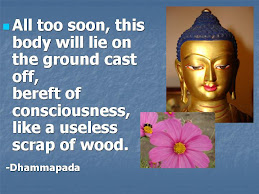
"Like a useless scrap of wood"


All too soon, this body
will lie on the ground
cast off,
bereft of consciousness,
like a useless scrap
of wood.
-Dhammapada

Thursday, December 13, 2007

"How to grasp a snake" ? The Buddha's words on the goal of learning Dhamma

"Monks, there is the case where some worthless men study the Dhamma..... They study the Dhamma both for attacking others and for defending themselves in debate.....Their wrong grasp of those Dhammas will lead to their long-term harm & suffering. Why is that? Because of the wrong grasp of the Dhammas.


"Suppose there were a man needing a water-snake.....grasp it by the coils or by the tail. The water-snake, turning around, would bite him ..... that cause he would suffer death or death-like suffering. Why is that? Because of the wrong grasp of the water-snake.

The Same way ....They study the Dhamma both for attacking others and for defending themselves in debate. They don't reach the goal for which [people] study the Dhamma. Their wrong grasp of those Dhammas will lead to their long-term harm & suffering. Why is that? Because of the wrong grasp of the Dhammas."- Buddha
To Read the full sutta click
Please Note:
The simile of the water-snake, which in turn is an introduction to the simile of the raft (see the previous post below). It is important to underline the connection between these two similes, for it is often missed. Many a casual reader has concluded from the simile of the raft simply that the Dhamma is to be let go.....However, the simile of the water-snake makes the point that the Dhamma has to be grasped; the trick lies in grasping it properly. When this point is then applied to the raft simile, the implication is clear: One has to hold onto the raft properly in order to cross the river. Only when one has reached the safety of the further shore can one let go.
-Thanissaro Bhikkhu
Related posts:

Wednesday, December 12, 2007

Dhamma compared to a raft, for the purpose of crossing over...


"I have taught the Dhamma compared to a raft, for the purpose of crossing over, not for the purpose of holding onto. Understanding the Dhamma as taught compared to a raft, you should let go even of Dhammas..."
-Buddha
Alagaddupama Sutta

Please Note:
"One has to hold onto the raft properly in order to cross the river. Only when one has reached the safety of the further shore can one let go."
-Thanissaro Bhikkhu

The wise would make an island...


Through initiative, heedfulness,
restraint, & self-control,
the wise would make
an island
no flood
can submerge.
-Dhammapada

Tuesday, December 11, 2007

As a Butterfly....


As a butterfly... without harming
the blossom,
its color,
its fragrance ...
takes its nectar & flies away:
so should the sage
go through a village.


-Dhammapada

Note:In In the original version it is a bee, not a butterfly

Monday, December 10, 2007

Why do bad things happen to good people? A Buddhist perspective

Why do bad things happen to good people? This was one of questions asked by someone in my last post. Since the post about the death of my friend with lung cancer, I had more bad news. A colleague of mine has been recently diagnosed with a type of bone cancer. This doctor too is a very kind and a compassionate person, well liked by all his peers and patients. I am yet to hear a complain about this doctor, who may have saved many thousands of lives. Since this bothered me so much, I decided to explore this question further, "why do bad things happen to good people?"

We all know that wholesome kamma should produce good results. So ideally a "good person" should not get "bad results". However we all know that this does not always happen. Sometimes bad things happen to good people. How do you explain this? The timing of Kamma is a very complex subject. There are basically three types of kamma with regard to the time of their results: (1) kamma resulting in this life-time (ditthadhamma-vedaniya-kamma), (2)kamma resulting in the next life (upapajja-vedaniya-kamma), (3) kamma resulting in later lives (aparapariya-vedaniya-kamma). In Buddhist literature there are some instances where even fully enlightened monks had to repay their previous kamma from past lives. ( Ven. Mugalan and Losaka)

Buddhists believe that some of the inequality of humans can be explained by kamma although it is not the sole determining factor. Buddha's teachings explain that there are five orders or processes – Niyama Dhamma 1.Utu Niyama(Physical-Seasonal changes and climate) 2.Bija Niyama(Biological/Genetic inheritance)3.Kamma Niyama (Ethical /Consequences of one's actions)4.Citta Niyama (Psychological/Will of mind) 4.Dhamma Niyama (Laws of nature).
What really happens to us at the end may be a result of a complex interactions of physical, biological, psychological, ethical, or laws of nature. The karmic potential may be the main player and it ripens as a result of the other four conditions coming together. Therefore kamma is only one of the five factors that come into play when something happens to us, either good or bad.
Our journey through Samsara is like a movie with a long reel of film. In this life what we really see is only "one frame" of the film. It is just a very small fraction of the entire movie. Therefore it is difficult for us to pass judgements or make assumptions like what happened to this person is "good" or "bad," without playing the whole movie. It impossible to replay the entire movie from the beginning. In fact Buddha even said that"I cannot see a beginning." What is more important is for us to realize that there is an end. This is the end to all suffering called Nirvana.
Related Suttas and discussions:
Kamma -Kamma A Study Guide prepared by Thanissaro Bhikkhu
Related posts:


Sunday, December 9, 2007

The good shine from afar...


The good shine from afar
like the snowy Himalayas.
The bad don't appear
even when near,
like arrows shot into the night.
-Dhammapada
Related Posts:
What is the matter with my grass? (post on loving kindness)

As the rising of the sun...


Delusion causes harm.
Delusion provokes the mind.
People don't realize it
as a danger born from within.
A person, when deluded,
doesn't know his own welfare;
when deluded,
doesn't see Dhamma.
Overcome with delusion
he's in the dark, blind.
But when one, abandoning delusion,
feels no delusion
for what would merit delusion,
he disperses all delusion...
as the rising of the sun, the dark.


Iti 3.39; Iti 83

Thursday, December 6, 2007

Leaves from a tree


He has become calm and at rest,
Wise in speech and not self-centered;
He's shaken off unwholesome states
...Like wind would leaves from a tree.
Thag 17.2
Related posts: