Sunday, May 16, 2010

One whose passion, aversion, & ignorance are washed away...


One whose passion, aversion, & ignorance
are washed away,
has crossed over this ocean
with its sharks,
demons,
dangerous waves,
so hard to cross.


§ 69. {Iti 3.20; Iti 57}

Itivuttaka: The Group of Threes
translated from the Pali by
Thanissaro Bhikkhu

Saturday, May 15, 2010

It's not easy to teach the Dhamma to others...


"It's not easy to teach the Dhamma to others, Ananda. The Dhamma should be taught to others only when five qualities are established within the person teaching.

Which five?

"


[1] The Dhamma should be taught with the thought, 'I will speak step-by-step.'

"

[2] The Dhamma should be taught with the thought, 'I will speak explaining the sequence [of cause & effect].'

"

[3] The Dhamma should be taught with the thought, 'I will speak out of compassion.'

"

[4] The Dhamma should be taught with the thought, 'I will speak not for the purpose of material reward.'

"

[5] The Dhamma should be taught with the thought, 'I will speak without hurting myself or others.'


AN 5.159 PTS: A iii 184
 Udayi Sutta: About Udayin

Translated from the Pali by
Thanissaro Bhikkhu

Sunday, May 9, 2010

Swimming against the stream


The path to enlightenment is not so easy. It is a path that goes against the stream. Buddha called this "Patisothagami " or going against the stream. It is just like when almost all the fish in the water are swimming with the flow while only one fish is trying hard to swim against the flow. It's not swimming against the resistance of the flow of water but also the resistance of the other fish that may impede its path.

Saturday, May 8, 2010

In meditation never criticize yourself...


I think in meditation sometimes we get caught to a trap. When the mind runs out of the primary object, just acknowledge it and let go. Never criticize yourself this as a weakness. Just be aware of it. That's all! It is said this will strengthen your mindfulness.


I learnt about this from the visiting Buddhist monk, Venerable Uda-Iriyagama Dhammajeeva Thera of Nissarana Vanaya (Forest) Meditation Centre, Sri Lanka, who is currently conducting a meditataion retreat at The Toronto Maha Vihara.

To listen to his talks please visit
http://nissaranavanaya.blogspot.com/
http://sinhaladhamma.blogspot.com/

Thursday, May 6, 2010

The fetter of craving


"Monks, I don't envision even one other fetter* — fettered by which beings conjoined go wandering & transmigrating on for a long, long time — like the fetter of craving. Fettered with the fetter of craving, beings conjoined go wandering & transmigrating on for a long, long time."

*Fetters
The five lower fetters:
1. Self-identity views
2. Doubt (uncertainty)
3. Grasping at precepts & practices
4. Craving (Sensual desire)
5. Ill will.

The five higher fetters:
1. Passion for form
2. Passion for what is formless
3. Conceit
4. Restlessness
5. Ignorance

Iti 1.15; Iti 8

Itivuttaka: The Group of Ones

translated from the Pali by Thanissaro Bhikkhu

http://www.accesstoinsight.org/tipitaka/kn/iti/iti.1.001-027.than.html

Wednesday, May 5, 2010

The three layers of "weeds" in the mind...


I recently removed weeds off my flower bed and added mulch to prevent further weeds form growing. The mulch helped to prevent new weeds seeding in the flower bed. However to my surprise, after about a week I found new weeds coming through the thick layer of mulch (see the photo above).

This reminded of me of the three layers of defilements* in our minds. The most superficial layer of defilements arise from our bodily actions and our verbal actions. The defilements from our bodily actions are the killing living beings, stealing, and sexual misconduct. The defilements that arise from our verbal actions include false speech, slanderous speech, harsh speech and idle chatter. Restraining from this is basically cultivating the morality (Sila precept). These I compared to the existing weeds in the flower bed that were removed at the onset of cleaning.

Applying mulch to the bed was to prevent from new weeds growing in the flower bed from disposition of weeds carried by the wind. In this simile I compared these to our obsessional defilements of the mind called the hindrances. They are sensual desire, Ill-will, sloth and torpor, restlessness and remorse and doubt. Practicing samatha meditation (Samadhi precept), for example breath meditation, will suppress these defilements.

However the deep layer of defilements in the mind are just like the deep rooted weeds in this simile. They will surface from time to time given the right conditions, unless they are completely removed without a trace. In the garden I learnt that I had to remove all the weeds down to the tiniest roots before applying the mulch to keep the flower beds weed free. In the mind the deep "weeds" of defilements are mainly removed by wisdom gained through insight practice or Vipassana meditation (Panna precept). Some of the deep rooted defilements of the mind are listed below.

(1) Covetousness and unrighteous greed (2) ill will (3) anger (4) hostility (5) denigration(6) domineering (7) envy (8) miserly(9) hypocrisy(10) fraud (11) obstinacy (12) presumption (13) conceit (14) arrogance (15) vanity (16) negligence

I learnt about the three layers of defilements* from the visiting Buddhist monk, Venerable Uda-Iriyagama Dhammajeeva Thera of Nissarana Vanaya (Forest) Meditation Centre, Sri Lanka, who is currently conducting a meditataion retreat at The Toronto Maha Vihara.

Sunday, May 2, 2010

The monk who has demolished conceit...


The monk who has demolished conceit* without leaving a trace,
as a great flood,
a very weak bridge made of reeds,
sloughs off the near shore & far** — as a snake,
its decrepit old skin.


* Conceit (one of the higher fetters) is thought to be totally abolished at the level of attaining Arahantship (please click on the following link to see the four stages of enlightenment).

The four stages of enlightenment

.

** Near and far shores are thought to be here the five lower and higher fetters**

***
Fetters- See labels below

Uraga Sutta: The Snake
translated from the Pali by
Thanissaro Bhikkhu

Uraga Sutta: The Snake (Sn 1.1) [Nyanaponika | Thanissaro]
http://www.accesstoinsight.org/tipitaka/kn/snp/snp.1.01.than.html

Friday, April 30, 2010

The monk who has cut off craving ...


The monk who has cut off craving without leaving a trace, as if he had dried up a swift-flowing stream, sloughs off the near shore & far* — as a snake, its decrepit old skin.

*
Near and far shores are thought to be here the five lower and higher fetters**

**
Fetters- See labels below

Uraga Sutta: The Snake
translated from the Pali by
Thanissaro Bhikkhu

http://www.accesstoinsight.org/tipitaka/kn/snp/snp.1.01.than.html

Wednesday, April 28, 2010

"Common sense" or "non-sense"


If you try to untangle your headphones by pulling them a part in a rush, it may even make it worse. But if you start from one end and gradually untangle it you will eventually be successful. At the end you will get to the two ear pieces to connect with your music.

In the same way if try to realize Dhamma by grasping it the wrong way you may get confused or even harm yourself. But if you gradually follow this path with mindful reflection of the teachings, you will eventually end up with your six senses as the starting point. The six senses connect us to our world, just like the ear pieces connected us to our music as in the example above.

These six senses bind to the samsara. However, these very senses, when contemplated wisely can also help to get out of this same samsara.

This may be "common-sense" but hard to see because of our ignorance. One might even call it "non-sense" for the same reason.

Saturday, April 17, 2010

The sullied nature of his mind...


"Suppose there were a pool of water — sullied, turbid, and muddy. A man with good eyesight standing there on the bank would not see shells, gravel, and pebbles, or shoals of fish swimming about and resting. Why is that? Because of the sullied nature of the water. In the same way, that a monk with a sullied mind would know his own benefit, the benefit of others, the benefit of both; that he would realize a superior human state, a truly noble distinction of knowledge & vision: Such a thing is impossible. Why is that? Because of the sullied nature of his mind."

"Suppose there were a pool of water — clear, limpid, and unsullied. A man with good eyesight standing there on the bank would see shells, gravel, & pebbles, and also shoals of fish swimming about and resting. Why is that? Because of the unsullied nature of the water. In the same way, that a monk with an unsullied mind would know his own benefit, the benefit of others, the benefit of both; that he would realize a superior human state, a truly noble distinction of knowledge & vision: Such a thing is possible. Why is that? Because of the unsullied nature of his mind."

Thursday, March 25, 2010

Cling no more to this "world"...


If you see an object just as an object, if you hear a sound just as a sound...(apply the same to the other senses) without "feeding" them to the mind too much...with practice the "grasp"* gets weaker and eventually you cling no more to this "world."** Then you are free. This is the end of suffering.


* grasping here is the craving (see lables)
**world here is the six senses (see labels)

Thursday, March 18, 2010

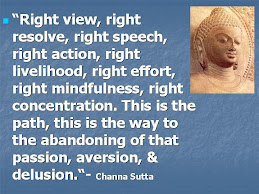
How does "The Noble Eightfold Path" becomes an integral part of the meditator...


Reality as it is becomes the right view of the meditator. Thinking of it as it is becomes the right thought. Awareness of it as it is becomes the right awareness. Concentration on it as it is becomes the right concentration. Actions of the body and speech* are then aligned to reality as it is. In this way the meditator develops and is fulfilled.

- Majjhima Nikaya

It is amazing to see how "The Noble Eightfold Path" becomes an integral part of the meditator...

1. Right View
2. Right Intention (Translated as "Right Thought" above)
3. Right Speech
4. Right Action
5. Right Livelihood
6. Right Effort
7. Right Mindfulness (Translated as "Right Awareness" above)
8. Right Concentration

*Actions of the body and speech are # 3, 4, 5, and 6

Saturday, March 6, 2010

He disperses all delusion -- as the rising of the sun, the dark


Greed causes harm.
Greed provokes the mind.
People don't realize itas a danger born from within.
A person, when greedy,doesn't know his own welfare;
when greedy,
doesn't see Dhamma.
Overcome with greed,
he's in the dark, blind.
But when one, abandoning greed,
feels no greed
for what would merit greed,
greed gets shed from him -- like a drop of water off a lotus leaf.

Aversion causes harm.
Aversion provokes the mind.
People don't realize itas a danger born from within.
A person, when aversive,
doesn't know his own welfare;
when aversive,
doesn't see Dhamma.
Overcome with aversionhe's in the dark, blind.
But when one, abandoning aversion,
feels no aversion
for what would merit aversion,
aversion drops away from him -- like a palm leaf from its stem.

Delusion causes harm.
Delusion provokes the mind.
People don't realize itas a danger born from within.
A person, when deluded,doesn't know his own welfare;
when deluded,
doesn't see Dhamma.
Overcome with delusionhe's in the dark, blind.
But when one, abandoning delusion,
feels no delusion
for what would merit delusion,
he disperses all delusion -- as the rising of the sun, the dark.

Monday, March 1, 2010

The body you cannot recycle but the mind...


Our only refuge is the Buddha Dhamma.. Sooner or later we are all going to perish. That is the reality. Body you cannot recycle... But the mind "in good condition" (well trained) can be of good use.

Saturday, February 27, 2010

Lay down this "burden"...


Even for a moment if we can lay down this "burden," the five aggregates, we can be free from dukka. However as these moments pass we are back in the samsara as our six senses continue to generate this burden with the help of our craving as it's main fuel. With insight gained through practice if we can somehow cut off this fuel completely, we then can lay this burden down forever and can be free dukka and from this samsara.

Friday, February 19, 2010

"Buddhism teaches that a craving for things outside ourselves causes an unhappy pointless search for security"- Tiger Woods


"Buddhism teaches that a craving for things outside ourselves causes an unhappy pointless search for security," Woods said, adding that he had drifted from the teachings in recent years. "It teaches me to stop following every impulse and to learn restraint. Obviously, I lost track of what I was taught."
-Tiger Woods, 19th February, 2010

http://newsblogs.chicagotribune.com/religion_theseeker/2010/02/tiger-woods-talks-of-return-to-golf-buddhism-.html
newsblogs.chicagotribune.com

Thursday, February 18, 2010

How does a monk know moderation in eating?


"There is the case where a monk, considering it appropriately, takes his food not playfully, nor for intoxication, nor for putting on bulk, nor for beautification, but simply for the survival & continuance of this body, for ending its afflictions, for the support of the holy life, thinking, 'I will destroy old feelings [of hunger] & not create new feelings [from overeating]. Thus I will maintain myself, be blameless, & live in comfort.' This is how a monk knows moderation in eating."

How does a monk guard the doors to his sense faculties?

"There is the case where a monk, on seeing a form with the eye, does not grasp at any theme or variations by which — if he were to dwell without restraint over the faculty of the eye — evil, unskillful qualities such as greed or distress might assail him. He practices with restraint. He guards the faculty of the eye. He achieves restraint with regard to the faculty of the eye.

"On hearing a sound with the ear...

"On smelling an aroma with the nose...

"On tasting a flavor with the tongue...

"On feeling a tactile sensation with the body...

"On cognizing an idea with the intellect, he does not grasp at any theme or variations by which — if he were to dwell without restraint over the faculty of the intellect — evil, unskillful qualities such as greed or distress might assail him. He practices with restraint. He guards the faculty of the intellect. He achieves restraint with regard to the faculty of the intellect. This is how a monk guards the doors to his sense faculties.

Aparihani Sutta: No Falling Away
translated from the Pali by
Thanissaro Bhikkhu

http://www.accesstoinsight.org/tipitaka/an/an04/an04.037.than.html

Sunday, February 7, 2010

All about the mind...


Like a fish pulled from its home in the water & thrown on land: this mind flips & flaps about to escape Mara's sway.


Hard to hold down, nimble, alighting wherever it likes: the mind. Its taming is good. The mind well-tamed brings ease.


So hard to see, so very, very subtle, alighting wherever it likes: the mind. The wise should guard it. The mind protected brings ease.


Wandering far, going alone, bodiless, lying in a cave: the mind. Those who restrain it: from Mara's bonds they'll be freed.
-Dhammapada