Saturday, April 7, 2012
Buddhism and Science:Introductory Video, Oxford University
The complete set of recordings is on www.voicesfromoxford.org Click on Events, then on Buddhism and Science.


Friday, March 23, 2012
Its a feeding frenzy! Not only the mind feeds on thoughts, it also regurgitates and chews on them.
The mind always likes to feed on thoughts. Sometimes this happens even when sleeping. Not only the mind feeds on thoughts it also regurgitates and chews on them. Just like a cow that chews on old grass that has been eaten before (Figure 1).

Figure 1
Lets see how it works. Mind gets the basic information about the external world from our five senses. This is shown in the mind works model. All the information that arrives is finally channeled to the mind as thoughts (Figure 2). They are stored as memory. They become mind objects and and can be retrieved and fed to the mind again and again. This become a continuous loop of feeding of thoughts to the mind (figure 4). This is what was meant by regurgitation and chewing of them again. This is also referred to as mental proliferation. We will explore this further in the next step.
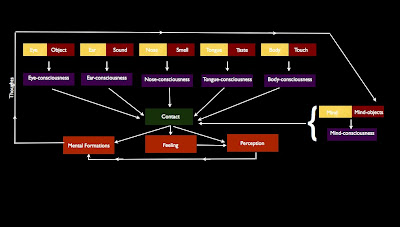
Figure 2: This figure shows how the information from the senses flow to the mind. Mind eventually receives all the information from the senses. It can then retrieve them making a continuous loop.
In the Figure 3 it is shown how the mind feeds on thoughts. The eye is taken as the sense organ and an object taken as the sense stimulus in the example. We hang on to these thoughts triggered by the object with craving and this is what we call clinging to sensuality. The information that flows to the mind as thoughts are called the taints. As long as there is craving and clinging, mind is not free from taints. This is the pattern seen in an ordinary person (untrained mind). The Arahants have no craving or clinging. They therefore are free from all taints. There are no spontaneous flow of thoughts triggered by craving and clinging after the object is seen. These thoughts stop after its purpose is done. There are no spontaneous flow of thoughts. This is what is meant when said "in reference to the seen, there will be only the seen" in Bahiya sutta. These thoughts therefore do not generate any kamma (positive or negative) as they are free from taints (please see the post on taints for further discussions).

Figure 3: This figure shows the flow of thoughts in a ordinary person looking at an object.
In Figure 4 it shows that the visual object is no longer present. However the memory of the object already stored can be retrieved as mental objects and fed back into to the mind. This is how we feed the mind about the past objects we have seen. This is a type of mental nutriment (mano-sancetanaa). This process is called mental proliferation and in this case it is about the past. This is what was meant when it was said that the "mind chews on the regurgitated thoughts." Just like "a cow chews on old grass it has eaten before."

Figure 4: This figure shows how memory about the object is retrieved by the mind (craving is not shown in this figure).
We now know that the mind has to be fed. It is always hungry by nature. At least it is better to feed the mind with healthy food and not with junk food. Not only we feed on our old food we also have this habit of feeding on food scarps that other people throw at us. Sometimes we can get mentally sick or depressed feeding on them. There is an interesting story in Akkosa sutta how Buddha refused to feed on another persons words of abuse. So if you decide to feed on mental food at least feed on healthy food. Healthy food can generate good kamma. These are thoughts of your generosity, virtue and practice of meditation. Buddha compared higher mental absorptions (The four Rupa Jhanas) experienced through meditations like the internal food and medicine to the mind. However the ultimate goal is to stop feeding on all thoughts. This is the mind of an Arahant. This is when the feeding frenzy finally stops.
If you want to explore more on this subject please listen to these talks on "mental food" by Thanissaro Bhikkhu:
Tuesday, January 17, 2012
Stress: Its all about clinging to the activity of the five aggregates

Figure 1: This figures shows that clinging to five aggregates is the basis of stress or suffering
Buddha did not say life is stress and suffering. Buddha only said there is stress and suffering in life (the First Noble Truth). What some people fail to see is that not only he said there is stress and suffering in life, he also gave the cause for it (the Second Noble Truth), how to get rid of it (the Third Noble Truth) and a clear path to get rid of this stress and suffering (the Fourth Noble Truth).
"Now what is the noble truth of stress?
Birth is stressful, aging is stressful, death is stressful; sorrow, lamentation, pain, distress, & despair are stressful; association with the unbeloved is stressful; separation from the loved is stressful; not getting what one wants is stressful.
In short, the five clinging-aggregates are stressful..."
" Maha-satipatthana Sutta: The Great Frames of Reference" (DN 22), translated from the Pali by Thanissaro Bhikkhu. Access to Insight, 15 October 2011,http://www.accesstoinsight.org/tipitaka/dn/dn.22.0.than.html . Retrieved on 17 January 2012.
What does it really mean when you say "In short, the five clinging-aggregates are stressful."?
Let us take the first cause stress or suffering which is birth. As we all know when the fetus comes through the birth canal there is a lot of moulding of the head and the body. There must be a lot of pain perceived by the child being born. This is implied by the loud cry of every child as the fist response after birth. This is the expression of stress.
The perception of the pain during birth is the activity of the mind. It is basically the activity of the five aggregates. It is the body and touch sensation, body consciousness, contact, feeling, perception... as we have discussed in previous posts. Please see mind works model to appreciate the flow of Nama Dhamma (conciousness, contact, feeling, perception, and thoughts) for further reference. This is why birth stress is in short defined as clinging to the activity of the five aggregates.
Same principal applies to all the stresses shown in the diagram above (Figure 1) whether it is physical or mental stress. These include the stress of aging, death, sorrow, lamentation, pain (physical), distress (mental pain), despair, association with un-beloved, separation form the loved and not getting what one wants. They all are ultimately perceived by the mind and become activities of the five aggregates of clinging. Mind does not have hands to cling. We cling with our thoughts. Craving facilitates this clinging. Witout Craving there is no clinging. So we now come to the second Noble Truth, the Noble Truth of the origination of stress. This is nothing other than our Craving.
Therefore the first noble truth, the noble truth of suffering and stress is all about clinging to the five aggregates.
Sunday, January 15, 2012
The story of the two arrows: Physical pain is inevitable but the mental pain is optional

Buddha explained this very nicely in the Sallatha Sutta. He compares the physical pain to the first arrow and the mental pain to a second arrow. The physical pain we all have to endure. However the mental pain we create due to our own ignorance and it is optional.
"When touched with a feeling of pain, the uninstructed run-of-the-mill person sorrows, grieves, & laments, beats his breast, becomes distraught. So he feels two pains, physical & mental. Just as if they were to shoot a man with an arrow and, right afterward, were to shoot him with another one, so that he would feel the pains of two arrows; in the same way, when touched with a feeling of pain, the uninstructed run-of-the-mill person sorrows, grieves, & laments, beats his breast, becomes distraught. So he feels two pains, physical & mental..."
"Now, the well-instructed disciple of the noble ones, when touched with a feeling of pain, does not sorrow, grieve, or lament, does not beat his breast or become distraught. So he feels one pain: physical, but not mental. Just as if they were to shoot a man with an arrow and, right afterward, did not shoot him with another one, so that he would feel the pain of only one arrow. In the same way, when touched with a feeling of pain, the well-instructed disciple of the noble ones does not sorrow, grieve, or lament, does not beat his breast or become distraught. He feels one pain: physical, but not mental..."
"Sallatha Sutta: The Arrow" (SN 36.6), translated from the Pali by Thanissaro Bhikkhu. Access to Insight, 30 June 2010,http://www.accesstoinsight.org/tipitaka/sn/sn36/sn36.006.than.html . Retrieved on 15 January 2012.
The physical pain is received by the mind in a series of sensory inputs from the neuronal pathways to the brain. The brain receives this as a pain sensation. The mind recognizes this thorough a series of mental changes consciousness, contact, feeling, perception and thoughts. Please see the mind works model for arising and passing these Nama Dhamma. It is also discussed in the post on The five aggregates: a self generating entity. We dislike the unpleasent feeling of this pain and we create a series of thoughts of aversion and clinging to them and creating our own mental suffering. Seeing this as it happens and letting go of it is the work of insight.
Also listen to:The Arrows of Emotion by Thanissaro Bhikkhu
Related science news:Why chronic pain is all in your head
Published: Sunday, July 1, 2012 - 20:01 in Health & Medicine
http://esciencenews.com/articles/2012/07/01/why.chronic.pain.all.your.head
Sunday, January 8, 2012
The five aggregates: A "SELF" generating entity

Figure 1: The five aggregates

Figure 2:The five aggregates are arranged according to the sequence they are generated as shown in the mind works model (figure 3). The usual order in which the five aggregates are described in the literature is form, feeling, perception, mental formation (fabrication) and consciousness (figure 1).
"And why do you call them 'fabrications'? Because they fabricate fabricated things, thus they are called 'fabrications.' What do they fabricate as a fabricated thing? For the sake of form-ness, they fabricate form* as a fabricated thing. For the sake of feeling-ness, they fabricate feeling* as a fabricated thing. For the sake of perception-hood, they fabricate perception* as a fabricated thing. For the sake of fabrication-hood, they fabricate fabrication* as a fabricated thing. For the sake of consciousness-hood, they fabricate consciousness* as a fabricated thing. Because they fabricate fabricated things, they are called fabrications."
- "Khajjaniya Sutta: Chewed Up" (SN 22.79), translated from the Pali by Thanissaro Bhikkhu. Access to Insight, 29 June 2010,http://www.accesstoinsight.org/tipitaka/sn/sn22/sn22.079.than.html . Retrieved on 2 January 2012.
* The five aggregates
Here "sankara" (of the five aggregates) are translated as fabrications. In the Figure 1 & 2 above it is translated as mental formations. These are mainly "cetana" or intentions that consist of thoughts. The thoughts are responsible for regeneration maintenance of our current form (body). These thoughts direct us to maintain the form by feeding it with nutrients. Therefore mental formations or sankara have the ability to fabricate the form. The mental formations also can fabricate or regenerate more consciousness (mind-consciousness), feeling, perceptions and more mental formations (see Figure 3).

Figure 3: The basic mind works model
Not only in the present life, mental formations or thoughts are responsible for generation of future form in the rebirth process.
The six senses in the form generate consciousness dependent on the sense base (eye, ear...) and give rise to contact (Figure 3). The sequence of events that happen from here on are discussed in detail in the mind works model. This will give rise to further perception, feeling and in tun more thoughts (mental formations) in our present life as discussed before.
These thoughts (intentions) become our kamma for the next birth. The last thought will determine the rebirth-consciousness that will link with the next name-and-form and this is explained in the post on last thought and rebirth.
The main message in this post is mental formation is the key player in reconstructing or fabricating, form, feeling, perception, (more)mental formations and consciousness as a self perpetuating cycle. This process not only influence this life but also the next life.
A person or a being is basically a process or a "SELF" generating entity (please see the post on the anatomy of a being) of Rupa Dhamma (form/six senses) generating Nama Dhamma (feeling, perceptions, mental formations and consciousness or perceptions, feeling, mental formations, contact, attention as described in elsewhere). There is only clinging to a distorted perception of "SELF." There is no "person" or "SELF" in control. These Nama Dhammas constantly arise and pass away. The form that consists of the four elements (solid, liquid, heat, gas) will arise and pass away too just as the Nama Dhamma. This change in form or its existence is perceived by the mind (as a perception) and therefore this can be basically seen as a Nama Dhamma (please see the post on "The five aggregates: They are all activities of the mind)". Seeing this clearly as it happens in the present moment is the work of insight.
Monday, January 2, 2012
The last thought and rebirth: A possible mechanism

Figure 1: The basic Mind Works Model
The six senses in the form generate consciousness dependent on the sense base (eye, ear...) and give rise to contact (Figure 1). The sequence of events that happen from here on are discussed in detail in the mind works model. This will give rise to perceptions, feelings and thoughts (mental formations) in our present life as shown above. These perceptions, feelings and thoughts are influenced by our memories.
These thoughts (intentions) become our kamma for birth. The last thought will determine the rebirth-consciousness that will link with the next name-and-form and this is explained in the post, rebirth: how does it work?
When the present body dies, the six senses cease to exist. However the last contact from the senses (eye in this example) will keep generating throghts as shown in the video below. This suggests the mind can still be active when the body is clinically dead. Activity of the mind after clinical death is shown in scientific research published on Near Death experience (NDE). It is possible that one of these thoughts become the last thought. This thought will determine the last mind consciousness and that will become the rebirth-consciousness. The rebirth-consciousness will link with a new Name-and-Form and produce a rebirth or a new form (body). This body will hvae six senses and this process will go on (See Figure 2, Video).
Figure 2, Video
Tuesday, November 29, 2011
When you dislike a person you only dislike your own feelings.

How does this happen?
What changes in the cognitive processing lead to these two completely different responses in the mind ?
We will first take an example to illustrate this. Supposing two people (A and B) see the same person (C), one may like the person C and the other one may dislike the person C. However these likes and dislike have nothing to do with the third person C. The person C is just an object that triggered a series of mental processes in each observer (A and B). The person C is completely unaware it.
Let us see how this happens. When the eyes of the person A and B meet the person C eye consciousness arises in both. The meeting of the the eye, the object and the eye consciousness will cause eye contact in each of them. This gives rise to perception, feeling and thought formation,* saying "I like you" in the person A and "I dont like you" in the person B. Previous memory about the person C is the critical factor for the differences in the opinion.The past memory of liking of the person C will influence the feeling and then the perception giving rise to positive thoughts. If the person A has never seen person C, some memory of familiarity to someone similar to C will influence the positive feeling. For example, the person A might think "she reminds me of my mother." The opposite mental process happens in person B. A past memory of dislike of person C will influence the feeling and negative thoughts. Again if the person B has never seen the person C, past memory of familiarity to some one similar will influence the negative feeling. For example the person B might think, "she looks like the person that always hates me."
It is clear that past memories inflence the feelings, perceptions and thereby subsequent series of thought formations. This way we may judge people too soon. The exact mechanism how this happens is explained in detail in previous posts like how the mind works, cognitive series andclinging.
The important thing to note here is that everything that happened was within the mind of the person A or B. The person C has nothing to do with it except being the trigger. It is not the person C that the person A likes or the person B dislikes. It is his own feelings the person A likes and it is his own feelings the person B dislikes. However the person A or B does not see it this way because of ignorance.
If you investigate this further you will find these are merely changes of "Name" phenomena (Nama Dhamma) of the "Name-and Form" (Nama-Rupa). They arise and fall away extremely fast speed with each sensory contact (please see the post on cognitive series). You will also find this all a mental process and there is no one really in control. There is no absolute free will. There is no person or a permanent self in charge. This is nothing other than the work of our six senses, working together with the five aggregates.
The same principal applies to everything we see, hear, smell, taste, touch and think. The stress or suffering we cause ourselves has nothing to do with the another person or a thing. It is caused by our clinging to thoughts generated by our likes and dislikes and our perceptions based on previous memory. However it is very difficult for us to see this although it happens right here in our own minds even as I write this post (like) you read this post (like or dislike).
Only way to see this process clearly is through practice of mindfulness. We have already discussed this in a post called how to fix your mind.
*Please see the posts on mind works, cognitive series to understand the interaction between these mental processes such as consciousness, contact, feeling, perception and thought constructs (mental formations).
Tuesday, November 22, 2011
Is there free will or determinism ? The answer is neither


There is no absolute free will. But we have a will (intention). The mind is like a random thought machine. Initial thoughts are triggered by our senses (for example; eye and object) are modified by our memories (see the post on cognitive series). Our likes, dislikes (feelings) and perceptions will modify our subsequent thought process (see the post on how the mind works). There is no self or a person in control of all these (see the post on the anatomy of a being). These are just the activities of the five aggregates (see the post on five aggregates). This creates a false sense of a self in control (see the post on personality view). This is just a process and therefore free will is not possible. There is now some scientific evidence* supporting this.
How about determinism? Everything does not depend on our Kamma (see the post on kamma). Kamma can be modified or extinguished (also see the post on how kamma works). There is no evidence that a God** is in control of our destiny either.
So we are deluded form the reality. The greed, hatred, delusion (ignorance) and fear put us off the tack from the path to awakening. The awaken one knows there is no self. This is just the work of the five aggregates. That's all. He knows that there is no self, no being or an external source in charge of him. He is fully mindful of all the thoughts as they arise and does not cling to a idea of permanent self. He knows for himself there is no permeant self by his own experience of internal investigation of the mind. He has the direct knowledge of the truth. This is the insight he gains through the practice of mindfulness meditation. There is no more ignorance, craving or even clinging. He is totally free and liberated within. There is no more birth for him.
** Related Discussions/Sutta:
1. "Buddhism and the God-idea", by Nyanaponika Thera. Access to Insight, 7 June 2010, http://www.accesstoinsight.org/lib/authors/nyanaponika/godidea.html . Retrieved on 24 November 2011
2. "Tittha Sutta: Sectarians" (AN 3.61), translated from the Pali by Thanissaro Bhikkhu. Access to Insight, 3 July 2010,http://www.accesstoinsight.org/tipitaka/an/an03/an03.061.than.html . Retrieved on 24 November 2011.
3. Tevijja Sutta (DN 13): Page 9-21 and 78-91; Basic Teachings of the Buddha by Glenn Wallis, 2007, Modern Library, NY
* Related links:
Saturday, November 19, 2011
There is no separate entity called the subconscious mind.

Tuesday, November 15, 2011
Saturday, November 12, 2011
Thursday, November 10, 2011
The five aggregates: They are all activities of the mind

(Please click on the label five aggregates below to read the other posts on the five aggregates)
Monday, October 17, 2011


Friday, October 7, 2011
Thursday, September 29, 2011
How to fix your mind?

If your car is broken you cannot fix it unless you know how it works. To know how it works you need to stop the car first, examine and then learn. Working with the mind is the similar to this. You cannot fix your mind (to get rid of greed, hatred and delusion) unless you know how it works. This knowledge or wisdom comes from insight meditation. Stopping the car can be compared breath meditation. This is how you still (concentration) your mind.
Monday, September 26, 2011
What Science Can Teach Us About Practice: The Neuroscience of Mindfulness
http://youtu.be/jMsatDwx07o
Wednesday, September 21, 2011
How smell rules your life

The unsung sense: How smell rules your life - life - 19 September 2011 - New Scientist
..."What's more, it is becoming clear that the brain's olfactory centres are intimately linked to its limbic system, which is involved in emotion, fear and memory. That suggests a link between smell and the way we think..."
Here is an extract from my model...
"...Sense consciousness from eye, ear,nose, tongue, body end up in the mind as a mental object...""...There are also thoughts that can be retrieved from memory in mind consciousness back into the mind. Mind consciousness may leave imprints of your past memory as sort of "auto save copy" in memory of your computer. The past memory in turn can influence your feelings, perceptions and thoughts."
To read more on this post follow this link:
http://wisdomthroughmindfulness.blogspot.com/2010/11/how-mind-works-revised-model.html
Subscribe to:
Posts (Atom)
























 Posts
Posts


