Showing posts with label wisdom. Show all posts

Monday, October 18, 2010

It all starts with a good friend...


Ven. Ananda was once thinking to himself that the practice of monastic life depended half on good friends and half on his own effort, so he said to the Buddha, "This is half of the holy life, that is, good friendship, good companionship, good comradeship." The Buddha replied, "Not so, Ananda. Not so, Ananda. This is the entire holy life, Ananda, that is, good friendship, good companionship, good comradeship (kalyana mitta)"

http://www.londonbuddhistvihara.org/samadhi/May2003.htm


So this path to liberation all starts with a good friend, a Noble friend(Kalyana Mitta or some times also referred to as Sathpurisa in Pali).

Now who is a Kalyana Mitta ?

1. One who has faith (Saddha) in Buddha, Dhamma and the Sangha and encourages you to do so.
2. One who has virtue (Sila) and encourages you to do so.
3. One who practices generosity (Dana) and encourages you to do so.
4. One who has the "Right View" (Samma Dhitthi) and and encourages you to do so.

So how does the path to liberation starts with a good friend (Kayana Mitta) ?
I heard this excellent Dhamma talk yesterday by Ven. Muditha Thera at the Missisauga Buddhist Vihara. The sutta was called Avijja sutta (AN 10.61). I could not find an English translation of this sutta so far on the web therefore I will try to summarize it.

This sutta basically talks about factors that will influence Ignorance. To be free from ignorance is one of the main tasks in this path. A good friend is essential for this task.

Now lets examine how it works according to this sutta.

There are two sequences discussed in this sutta. Each of the factors in both sequences has its own nutriment.

The first sequence:
1. Ignorance (Avijja) and the nutriment for ignorance is...
2. The five hindrances (Pancha Nivarana) and the nutriment for this is...
3. The three ways of bad conduct (mind, body and speech) (Trivida Duscharita) and the nutriment for this is...
4. Unrestraint of faculties (Indriya Asanvaraya) and nutriment for this is...
5. Unmindfulness and no clear comprehension (Asati and Asampajanna) and nutriment for this is...
6. Unwise consideration (Ayoniso manasikara) and nutriment for this is...
7. No confidence/faith/conviction (Asddha) (in Buddha, Dhamma, and the Sangha) and nutriment for this is...
8. Not listening to true Dhamma (asadhamma sarvanaya) and nutriment for this is...
9. Not associating with good friends or Kalyana Mitta (Asathpurisa Sevanaya).

So NOT associating with good friends or Kalyana Mitta (Asathpurisa Sevanaya) is the staring nutriment to the path that finally ends up with Ignorance (Avijja).

The second sequence:
1. True Knowledge (Vijja) and the nutriment for this is...
2. The Seven Enlightenment factors (Saptha Bojjhanga) and the nutriment for this is...
3. The Four Foundations of Mindfulness (Satara Satipattana) and the nutriment for this is...
4. The three ways of good conduct (mind, body and speech) (Trivida Sucharita) and the nutriment for this is...
5. Restraint of faculties (Indriya Sanvaraya) and nutriment for this is...
6. Mindfulness and clear comprehension (Sati and Sampajanna) and nutriment for this is...
7. Wise consideration (Yoniso Manasikara) and nutriment for this is...
8. Confidence/Faith/Conviction (Sddha) (in Buddha, Dhamma, and the Sangha) and nutriment for this is...
9. Listening to true Dhamma (Sadhamma Sarvanaya) and nutriment for this is...
10. Association of good friends or Kalyana Mitta (Sathpurisa Sevanaya).

...And again you can see association of good friends or Kalyana Mitta (Sathpurisa Sevanaya) leads to that path that ends in True Knowledge or Vijja

These two sequences are almost an opposite mirror reflections of each other. However in the first sequence the Five Hindrances are replaced and reflected as two factors in the second sequence, The Seven Enlightenment Factors and The Four Foundations of Mindfulness. This is because the suppression of the Five Hindrances will help to establish the The Four Foundations of Mindfulness and that will lead to the Seven Enlightenment Factors.

Also read:

The formula to progress in path of enlightenment

http://wisdomthroughmindfulness.blogspot.com/2008/06/formula-to-progress-in-path-of.html


P.S.
1. I will post here the link to Ven. Muditha Thera's talk (in Sinhalese) when it is available.

2. Here is an link to an English audio discussion of this Aviija sutta which I found in the internet:

Wednesday, June 23, 2010

Two people who are not easy to repay...


"I tell you, monks, there are two people who are not easy to repay. Which two? Your mother & father. Even if you were to carry your mother on one shoulder & your father on the other shoulder for 100 years, and were to look after them by anointing, massaging, bathing, & rubbing their limbs, and they were to defecate & urinate right there [on your shoulders], you would not in that way pay or repay your parents. If you were to establish your mother & father in absolute sovereignty over this great earth, abounding in the seven treasures, you would not in that way pay or repay your parents. Why is that? Mother & father do much for their children. They care for them, they nourish them, they introduce them to this world.
But anyone who rouses his unbelieving mother & father, settles & establishes them in conviction; rouses his unvirtuous mother & father, settles & establishes them in virtue; rouses his stingy mother & father, settles & establishes them in generosity; rouses his foolish mother & father, settles & establishes them in discernment: To this extent one pays & repays one's mother & father."
Sunday, November 29, 2009

How to grow a tree of wisdom....


This is the method how you grow this tree to bear tasty fruits.

1. Before you plant the seed, you need to prepare the soil (fertile).

2. Then you need to water it well.

3. When the tree grows you have to clean the roots.

4. Then you have to remove the worms that may damage the tree.

5. Finally you have to remove the spider webs from the tree for it to grow to full potential and bear tasty fruits.


In the simile here: Preparing the soil is morality (Sila), watering is acquiring knowledge of Dhamma (Sutha), Cleaning the roots is discussing Dhamma and clearing doubts ( Dhamma sarkach-cha), Clearing the worms is breath meditation (Samatha) and suppressing the five hindrances, and finally removing spider webs is mindfulness meditation (vipassana).

This is taken from a sutta I have heard called, "Anngghita sutta.
http://www.accesstoinsight.org/tipitaka/an/an05/an05.025.than.html
Note: I did not find the simile in the translation here...

Thursday, August 27, 2009

The three essential ingrients to gain wisdom ...


The three essential ingrients to gain wisdom are, the right effort, a clear comprehention and the right mindfulness. It is just like a plant needs sunlight, water and soil for it to grow to it's full potential.

Tuesday, June 2, 2009

Store the "weapons of Dhamma"...


"Just as the royal frontier fortress has many weapons stored, both arrows & things to be hurled, for the protection of those within and to ward off those without; in the same way...


.....the disciple of the noble ones has heard much, has retained what he has heard, has stored what he has heard. Whatever teachings are admirable in the beginning, admirable in the middle, admirable in the end, that — in their meaning & expression — proclaim the holy life that is entirely complete & pure: those he has listened to often, retained, discussed, accumulated, examined with his mind, and well-penetrated in terms of his views.


With learning as his weapons, the disciple of the noble ones abandons what is unskillful, develops what is skillful, abandons what is blameworthy, develops what is blameless, and looks after himself with purity.
http://www.accesstoinsight.org/tipitaka/an/an07/an07.063.than.html#learning

Wednesday, January 28, 2009

See the beauty inside the river...


Untrained mind is like a " beautiful river in a rain storm". We can hardly see the beauty inside of river. But when the mind is calm and there is clarity, it is as if the rain and the wind has suddenly stopped. We now start seeing all the beautiful fish, plants and the rocks inside.

Rain storm=five hindrances
mind clam and clear= mindfulness meditation
 beautiful fish, plants and rocks=wisdom

Wednesday, January 21, 2009

How to protect your Mind...just like a well protected fortress...


Buddha compared protecting the mind to a well protected Fortress

Seven External Protections:

1. "Just as the royal frontier fortress has a foundation post — deeply rooted, well embedded, immovable, & unshakable — for the protection of those within and to ward off those without; in the same way a disciple of the noble ones has conviction, is convinced of the Tathagata's Awakening...

2. "Just as the royal frontier fortress has a moat, both deep & wide, for the protection of those within and to ward off those without; in the same way, the disciple of the noble ones has a sense of shame. He feels shame at [the thought of engaging in] bodily misconduct, verbal misconduct, mental misconduct...

3. "Just as the royal frontier fortress has an encircling road, both high & wide, for the protection of those within and to ward off those without; in the same way, the disciple of the noble ones has a sense of concern (fear). He feels concern (afraid) for [the suffering that results from] bodily misconduct, verbal misconduct, mental misconduct...

4. "Just as the royal frontier fortress has many weapons stored, both arrows & things to be hurled, for the protection of those within and to ward off those without; in the same way, the disciple of the noble ones has heard much, has retained what he has heard, has stored what he has heard (knowledge of Dhamma)...

5. "Just as the royal frontier fortress has a large army stationed within — elephant soldiers, cavalry, charioteers, bowmen, standard-bearers, billeting officers, soldiers of the supply corps, noted princes, commando heroes, infantry, & slaves — for the protection of those within and to ward off those without; in the same way a disciple of the noble ones keeps his persistence (right effort) aroused for abandoning unskillful mental qualities and taking on skillful mental qualities, is steadfast, solid in his effort, not shirking his duties with regard to skillful mental qualities...

6. "Just as the royal frontier fortress has a gate-keeper — wise, experienced, intelligent — to keep out those he doesn't know and to let in those he does, for the protection of those within and to ward off those without; in the same way a disciple of the noble ones is mindful, highly meticulous, remembering & able to call to mind even things that were done & said long ago. With mindfulness as his gate-keeper...

7. "Just as the royal frontier fortress has ramparts (defensive wall) — high & thick & completely covered with plaster — for the protection of those within and to ward off those without; in the same way a disciple of the noble ones is discerning (wisdom), endowed with discernment leading to the arising of the goal — noble, penetrating, leading to the right ending of stress...

Four Internal Protections:

1. Just as a royal frontier fortress has large stores of grass, timber & water for the delight, convenience, & comfort of those within, and to ward off those without; in the same way the disciple of the noble ones, quite withdrawn from sensual pleasures, withdrawn from unskillful qualities, enters & remains in the first jhana...

2. Just as a royal frontier fortress has large stores of rice & barley for the delight, convenience, & comfort of those within, and to ward off those without; in the same way the disciple of the noble ones, with the stilling of directed thoughts & evaluations, enters & remains in the second jhana...

3. Just as a royal frontier fortress has large stores of sesame, green gram, & other beans for the delight, convenience, & comfort of those within, and to ward off those without; in the same way the disciple of the noble ones, with the fading of rapture, he remains equanimous, mindful, & alert, and senses pleasure with the body. He enters & remains in the third jhana...

4. Just as a royal frontier fortress has large stores of tonics — ghee, fresh butter, oil, honey, molasses, & salt — for the delight, convenience, & comfort of those within, and to ward off those without; in the same way the disciple of the noble ones, with the abandoning of pleasure & stress, as with the earlier disappearance of elation & distress, enters & remains in the fourth jhana ...

To read the full version of the sutta:

Saturday, December 22, 2007

How to expect "fruits" from a tree?


Morality is like the foundation in the path of practicing Dhamma. You will gain other qualities* such as faith, effort, mindfulness, concentration, and wisdom as you progress in this path using morality as its base. However, if one does not develop a good moral conduct (by mind, body and speech) but expect to progress in this path to become enlightened, it is something like expecting fruits from a tree after planting a seed in an infertile soil.

Friday, September 14, 2007

How can mindfunless lead to wisdom?

"Mindful attention causes beneficial thoughts that have not arisen, to arise. It will also cause harmful thoughts that have already arisen to vanish. In the one who is mindful, the good that is to be will be realized" -Buddha , Anguttara Nikaya

Mindfulness with skillful effort will lead to clear comprehension. This may ultimately lead to wisdom. This is like an initial formula, when you first practice mindfulness. In Pali language this is called "Athapi, sampajano -satima". If you loose mindfulness (happens to me a lot!), whatever the wisdom you have already gained may come to your rescue. With wisdom you have clear comprehension and this will enable you to make more skillful efforts to be mindful again. As time goes by and your mindfulness practice gets stronger this formula will work more towards leading to wisdom. This is my own hypothesis according to the Buddhist scripts and my own experience. You will have to test it for yourself.

The transformation of mind through different stages leading to enlightenment is described by Buddha as the seven factors of enlightenment in Sathipattana Sutta.

The Factors of Enlightenment
1. Mindfulness
2. Investigation of Mental Objects
3. Energy
4. Joy
5. Calm
6. Concentration
7. Equanimity


If you want to read more about how this works go to the following link:


The Factors of Enlightenment


Please also see other related posts:


Practice-of-mindfulness-four-bases-of mindfulness

Related sutta:

Mindfulness and Clear Comprehension

13. Then the Blessed One addressed the bhikkhus, saying: "Mindful should you dwell, bhikkhus, clearly comprehending; thus I exhort you.

14. "And how, bhikkhus, is a bhikkhu mindful? When he dwells contemplating the body in the body, earnestly, clearly comprehending, and mindfully, after having overcome desire and sorrow in regard to the world; and when he dwells contemplating feelings in feelings, the mind in the mind, and mental objects in mental objects, earnestly, clearly comprehending, and mindfully, after having overcome desire and sorrow in regard to the world, then is he said to be mindful.

15. "And how, bhikkhus, does a bhikkhu have clear comprehension? When he remains fully aware of his coming and going, his looking forward and his looking away, his bending and stretching, his wearing of his robe and carrying of his bowl, his eating and drinking, masticating and savoring, his defecating and urinating, his walking, standing, sitting, lying down, going to sleep or keeping awake, his speaking or being silent, then is he said to have clear comprehension.

"Mindful should you dwell, bhikkhus, clearly comprehending; thus I exhort you."

http://www.accesstoinsight.org/tipitaka/dn/dn.16.1-6.vaji.html

(Maha-parinibbana Sutta-Last Days of the Buddha)

Sunday, September 9, 2007

Life is just like a "Morning Glory"- Mindfulness about life

"With these flowers I venerate the Buddha,

By this merit may I gain liberation.

As these flowers fade and wither

So will this body be destroyed"


Morning glory flowers at 8.30 in the morning in my garden.


The Morning glory flowers at 6.30 in the evening, the same day!


This is a common stanza Buddhists recite mindfully when offering flowers to Buddha. Impermanence is one of the key teachings of the Buddha. Mindfulness of impermanence is fundamental to Buddhist insight meditation (Vipassana meditation). I will discuss this impermanence and how it can lead to wisdom in detail in a future post.

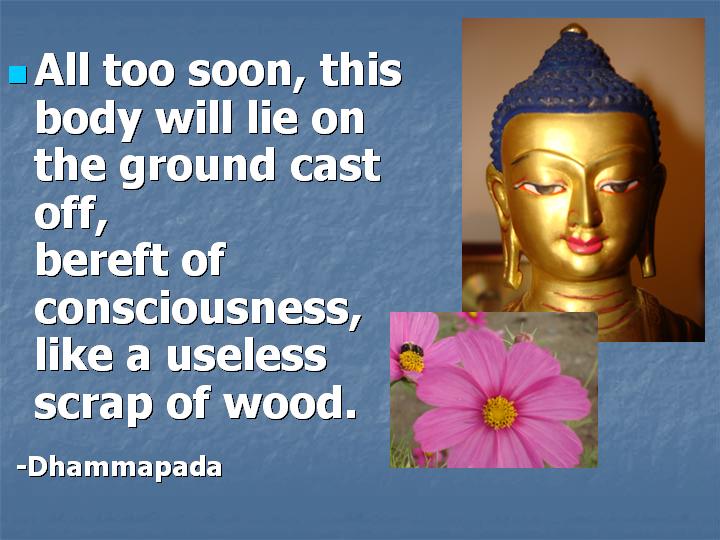
Buddha encouraged us to be always mindful about old age, sickness and death. He said "you can run but you can't hide from it". Sounds depressing? Well, that is the reality. We all know that we are going to get old, sick and die one day, but it is hard to realize "inside". It is almost like a realization through wisdom that comes within oneself. How to be mindful in aging and death is well explained by the Buddha, in the Sathipattana sutta in the mindfulness of the body section.


See other related posts:
The four Bases of Mindfulness

Mindfulness-About-Life-"A lesson-From The Garden"