Showing posts with label taints. Show all posts

Friday, February 8, 2013

The four kinds of kamma...


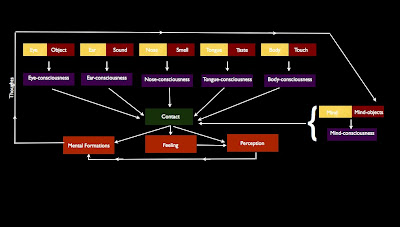
 (Please click on the figure to enlarge)

Kamma is the result of our will or intention.  We discussed before that we have no absolute free will. But we have a will. Therefore we can change our kamma.

Lets take an illustration and see how we make our kamma.

When a person sees an object the person can react or respond in four different ways (See the illustration in the figure above). In this example here it is the identical object comes to their visual field ("A", "B" and "C").

1. The person "A" may react in an unskilful way making "dark kamma" resulting in "dark results."
2. Person "B"  may react with "bright kamma" resulting in "bright result."
3. Their could be a person ("A" or "B" or both) with mix of "dark and bright kamma" resulting in mixed results ("dark and bright results").
4. Their is the person "C" is awakened (fully enlightened). This person may respond with kamma that ends kamma (extinguish kamma). This person knows this is a mere flow of Nama Dhamma arising and passing away in the individual's own mind. This is also will be last mental action at death resulting in no future births.  All the previous kamma dark or bright does not come to fruit. They end all their kamma with  the last kamma that ends kamma.  

The above illustration is for eye and object only. The exact same mechanism applies to other senses too, including mind and mind objects. At the time of death mostly mind and mind objects (memories retrieved) as discussed in the mind works model come into play. The awaked has no more taints and therefore flow of thoughts from the mind does not happen.  We have discussed this in detail a previous post on taints.

(Please click on the hyperlinked words or phrases to read the previous posts related to this topic if you wish).


Further reading from previous posts.
"... there are four kinds of kamma proclaimed by me after realization myself with direct knowledge.

What are the four?

1.There is dark kamma with dark ripening,
2. There is bright kamma with bright ripening,
3. There is dark-and-bright kamma with dark-and-bright ripening,
4. There is kamma that is not dark and not bright with neither-dark-nor-bright ripening that conduces to the exhaustion of kamma.

Kukkuravatika Sutta: The Dog-duty Ascetic


translated from the Pali by Ñanamoli Thera

Friday, March 23, 2012

Its a feeding frenzy! Not only the mind feeds on thoughts, it also regurgitates and chews on them.


The mind always likes to feed on thoughts. Sometimes this happens even when sleeping. Not only the mind feeds on thoughts it also regurgitates and chews on them. Just like a cow that chews on old grass that has been eaten before (Figure 1).


Figure 1

Lets see how it works. Mind gets the basic information about the external world from our five senses. This is shown in the mind works model. All the information that arrives is finally channeled to the mind as thoughts (Figure 2). They are stored as memory. They become mind objects and and can be retrieved and fed to the mind again and again. This become a continuous loop of feeding of thoughts to the mind (figure 4). This is what was meant by regurgitation and chewing of them again. This is also referred to as mental proliferation. We will explore this further in the next step.

Figure 2: This figure shows how the information from the senses flow to the mind. Mind eventually receives all the information from the senses. It can then retrieve them making a continuous loop.

In the Figure 3 it is shown how the mind feeds on thoughts. The eye is taken as the sense organ and an object taken as the sense stimulus in the example. We hang on to these thoughts triggered by the object with craving and this is what we call clinging to sensuality. The information that flows to the mind as thoughts are called the taints. As long as there is craving and clinging, mind is not free from taints. This is the pattern seen in an ordinary person (untrained mind). The Arahants have no craving or clinging. They therefore are free from all taints. There are no spontaneous flow of thoughts triggered by craving and clinging after the object is seen. These thoughts stop after its purpose is done. There are no spontaneous flow of thoughts. This is what is meant when said "in reference to the seen, there will be only the seen" in Bahiya sutta. These thoughts therefore do not generate any kamma (positive or negative) as they are free from taints (please see the post on taints for further discussions).

Figure 3: This figure shows the flow of thoughts in a ordinary person looking at an object.

In Figure 4 it shows that the visual object is no longer present. However the memory of the object already stored can be retrieved as mental objects and fed back into to the mind. This is how we feed the mind about the past objects we have seen. This is a type of mental nutriment (mano-sancetanaa). This process is called mental proliferation and in this case it is about the past. This is what was meant when it was said that the "mind chews on the regurgitated thoughts." Just like "a cow chews on old grass it has eaten before."

Figure 4: This figure shows how memory about the object is retrieved by the mind (craving is not shown in this figure).

We now know that the mind has to be fed. It is always hungry by nature. At least it is better to feed the mind with healthy food and not with junk food. Not only we feed on our old food we also have this habit of feeding on food scarps that other people throw at us. Sometimes we can get mentally sick or depressed feeding on them. There is an interesting story in Akkosa sutta how Buddha refused to feed on another persons words of abuse. So if you decide to feed on mental food at least feed on healthy food. Healthy food can generate good kamma. These are thoughts of your generosity, virtue and practice of meditation. Buddha compared higher mental absorptions (The four Rupa Jhanas) experienced through meditations like the internal food and medicine to the mind. However the ultimate goal is to stop feeding on all thoughts. This is the mind of an Arahant. This is when the feeding frenzy finally stops.


If you want to explore more on this subject please listen to these talks on "mental food" by Thanissaro Bhikkhu:

Sunday, September 18, 2011

Just as when a carpenter...


"Just as when a carpenter or carpenter's apprentice sees the marks of his fingers or thumb on the handle of his adze but does not know, 'Today my adze handle wore down this much, or yesterday it wore down that much, or the day before yesterday it wore down this much,' still he knows it is worn through when it is worn through. In the same way, when a monk dwells devoting himself to development*, he does not know, 'Today my Taints (effluents) wore down this much, or yesterday they wore down that much, or the day before yesterday they wore down this much,' still he knows they are worn through when they are worn through."

Nava Sutta: The Ship
translated from the Pali by
Thanissaro Bhikkhu

*This is called abandoning taints by developing (bhāvanā pahātabbā) ( Sabbasava sutta).

Internal tranquility through breath meditation will prevent taints of sensuality from arising as there is no room for the senses to be engaged in other activities other than the perception, feeling and directed evaluation (applied and sustained thoughts) of breath. This happen specially after mindfulness of the breath becomes immersed in the body. The metaphor Buddha gave here was the six animals tied to a strong pole in Chappana sutta. In Jhana states too taints of sensuality are abandoned. However taints of becomingmay still exists.

The difference in insight meditation is that thoughts arrive in the mind from six senses but the mind does not give any value to them as seeing them as impermanent, suffering, and not-self. This will not allow thoughts to proliferate any further. Craving does not arise here. The thoughts die in the mind itself without mental proliferations (papañca) generating taints. This method of training finally abandons all taints.

Sunday, August 28, 2011

What are Taints or Fermentations (Asava) of the mind? How do they work? A Buddhist perspective


Taints are basic defilements of the mind. Pali term for Taints is Asava. The purpose of this post is to further examine the meaning of this term and to understand clearly how they work in relation to the workings of the mind. Asava is also frequently translated as fermentations in the sutta. Other terms includes effluents, pollutants or cankers. They are also defined as In-flows, influxes, influences, corruption's, intoxicant biases.

There are three types of taints according to the sutta. Taints of sensuality (kāmāsava), Taints of becoming (bhavāsava) and taints of ignorance (avijjāsava). Abhidhamma adds another taint. This is called the taint of views (ditthāsava).

The fundamental taint of all these is the taint of ignorance (avijjāsava). This is confirmed in Sammaditthi sutta, when Ven. Sariputta said that ignorance was the cause of all taints. In this sutta he states "With the arising of ignorance there is the arising of the taints. With the cessation of ignorance there is the cessation of the taints." This is also confirmed in the Nibbedhika Sutta.*(see below)


The meaning of “Asava” according to Bhikkhu Bodhi: “Savathi” means flow, “A(h)” is the prefix interpreted as flow in (influents) or out (effluents). Some say that taints flow in whereas others say that taints flow out. There is yet another group that say taints can both flow in and out. This models supports that theory (explained later). However all agree that taints are basic defilements of the mind.

In this post we will try to examine how taints work in relation to the workings of the mind. We will also try to understand why different interpretations such as flowing in and flowing out were given by different authors.

Other related words:

Khīnāsava (also called anāsava or nirāsava) is the one whose taints are destroyed. It is another name given for an Arahant or fully enlighten one. When one attains Arahantship it is frequently called āsavakkhaya, the one who has destructed all taints. It is also known as one of the three fold knowledges* * (āsavānaŋ khaya nana) to complete this path. This is a recurrent theme you find when you read Sutta*** and Theragatha, the verses of the elder monks.

Sāsava: this means asava or taints are is still present. This is the opposite of Khīnāsava.


In this post we will examine the taints of sensuality which we usually deal with in day to day life. I have taken here the eye as the sense organ and a piece of cake as the sense object.

Taints are basically flow of information from the object to the mind through the senses (See Figure 1 below).


Figure 1

The flow will depend on our craving. More craving you have for the object more taints will arrive at the mind. Here is a simplified model of what happens (See Figure 2 below).


Figure 2

When an object is cognized by the eye we see the object (Figre 2-1). If it is pleasing to the eye we then want to look at the object as craving arises (Figure 2-2). The flow of information that is brought into the mind about the object becomes the taints. These are basically memory stored that can be retrieved. As we keep looking this gives rise to more craving and therefore this will give rise to more taints (Figure 2-3). Eventually we "lock on" or cling to the object with craving (Figure 2-4). How we cling to things were discussed in a previous post.

The mind is hungry and is always looking to feed on the taints. If it is an unpleasant object we crave for that in a different way. This time we crave to get rid of it. This too will give rise to unpleasant thoughts. These are continuous influx of thoughts both pleasant and unpleasant. They can be also considered as food of mental volition that keeps feeding the mind.


This continuous feeding of the thoughts can be regarded as mental proliferations (papañca) about the present (and even about the past and the future). This is may be why some translate Asavas as "fermentations" of the mind.

If you look into this in more detail using the mind works model you can see what really happens (Figure 3-5). When the eye meet the object, eye consciousness arises. Meeting of the eye, the object and the eye consciousness, the contact arises. Now this information appears to flow out of the senses into the mind.  these are stored as memory of previous events.  These can be triggered by new information coming in  and will add to the out flow of thoughts.  This may keep the attention on the object you desire causing more information and memories stored for future use. This may be why some scholars interpret that taints flow out. (Figure  5).

In the first few cognitive series gives us information about the perception, feeling and previous memory about the object (Figure 3). How cognitive series work was discussed in detail in previous post called "Are we really "multi tasking"or is it just another sophisticated function of the mind?"

If the object is pleasing to the eye craving arises (Figure 4). If it is unpleasant craving may arise to get rid of it (aversion). As craving increases more thoughts flows into the mind using multiple cognitive series (Figure 4&5). These thoughts can also trigger previous dormant memories about the object and retrieve more thoughts from the mind and are added to the flow of thoughts. These dormant memories retrieved are the taints. When there is minimal external sensory stimulation mind feeds on its own food (metal objects). This is because the mind has the ability to retrieve thoughts de novo, independent of a trigger. This can be observed well in meditation when our five senses are quiet. The mind will bring in new ideas from the past as memories and feed the mind as new taints (green arrows figure 5).

The number of thoughts are amplified (mental proliferation) as we keep the attention on the object. These thoughts are brought back to the mind as influxes or in-flows. All these thoughts are tainted with craving in the background of ignorance. These become the taints of the mind. All these thoughts make kamma depending on which ones you cling on to it will determine your future becoming (Bhava) and hence rebirth (Please see the post on rebirth and dependent origination). This is the diversity of taints discussed in Nibbedhika sutta (*See the notes at the end of this post).

Figure 3: Basic cognitive process that involves seeing an object. Although these figures (Figure 3,4 and 5) shows multiple cognitive series it is important to note that only one track is generated at a given time, triggered at a very rapid speed.


Figure 4: When we look at the object there is intention and desire present. More craving and more taints arise. There is a proliferation of the cognitive tracks here. The inflow of thoughts to the mind with craving becomes the taints of the mind.


Figure 5: If we keep interacting with the object further, more craving arises as other senses too may join in like smell, taste, sound, feeling, etc. This is specially true with food. The cognitive tracts from these senses are not shown in this figure to keep the diagram less busy. However the places where craving arises is shown in a red stars.  The multiple green arrows shows taints flowing out of the mind as mind-consciousness (i.e., as ideas). Here there is much more craving hence much more taints are generated. This is called clinging to the object.

Asava are therefore better defined as flows of thoughts in and out of the mind triggered by previous memories in the presence of carving and ignorance.

The translation of the Asava as Taints or Fermentations alone may not be enough to give the true meaning of Asava.

Kinasawa are inflows of thoughts into the mind devoided of craving and ignorance. This is the thought process of an Arahant. An Arahant has destroyed all craving and ignorance there are no more taints. The thoughts of an Arahant do not make kamma for a future birth (no more Bhava/Becoming) as there is no more craving and clinging. All this happen in the absence of ignorance.
In Samadhi sutta Buddha says "As for the individual who has attained both internal tranquillity of awareness & insight into phenomena through heightened discernment, his duty is to make an effort in establishing those very same skillful qualities to a higher degree for the ending of the taints."

This is called abandoning taints by developing (bhāvanā pahātabbā) (Please see Sabbasava sutta below).
Internal tranquility through breath meditation will prevent taints of sensuality from arising as there is no room for the senses to be engaged in other activities other than the perception, feeling and directed evaluation (applied and sustained thoughts) of breath. This happen specially after mindfulness of the breath becomes immersed in the body. The metaphor Buddha gave here was the six animals tied to a strong pole in Chappana sutta. In Jhana states too taints of sensuality are abandoned. However taints of becoming may still exists.

The difference in insight meditation is that thoughts arrive in the mind from six senses but the mind does not give any value to them as seeing them as impermanent, suffering, and not-self. This will not allow thoughts to proliferate any further. Craving does not arise here. The thoughts die in the mind itself without mental proliferations (papañca) generating taints. This method of training finally abandons all taints.

If one expects to abandon taints without developing, in Nava sutta Buddha says "it is like a hen expecting the chicks to break through the eggs without incubating them rightly."

However one who dwells devoting himself to development (bhāvanā pahātabbā) will know when the taints are abandoned, even though he cannot say how much taints are abandoned from day to day. Buddha says it is "just as when a carpenter or carpenter's apprentice sees the marks of his fingers or thumb on the handle of his adze but does not know, 'Today my adze handle wore down this much, or yesterday it wore down that much, or the day before yesterday it wore down this much,'' still he knows it is worn through when it is worn through" (Nava sutta).

There is a sutta that discusses in detail how to abandon all taints. It is called the Sabbasava sutta. In this sutta Buddha talks about seven methods of restraining/abandoning taints. The key to this is Yoniso manasikara (appropriate attention/reflection, wise attention/reflection).

The noble disciple (the one who has heard, skilled and disciplined in Dhamma) will abandon taints by Yoniso manasikara or reflecting appropriately. The taints (thoughts that proliferate with craving/aversion as discussed above) will subside, new taints will not arise. The last method will completely abandon all taints as discussed above.

1. Seeing (dassanā pahātabbā) Does not attend to what is unfit for attention, attends to what is fit for attention...
2. Restraining (savarā pahātabbā) - Restraining the six senses...
3. Using (paisevanā pahātabbā) -The use robes, alms-food, lodging, medicinal requisites...
4. Tolerating (adhivāsanā pahātabbā) - Endures cold, heat, hunger, & thirst...
5. Avoiding (parivajjanā pahātabbā) - Avoids certain animals, certain places, certain people..
6. Destroying (vinodanā pahātabbā) - Thoughts of sensuality, ill will and cruelty...
7. Developing (bhāvanā pahātabbā) - Develops mindfulness as a factor for Awakening dependent on seclusion... dispassion... cessation, resulting in letting go... (mindfulness meditaion/ insight practice).

There is a discussion on this sutta by Bhikkhu Bodhi. The links are give below. First you need to download the MP3 file and then listen.


4. Eliminating the taints

On 2004.08.31
MN 2: Sabbāsava Sutta — All the Taints
table: Fetters, Latent Tendencies, and Influxes
On 2004.09.07
MN 2: Sabbāsava Sutta —All the Taints
(continued)
On 2004.09.14
MN 2: Sabbāsava Sutta —All the Taints
(continued)
On 2004.09.21
MN 2: Sabbāsava Sutta —All the Taints
(continued)

Reference for audio mp3- A Systematic Study of the Majjhima Nikaya By Bhikkhu Bodhi


*Notes: Extract from Nibbedhika Sutta (Fermentations are used here for Asava instead of taints):
..."There are these three kinds of fermentations: the fermentation of sensuality, the fermentation of becoming, the fermentation of ignorance.
"And what is the cause by which fermentations comes into play? Ignorance is the cause by which fermentations comes into play.
"And what is the diversity in fermentations? There are fermentations that lead to hell, those that lead to the animal womb, those that lead to the realm of the hungry shades, those that lead to the human world, those that lead to the world of the devas. This is called the diversity in fermentations.
"And what is the result of fermentations? One who is immersed in ignorance produces a corresponding state of existence, on the side of merit or demerit. This is called the result of fermentations.
"And what is the cessation of fermentations? From the cessation of ignorance is the cessation of fermentations; and just this noble eightfold path — right view, right resolve, right speech, right action, right livelihood, right effort, right mindfulness, right concentration — is the way leading to the cessation of fermentations...
Nibbedhika Sutta: translated from the Pali by Thanissaro Bhikkhu-


* * Threefold knowledges:Knowledge of past lives, knowledge of the passing away and rebirth of living beings, and knowledge of the ending of taints (fermentations).
***To read more sutta on fermentation, taints or effluents please click on the hyperlinked words below:
2. Taints

I apologize for the variation in the font throughout this post.


Thursday, June 9, 2011

What is clinging? A Buddhist take on it.


We often hear about the word clinging in Buddhism, especially when we discuss the dependent origination. Clinging can also be translated as "sustenance" or "feeding". Feeding what? Feeding the mind with "mental food" (as thoughts). 

As Thanissaro Bhikkhu says in one of his talks "the mind has no 'hands' to cling". So how does the mind cling to things? Here we will explore the mechanism of clinging by using the mind works model. Clinging to sensual desire is discussed in this post.

We have already discussed how the mind performs "multi tasking" using cognitive series in a previous post called: Are we really "multi tasking"or is it just another sophisticated function of the mind?


Before we explore the main topic of clinging, we will examine the difference between seeing and looking*. We will take the same driving example here as in a previous posts. When we see a car in front of us, while driving, we just see it. We keep driving without thinking about it. We see the traffic light changing. We stop and then go again without thinking about it. Now supposing you see a car you have never seen before in front of you and you like it, you will see it first and then look at it. Think about it.

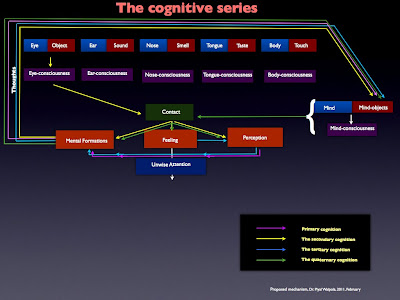
Now there is a difference between seeing and looking. In the initial seeing of the car only the primary cognitive series is used. This is the mere perception of the car. This generates the first thought about it. The thoughts from then on are a product of your active will, which is present and can shape your experience about the new car. Your feeling and memory will play a part in these thoughts as discussed in a previous post as secondary, tertiary and quaternary cognitive series to add more information about the car (Figure 1). The mechanism of this was discussed in a previous post called: Are we really "multi tasking"or is it just another sophisticated function of the mind?


Figure 1

When we look, an active thought process occurs. There is will present here. Now you are "locking on" to the object because the craving for the object that is present. In this example it is the new car. As long you have craving to look at the object you can keep the attention and a countless number of cognitives series (primary, secondary, tertiary and quaternary) are generated at a rapid speed (Figure 2). Now the flow of incoming sensory information from the object may be called taints or fermentations (asava) and we will examine this in detail in the next post.


Figure 2

Now where does craving arise and where does it dwell when we look at a object? Figure 3 below shows where craving is generated and dwells using the mind works model.


Figure 3

When you "lock on" to an object you desire, as said before, there are a countless number of cognitives series (primary, secondary, tertiary and quaternary) generated. There is craving that arises at each step during the process. This is really what is known as clinging (Figure 4 below). The mind is functionally clinging to the object with numerous thoughts at a very rapid speed. This could also be regarded as mental proliferation of the mind in the present.


Figure 4


So this is where craving leads to clinging in the dependent origination or dependent co-arising. Here what is shown is the clinging is to sensual desires. This clinging will be present until the next moment you see another object and the attention changes.

The other five senses and their respective stimuli behave exactly the same. Therefore Mind is like a "working of a radio" changing its six channels tuning in to the channel we desire and clinging at times due to the craving.

All these thoughts that are generated in this clinging is what is called Becoming (Bhava) or kamma that will make a result in the future result (Vipaka). This is the link where clinging that will lead to Becoming. At the end our last thought will become the rebirth kamma that will shape our rebirth consciousness and birth and was discussed in a the post Rebirth: How does it work? A model based on the dependent origination.

All these thing happen in the background of ignorance and we have discussed this topic in other posts. Training our mind only to see, when you see (not looking), only to hear, when you hear (not listening)..., (same applies to the other senses) should be our training. Interestingly this was the brief instructions Buddha gave to Bahiya in the famous Bahiya Sutta
and he attained full enlightenment contemplating on this alone.


Clinging to identify things as mine is an innate desire or craving of all human beings. Clinging to our body (form), feelings, perceptions, thoughts and consciousness (the five aggregates) as mine
is called Personality view or self Identity view (sakkaya-ditthi[sakkaaya-di.t.thi and we have discussed this in other posts.


*Seeing and looking in this post:
Seeing is passive here. You are just the observer, no craving or clinging is present here.
Looking is active here. You are actively involved in looking and seeking some object. There is craving and clinging present here. The same applies to hearing/listening and of other senses.