Showing posts with label craving. Show all posts

Sunday, May 19, 2013

Further Examination of the Third Noble Truth


The third noble ruth is the cessation from suffering.  This is how it is said in Maha-Satipatthana Sutta.

"And what is the noble truth of the cessation of stress? The remainderless fading & cessation, renunciation, relinquishment, release, & letting go of that very craving.

"And where, when being abandoned, is this craving abandoned? And where, when ceasing, does it cease? Whatever seems endearing and agreeable in terms of the world: that is where, when being abandoned, this craving is abandoned. That is where, when ceasing, it ceases.

"And what seems endearing and agreeable in terms of the world? The eye seems endearing and agreeable in terms of the world. That is where, when being abandoned, this craving is abandoned. That is where, when ceasing, it ceases.

"The ear... The nose... The tongue... The body... The intellect...

"Forms... Sounds... Smells... Tastes... Tactile sensations... Ideas...

"Eye-consciousness... Ear-consciousness... Nose-consciousness... Tongue-consciousness... Body-consciousness... Intellect-consciousness...

"Eye-contact... Ear-contact... Nose-contact... Tongue-contact... Body-contact... Intellect-contact...
"Feeling born of eye-contact... Feeling born of ear-contact... Feeling born of nose-contact... Feeling born of tongue-contact... Feeling born of body-contact... Feeling born of intellect-contact...
"Perception of forms... Perception of sounds... Perception of smells... Perception of tastes... Perception of tactile sensations... Perception of ideas...
"Intention for forms... Intention for sounds... Intention for smells... Intention for tastes... Intention for tactile sensations... Intention for ideas...
"Craving for forms... Craving for sounds... Craving for smells... Craving for tastes... Craving for tactile sensations... Craving for ideas...
"Thought directed at forms... Thought directed at sounds... Thought directed at smells... Thought directed at tastes... Thought directed at tactile sensations... Thought directed at ideas...
"Evaluation of forms... Evaluation of sounds... Evaluation of smells... Evaluation of tastes... Evaluation of tactile sensations... Evaluation of ideas seems endearing and agreeable in terms of the world. That is where, when being abandoned, this craving is abandoned. That is where, when ceasing, it ceases.
"This is called the noble truth of the cessation of stress.
" Maha-satipatthana Sutta: The Great Frames of Reference" (DN 22), translated from the Pali by Thanissaro Bhikkhu. Access to Insight, 15 October 2011,http://www.accesstoinsight.org/tipitaka/dn/dn.22.0.than.html . Retrieved on 7 May 2013.


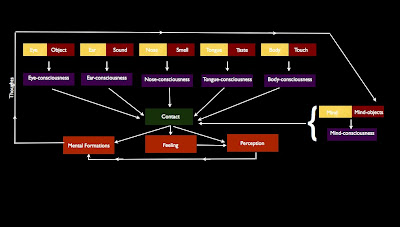
So the third noble truth cessation of suffering is basically cessation of craving.  In the passage above in Maha-Satipatthana sutta Buddha explains the craving that results from the cognitive function of the six senses. This is our "world."  The world of six senses. This is basically how we perceive our world around us. Now we will briefly revisit the basic mind works model (shown below).

You can see from the figure above how the cognitive pathways flow from the senses and how contact plays a central role in making this a reentry circuit of thoughts. It is important to note that only one consciousness arises at a given time resulting in one contact.  This will be the corresponding contact of the sense base that is firing (one sense is on "fire") in that moment.  However in the model above it is shown as one common contact to keep the model simple. Therefore only one sense base is born (and die) at a given time.  This the momentary birth and death sometimes we talk about in Buddhism. We have discussed in great detail how we can apply this model to dependent origination and rebirth in our other posts like the mind work model, rebirth and the youtube channel videos.

From dependent origination we know that contact causes feeling and feeling causes our craving.  This then causes our clinging (feeding). Please see the diagram below.  Here only five steps are shown out of the twelve for the purpose of this post.

 If we can get rid of our contact we will have no more feeling and no more craving. However it is impossible to get rid of the first contact.  It is a process dependently arisen as a result of an interaction between a sense and a sensory object. We will call the first contact as the primary contact.  The subsequent contacts that arise as a result of reentry of thoughts we will call here as the secondary contacts. The generation of secondary contacts we are entirely responsible and it is a result of our craving. The caving generates directed thoughts and evaluation of the sensory object perceived through the sense organ (as said in the above passage from the sutta).   The idea of training the mind through the noble eight fold path is to gradually get rid of the secondary contacts that occur as a result of our craving as we cling to the object.  As we become disenchanted and dispassionate (less craving to the same object), less and less contacts will form from the same sensory encounter. When one reaches cessation only the primary contact will  remain with a given sensory encounter.  There is no more craving and clinging.  This is "when one sees, one only sees (brief instructions Buddha gave to Bahiya)." No more delight and evaluation of sights as before.  There are no more taints (previous memories of the encounters) automatically flowing through the mind as there is no more craving.  However if he intends to have more contact he can do so if necessary without clinging. The only way to confirm this hypothesis is to directly experience this ourselves, developing the noble eight fold path to its culmination and gain insight knowledge, vision and the final release.

If this hypothesis is correct then there should be a sutta that explains the cessation of contact (secondary) leading to cessation of feeling  and cessation of craving.  Nibbedhika sutta is an good example for this. 

It says:

"And what is the cessation of feeling? From the cessation of contact is the cessation of feeling.. 

Here what is meant by the cessation of contact is the cessation of the secondary contact or multiple secondary contacts as a result of reentry thoughts. Please see below the extract of a passage on feeling from this sutta.

"'Feeling should be known. The cause by which feeling comes into play... The diversity in feeling... The result of feeling... The cessation of feeling... The path of practice for the cessation of feeling should be known.' Thus it has been said. In reference to what was it said?

"There are these three kinds of feeling: a feeling of pleasure, a feeling of pain, & feeling of neither pleasure nor pain.

"And what is the cause by which feeling comes into play? Contact is the cause by which feeling comes into play.

"And what is the diversity in feeling? There is the feeling of pleasure connected with the baits of the world. There is the feeling of pleasure not connected with the baits of the world. There is the feeling of pain connected with the baits of the world. There is the feeling of pain not connected with the baits of the world. There is the feeling of neither pleasure nor pain connected with the baits of the world. There is the feeling of neither pleasure nor pain not connected with the baits of the world. This is called the diversity in feeling.

"And what is the result of feeling? One who feels a feeling produces a corresponding state of existence, on the side of merit or demerit. This is called the result of feeling.

"And what is the cessation of feeling? From the cessation of contact is the cessation of feeling; and just this noble eightfold path — right view, right resolve, right speech, right action, right livelihood, right effort, right mindfulness, right concentration — is the way leading to the cessation of feeling.
"Now when a disciple of the noble ones discerns feeling in this way, the cause by which feeling comes into play in this way, the diversity of feeling in this way, the result of feeling in this way, the cessation of feeling in this way, & the path of practice leading to the cessation of feeling in this way, then he discerns this penetrative holy life as the cessation of feeling.
"'Feeling should be known. The cause by which feeling comes into play... The diversity in feeling... The result of feeling... The cessation of feeling... The path of practice for the cessation of feeling should be known.' Thus it has been said, and in reference to this was it said.

"Nibbedhika Sutta: Penetrative" (AN 6.63), translated from the Pali by Thanissaro Bhikkhu. Access to Insight, 4 July 2010,http://www.accesstoinsight.org/tipitaka/an/an06/an06.063.than.html . Retrieved on 7 May 2013.  

So in summary with the cessation of contact (secondary) there comes the cessation of feeling, craving and clinging. This means no more becoming and no more birth.  The end of birth means no more old age, sickness, death.  This is end of suffering in life. The key is to follow the noble eightfold path as Buddha once said "the right technique will give you the right result." 

Sunday, June 24, 2012

Further investigation of the second Noble Truth: The Craving

We discussed the first noble truth in a previous post. Here we will try to explore the second noble truth, the cause of suffering or stress. This is nothing other than our craving. There are three types of cravings. Craving for sensual desires, craving for existence and craving for non-existence. In this post we will focus on craving for sensual desires. In a previous post we discussed where craving arises and is abandoned as discussed in Maha-satipattana sutta.  However it is not clear what craving is in terms of five aggregates as it has to belong to one of them.


Figure 1: "The eye is not the fetter of forms, nor are forms the fetter of the eye, but whatever desire & ; passion arises in dependence on the two of them: That is the fetter there." -"Kotthita Sutta:


It seems like craving is a just another mental formation (fabrication) or a thought. Although it is said that craving arises dependent on the eye and the object it actually arises in the mind as thoghts.  It does not arise at the eye or at the object (Figure 1). Nor dose it arise at the level of eye conciseness or contact.  When Buddha said this where craving arises and is abandoned in each point of cognitive process as discussed in Maha-satipattana sutta, it is likely what he really meant that craving was the result of this series of dependently arisen processes on the cognitive path. So when you see an object you will generate perceptions, feelings, and thoughts about the object (Figure 2: blue, purple, yellow lines). This is the initial cognitive series and this is how we get our basic information about the object. This requires minimum of four or more cognitives series. This is the bare awareness* necessary for us to function. If this is a pleasing object pleasant feelings thoughts and perceptions will arise. These will lead to more thoughts and the mind keeps feeding on these thoughts of lust or unskilful desires. This is what is called craving.  Previous memory about the object will influence this.  Stronger the past memory of craving and clinging to the object we have stronger the craving to the present object we see. The cognitive series here is similar to how the mind feeds on the thoughts from the memory of the object as shown in a previous post (Figure 2: green lines). They become our thoughts of craving and we cling to them as it feeds the mind. This complex patterns of thoughts intertwined between thoughts about the object and craving can repeat itself as long as there is an object in the sight (attention) or mind (attention and memory).

Figure 2: This figure shows two sets of series of cognitive paths which are basically mental formations (sankara/fabrications) received by the mind. The first set is the initial cognitive series that brings in the basic information necessary to recognize the object. These are shown here as thoughts about the object. The second set of cognitive series are thoughts of craving influenced by previous memories are shown here as thoughts of craving.

Lets look at this in more detail in terms of the five aggregates. We now know the multiple thoughts of craving will lead to clinging.  So when we say we cling to the five aggregates we are really NOT clinging to the objects, feelings, perceptions or mental formations (thoughts) directly.  What really happens is we create multiple thoughts of craving and we cling with our thoughts.  Obviously the feeling is greatly influenced by our perceptions and previous memories about the object.  This feeling is expressed by initial thoughts and  followed by thoughts of craving as discussed above.  So when we say "feeling leads to craving and craving leads to clinging" the dependent origination formula,  this is what happens at the level of the mind.

It is also important to remember that ALL these processes happen EXCLUSIVELY within our mind (the aggregates arise and pass away rapidly) and it has nothing to do with the object (or the person) we saw, except it was only a trigger.  You only like dislike your own feelings.  That is all! The object or the person has no idea of what happened within your mind and will not be affected by it (unless you decide to express verbally or physically).

So if we examine carefully with wise attention wee can see how we create our own suffering and stress.  This is the second noble truth.  It is also important to note here that the five aggregates arise and pass away very quickly and are not permanent entities of the mind as discussed in a previous post. This is called instant impermanence of aggregates.  If we try to see this from moment to moment with insight  we begin to see how long we have been deluded in this samsaric journey.  With practice of insight meditation one penetrates in to this direct knowledge within oneself.  The application of this in day to day life can lead to disenchantment (distaste), dispassion and eventually to release. 

The craving therefore is nothing but a mental formation (fabrication) arisen dependently on an sensual object and sense organ. 


(In this post we examined  the craving for sensuality. The same applies to other sense organs and their respective stimuli as well. Same principal applies to craving for existence and craving for non-existence.)


*The bare awareness with the initial cognitive series with no craving to generate further  influxes of thoughts (taitns) may be the an Arahant's mind works. They have no craving, no mental proliferation's (no re-feeding) of the mind, therefore no clinging and no more future births. They may therefore function with only the primary cognitive series of thoughts.  This may be what the brief instructions Buddha gave to Bahiya in Bahiya sutta.  Here is a brief extract "...Bahiya, you should train yourself thus: In reference to the seen, there will be only the seen. In reference to the heard, only the heard. In reference to the sensed, only the sensed. In reference to the cognized, only the cognized. That is how you should train yourself... "

 "Bahiya Sutta: About Bahiya" (Ud 1.10), translated from the Pali by Thanissaro Bhikkhu. Access to Insight, 8 July 2010,http://www.accesstoinsight.org/tipitaka/kn/ud/ud.1.10.than.html . Retrieved on 25 June 2012.


Friday, March 23, 2012

Its a feeding frenzy! Not only the mind feeds on thoughts, it also regurgitates and chews on them.


The mind always likes to feed on thoughts. Sometimes this happens even when sleeping. Not only the mind feeds on thoughts it also regurgitates and chews on them. Just like a cow that chews on old grass that has been eaten before (Figure 1).


Figure 1

Lets see how it works. Mind gets the basic information about the external world from our five senses. This is shown in the mind works model. All the information that arrives is finally channeled to the mind as thoughts (Figure 2). They are stored as memory. They become mind objects and and can be retrieved and fed to the mind again and again. This become a continuous loop of feeding of thoughts to the mind (figure 4). This is what was meant by regurgitation and chewing of them again. This is also referred to as mental proliferation. We will explore this further in the next step.

Figure 2: This figure shows how the information from the senses flow to the mind. Mind eventually receives all the information from the senses. It can then retrieve them making a continuous loop.

In the Figure 3 it is shown how the mind feeds on thoughts. The eye is taken as the sense organ and an object taken as the sense stimulus in the example. We hang on to these thoughts triggered by the object with craving and this is what we call clinging to sensuality. The information that flows to the mind as thoughts are called the taints. As long as there is craving and clinging, mind is not free from taints. This is the pattern seen in an ordinary person (untrained mind). The Arahants have no craving or clinging. They therefore are free from all taints. There are no spontaneous flow of thoughts triggered by craving and clinging after the object is seen. These thoughts stop after its purpose is done. There are no spontaneous flow of thoughts. This is what is meant when said "in reference to the seen, there will be only the seen" in Bahiya sutta. These thoughts therefore do not generate any kamma (positive or negative) as they are free from taints (please see the post on taints for further discussions).

Figure 3: This figure shows the flow of thoughts in a ordinary person looking at an object.

In Figure 4 it shows that the visual object is no longer present. However the memory of the object already stored can be retrieved as mental objects and fed back into to the mind. This is how we feed the mind about the past objects we have seen. This is a type of mental nutriment (mano-sancetanaa). This process is called mental proliferation and in this case it is about the past. This is what was meant when it was said that the "mind chews on the regurgitated thoughts." Just like "a cow chews on old grass it has eaten before."

Figure 4: This figure shows how memory about the object is retrieved by the mind (craving is not shown in this figure).

We now know that the mind has to be fed. It is always hungry by nature. At least it is better to feed the mind with healthy food and not with junk food. Not only we feed on our old food we also have this habit of feeding on food scarps that other people throw at us. Sometimes we can get mentally sick or depressed feeding on them. There is an interesting story in Akkosa sutta how Buddha refused to feed on another persons words of abuse. So if you decide to feed on mental food at least feed on healthy food. Healthy food can generate good kamma. These are thoughts of your generosity, virtue and practice of meditation. Buddha compared higher mental absorptions (The four Rupa Jhanas) experienced through meditations like the internal food and medicine to the mind. However the ultimate goal is to stop feeding on all thoughts. This is the mind of an Arahant. This is when the feeding frenzy finally stops.


If you want to explore more on this subject please listen to these talks on "mental food" by Thanissaro Bhikkhu:

Tuesday, January 17, 2012

Stress: Its all about clinging to the activity of the five aggregates


Figure 1: This figures shows that clinging to five aggregates is the basis of stress or suffering

Buddha did not say life is stress and suffering. Buddha only said there is stress and suffering in life (the First Noble Truth). What some people fail to see is that not only he said there is stress and suffering in life, he also gave the cause for it (the Second Noble Truth), how to get rid of it (the Third Noble Truth) and a clear path to get rid of this stress and suffering (the Fourth Noble Truth).

When we talk about the First Noble Truth it is about stress or suffering. Here is a extract from Maha- satipatthana sutta (The four foundations of mindfulness):

"Now what is the noble truth of stress?

Birth is stressful, aging is stressful, death is stressful; sorrow, lamentation, pain, distress, & despair are stressful; association with the unbeloved is stressful; separation from the loved is stressful; not getting what one wants is stressful.

In short, the five clinging-aggregates are stressful..."

" Maha-satipatthana Sutta: The Great Frames of Reference" (DN 22), translated from the Pali by Thanissaro Bhikkhu. Access to Insight, 15 October 2011,http://www.accesstoinsight.org/tipitaka/dn/dn.22.0.than.html . Retrieved on 17 January 2012.

What does it really mean when you say "In short, the five clinging-aggregates are stressful."?

Let us take the first cause stress or suffering which is birth. As we all know when the fetus comes through the birth canal there is a lot of moulding of the head and the body. There must be a lot of pain perceived by the child being born. This is implied by the loud cry of every child as the fist response after birth. This is the expression of stress.

The perception of the pain during birth is the activity of the mind. It is basically the activity of the five aggregates. It is the body and touch sensation, body consciousness, contact, feeling, perception... as we have discussed in previous posts. Please see mind works model to appreciate the flow of Nama Dhamma (conciousness, contact, feeling, perception, and thoughts) for further reference. This is why birth stress is in short defined as clinging to the activity of the five aggregates.

Same principal applies to all the stresses shown in the diagram above (Figure 1) whether it is physical or mental stress. These include the stress of aging, death, sorrow, lamentation, pain (physical), distress (mental pain), despair, association with un-beloved, separation form the loved and not getting what one wants. They all are ultimately perceived by the mind and become activities of the five aggregates of clinging. Mind does not have hands to cling. We cling with our thoughts. Craving facilitates this clinging. Witout Craving there is no clinging. So we now come to the second Noble Truth, the Noble Truth of the origination of stress. This is nothing other than our Craving.

Therefore the first noble truth, the noble truth of suffering and stress is all about clinging to the five aggregates.

Tuesday, November 22, 2011

Is there free will or determinism ? The answer is neither


There is no absolute free will. But we have a will (intention).  The mind is like a random thought machine. Initial thoughts are triggered by our senses (for example; eye and object) are modified by our memories (see the post on cognitive series). Our likes, dislikes (feelings) and perceptions will modify our subsequent thought process (see the post on how the mind works). There is no self or a person in control of all these (see the post on the anatomy of a being). These are just the activities of the five aggregates (see the post on five aggregates). This creates a false sense of a self in control (see the post on personality view). This is just a process and therefore free will is not possible. There is now some scientific evidence* supporting this.

How about determinism? Everything does not depend on our Kamma (see the post on kamma). Kamma can be modified or extinguished (also see the post on how kamma works). There is no evidence that a God** is in control of our destiny either.

So we are deluded form the reality. The greed, hatred, delusion (ignorance) and fear put us off the tack from the path to awakening. The awaken one knows there is no self. This is just the work of the five aggregates. That's all. He knows that there is no self, no being or an external source in charge of him. He is fully mindful of all the thoughts as they arise and does not cling to a idea of permanent self. He knows for himself there is no permeant self by his own experience of internal investigation of the mind. He has the direct knowledge of the truth. This is the insight he gains through the practice of mindfulness meditation. There is no more ignorance, craving or even clinging. He is totally free and liberated within. There is no more birth for him.

** Related Discussions/Sutta:
1. "Buddhism and the God-idea", by Nyanaponika Thera. Access to Insight, 7 June 2010, http://www.accesstoinsight.org/lib/authors/nyanaponika/godidea.html . Retrieved on 24 November 2011

2. "Tittha Sutta: Sectarians" (AN 3.61), translated from the Pali by Thanissaro Bhikkhu. Access to Insight, 3 July 2010,http://www.accesstoinsight.org/tipitaka/an/an03/an03.061.than.html . Retrieved on 24 November 2011.

3. Tevijja Sutta (DN 13): Page 9-21 and 78-91; Basic Teachings of the Buddha by Glenn Wallis, 2007, Modern Library, NY

* Related links:


Sunday, August 28, 2011

What are Taints or Fermentations (Asava) of the mind? How do they work? A Buddhist perspective


Taints are basic defilements of the mind. Pali term for Taints is Asava. The purpose of this post is to further examine the meaning of this term and to understand clearly how they work in relation to the workings of the mind. Asava is also frequently translated as fermentations in the sutta. Other terms includes effluents, pollutants or cankers. They are also defined as In-flows, influxes, influences, corruption's, intoxicant biases.

There are three types of taints according to the sutta. Taints of sensuality (kāmāsava), Taints of becoming (bhavāsava) and taints of ignorance (avijjāsava). Abhidhamma adds another taint. This is called the taint of views (ditthāsava).

The fundamental taint of all these is the taint of ignorance (avijjāsava). This is confirmed in Sammaditthi sutta, when Ven. Sariputta said that ignorance was the cause of all taints. In this sutta he states "With the arising of ignorance there is the arising of the taints. With the cessation of ignorance there is the cessation of the taints." This is also confirmed in the Nibbedhika Sutta.*(see below)


The meaning of “Asava” according to Bhikkhu Bodhi: “Savathi” means flow, “A(h)” is the prefix interpreted as flow in (influents) or out (effluents). Some say that taints flow in whereas others say that taints flow out. There is yet another group that say taints can both flow in and out. This models supports that theory (explained later). However all agree that taints are basic defilements of the mind.

In this post we will try to examine how taints work in relation to the workings of the mind. We will also try to understand why different interpretations such as flowing in and flowing out were given by different authors.

Other related words:

Khīnāsava (also called anāsava or nirāsava) is the one whose taints are destroyed. It is another name given for an Arahant or fully enlighten one. When one attains Arahantship it is frequently called āsavakkhaya, the one who has destructed all taints. It is also known as one of the three fold knowledges* * (āsavānaŋ khaya nana) to complete this path. This is a recurrent theme you find when you read Sutta*** and Theragatha, the verses of the elder monks.

Sāsava: this means asava or taints are is still present. This is the opposite of Khīnāsava.


In this post we will examine the taints of sensuality which we usually deal with in day to day life. I have taken here the eye as the sense organ and a piece of cake as the sense object.

Taints are basically flow of information from the object to the mind through the senses (See Figure 1 below).


Figure 1

The flow will depend on our craving. More craving you have for the object more taints will arrive at the mind. Here is a simplified model of what happens (See Figure 2 below).


Figure 2

When an object is cognized by the eye we see the object (Figre 2-1). If it is pleasing to the eye we then want to look at the object as craving arises (Figure 2-2). The flow of information that is brought into the mind about the object becomes the taints. These are basically memory stored that can be retrieved. As we keep looking this gives rise to more craving and therefore this will give rise to more taints (Figure 2-3). Eventually we "lock on" or cling to the object with craving (Figure 2-4). How we cling to things were discussed in a previous post.

The mind is hungry and is always looking to feed on the taints. If it is an unpleasant object we crave for that in a different way. This time we crave to get rid of it. This too will give rise to unpleasant thoughts. These are continuous influx of thoughts both pleasant and unpleasant. They can be also considered as food of mental volition that keeps feeding the mind.


This continuous feeding of the thoughts can be regarded as mental proliferations (papaƱca) about the present (and even about the past and the future). This is may be why some translate Asavas as "fermentations" of the mind.

If you look into this in more detail using the mind works model you can see what really happens (Figure 3-5). When the eye meet the object, eye consciousness arises. Meeting of the eye, the object and the eye consciousness, the contact arises. Now this information appears to flow out of the senses into the mind.  these are stored as memory of previous events.  These can be triggered by new information coming in  and will add to the out flow of thoughts.  This may keep the attention on the object you desire causing more information and memories stored for future use. This may be why some scholars interpret that taints flow out. (Figure  5).

In the first few cognitive series gives us information about the perception, feeling and previous memory about the object (Figure 3). How cognitive series work was discussed in detail in previous post called "Are we really "multi tasking"or is it just another sophisticated function of the mind?"

If the object is pleasing to the eye craving arises (Figure 4). If it is unpleasant craving may arise to get rid of it (aversion). As craving increases more thoughts flows into the mind using multiple cognitive series (Figure 4&5). These thoughts can also trigger previous dormant memories about the object and retrieve more thoughts from the mind and are added to the flow of thoughts. These dormant memories retrieved are the taints. When there is minimal external sensory stimulation mind feeds on its own food (metal objects). This is because the mind has the ability to retrieve thoughts de novo, independent of a trigger. This can be observed well in meditation when our five senses are quiet. The mind will bring in new ideas from the past as memories and feed the mind as new taints (green arrows figure 5).

The number of thoughts are amplified (mental proliferation) as we keep the attention on the object. These thoughts are brought back to the mind as influxes or in-flows. All these thoughts are tainted with craving in the background of ignorance. These become the taints of the mind. All these thoughts make kamma depending on which ones you cling on to it will determine your future becoming (Bhava) and hence rebirth (Please see the post on rebirth and dependent origination). This is the diversity of taints discussed in Nibbedhika sutta (*See the notes at the end of this post).

Figure 3: Basic cognitive process that involves seeing an object. Although these figures (Figure 3,4 and 5) shows multiple cognitive series it is important to note that only one track is generated at a given time, triggered at a very rapid speed.


Figure 4: When we look at the object there is intention and desire present. More craving and more taints arise. There is a proliferation of the cognitive tracks here. The inflow of thoughts to the mind with craving becomes the taints of the mind.


Figure 5: If we keep interacting with the object further, more craving arises as other senses too may join in like smell, taste, sound, feeling, etc. This is specially true with food. The cognitive tracts from these senses are not shown in this figure to keep the diagram less busy. However the places where craving arises is shown in a red stars.  The multiple green arrows shows taints flowing out of the mind as mind-consciousness (i.e., as ideas). Here there is much more craving hence much more taints are generated. This is called clinging to the object.

Asava are therefore better defined as flows of thoughts in and out of the mind triggered by previous memories in the presence of carving and ignorance.

The translation of the Asava as Taints or Fermentations alone may not be enough to give the true meaning of Asava.

Kinasawa are inflows of thoughts into the mind devoided of craving and ignorance. This is the thought process of an Arahant. An Arahant has destroyed all craving and ignorance there are no more taints. The thoughts of an Arahant do not make kamma for a future birth (no more Bhava/Becoming) as there is no more craving and clinging. All this happen in the absence of ignorance.

In Samadhi sutta Buddha says "As for the individual who has attained both internal tranquillity of awareness & insight into phenomena through heightened discernment, his duty is to make an effort in establishing those very same skillful qualities to a higher degree for the ending of the taints."

This is called abandoning taints by developing (bhāvanā pahātabbā) (Please see Sabbasava sutta below).

Internal tranquility through breath meditation will prevent taints of sensuality from arising as there is no room for the senses to be engaged in other activities other than the perception, feeling and directed evaluation (applied and sustained thoughts) of breath. This happen specially after mindfulness of the breath becomes immersed in the body. The metaphor Buddha gave here was the six animals tied to a strong pole in Chappana sutta. In Jhana states too taints of sensuality are abandoned. However taints of becoming may still exists.

The difference in insight meditation is that thoughts arrive in the mind from six senses but the mind does not give any value to them as seeing them as impermanent, suffering, and not-self. This will not allow thoughts to proliferate any further. Craving does not arise here. The thoughts die in the mind itself without mental proliferations (papaƱca) generating taints. This method of training finally abandons all taints.

If one expects to abandon taints without developing, in Nava sutta Buddha says "it is like a hen expecting the chicks to break through the eggs without incubating them rightly."

However one who dwells devoting himself to development (bhāvanā pahātabbā) will know when the taints are abandoned, even though he cannot say how much taints are abandoned from day to day. Buddha says it is "just as when a carpenter or carpenter's apprentice sees the marks of his fingers or thumb on the handle of his adze but does not know, 'Today my adze handle wore down this much, or yesterday it wore down that much, or the day before yesterday it wore down this much,'' still he knows it is worn through when it is worn through" (Nava sutta).

There is a sutta that discusses in detail how to abandon all taints. It is called the Sabbasava sutta. In this sutta Buddha talks about seven methods of restraining/abandoning taints. The key to this is Yoniso manasikara (appropriate attention/reflection, wise attention/reflection).

The noble disciple (the one who has heard, skilled and disciplined in Dhamma) will abandon taints by Yoniso manasikara or reflecting appropriately. The taints (thoughts that proliferate with craving/aversion as discussed above) will subside, new taints will not arise. The last method will completely abandon all taints as discussed above.

1. Seeing (dassanā pahātabbā) Does not attend to what is unfit for attention, attends to what is fit for attention...
2. Restraining (saṃvarā pahātabbā) - Restraining the six senses...
3. Using (paṭisevanā pahātabbā) -The use robes, alms-food, lodging, medicinal requisites...
4. Tolerating (adhivāsanā pahātabbā) - Endures cold, heat, hunger, & thirst...
5. Avoiding (parivajjanā pahātabbā) - Avoids certain animals, certain places, certain people..
6. Destroying (vinodanā pahātabbā) - Thoughts of sensuality, ill will and cruelty...
7. Developing (bhāvanā pahātabbā) - Develops mindfulness as a factor for Awakening dependent on seclusion... dispassion... cessation, resulting in letting go... (mindfulness meditaion/ insight practice).

There is a discussion on this sutta by Bhikkhu Bodhi. The links are give below. First you need to download the MP3 file and then listen.


4. Eliminating the taints

On 2004.08.31
MN 2: Sabbāsava Sutta — All the Taints
table: Fetters, Latent Tendencies, and Influxes
On 2004.09.07
MN 2: Sabbāsava Sutta —All the Taints
(continued)
On 2004.09.14
MN 2: Sabbāsava Sutta —All the Taints
(continued)
On 2004.09.21
MN 2: Sabbāsava Sutta —All the Taints
(continued)

Reference for audio mp3- A Systematic Study of the Majjhima Nikaya By Bhikkhu Bodhi


*Notes: Extract from Nibbedhika Sutta (Fermentations are used here for Asava instead of taints):
..."There are these three kinds of fermentations: the fermentation of sensuality, the fermentation of becoming, the fermentation of ignorance.
"And what is the cause by which fermentations comes into play? Ignorance is the cause by which fermentations comes into play.
"And what is the diversity in fermentations? There are fermentations that lead to hell, those that lead to the animal womb, those that lead to the realm of the hungry shades, those that lead to the human world, those that lead to the world of the devas. This is called the diversity in fermentations.
"And what is the result of fermentations? One who is immersed in ignorance produces a corresponding state of existence, on the side of merit or demerit. This is called the result of fermentations.
"And what is the cessation of fermentations? From the cessation of ignorance is the cessation of fermentations; and just this noble eightfold path — right view, right resolve, right speech, right action, right livelihood, right effort, right mindfulness, right concentration — is the way leading to the cessation of fermentations...
Nibbedhika Sutta: translated from the Pali by Thanissaro Bhikkhu-


* * Threefold knowledges:Knowledge of past lives, knowledge of the passing away and rebirth of living beings, and knowledge of the ending of taints (fermentations).
***To read more sutta on fermentation, taints or effluents please click on the hyperlinked words below:
2. Taints

I apologize for the variation in the font throughout this post.