Saturday, April 17, 2010
The sullied nature of his mind...

Thursday, March 25, 2010
Cling no more to this "world"...

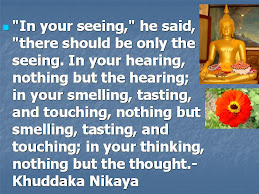
If you see an object just as an object, if you hear a sound just as a sound...(apply the same to the other senses) without "feeding" them to the mind too much...with practice the "grasp"* gets weaker and eventually you cling no more to this "world."** Then you are free. This is the end of suffering.
* grasping here is the craving (see lables)
**world here is the six senses (see labels)
Thursday, March 18, 2010
How does "The Noble Eightfold Path" becomes an integral part of the meditator...

Reality as it is becomes the right view of the meditator. Thinking of it as it is becomes the right thought. Awareness of it as it is becomes the right awareness. Concentration on it as it is becomes the right concentration. Actions of the body and speech* are then aligned to reality as it is. In this way the meditator develops and is fulfilled.
- Majjhima Nikaya
It is amazing to see how "The Noble Eightfold Path" becomes an integral part of the meditator...
1. Right View
2. Right Intention (Translated as "Right Thought" above)
3. Right Speech
4. Right Action
5. Right Livelihood
6. Right Effort
7. Right Mindfulness (Translated as "Right Awareness" above)
8. Right Concentration
*Actions of the body and speech are # 3, 4, 5, and 6
Saturday, March 6, 2010
He disperses all delusion -- as the rising of the sun, the dark
Greed provokes the mind.
People don't realize itas a danger born from within.
A person, when greedy,doesn't know his own welfare;
when greedy,
doesn't see Dhamma.
Overcome with greed,
he's in the dark, blind.
But when one, abandoning greed,
feels no greed
Aversion causes harm.
Aversion provokes the mind.
People don't realize itas a danger born from within.
A person, when aversive,
doesn't know his own welfare;
when aversive,
doesn't see Dhamma.
Overcome with aversionhe's in the dark, blind.
But when one, abandoning aversion,
feels no aversion
aversion drops away from him -- like a palm leaf from its stem.
Delusion causes harm.
Delusion provokes the mind.
People don't realize itas a danger born from within.
A person, when deluded,doesn't know his own welfare;
when deluded,
doesn't see Dhamma.
Overcome with delusionhe's in the dark, blind.
But when one, abandoning delusion,
feels no delusion
he disperses all delusion -- as the rising of the sun, the dark.
Monday, March 1, 2010
The body you cannot recycle but the mind...
Saturday, February 27, 2010
Lay down this "burden"...

Even for a moment if we can lay down this "burden," the five aggregates, we can be free from dukka. However as these moments pass we are back in the samsara as our six senses continue to generate this burden with the help of our craving as it's main fuel. With insight gained through practice if we can somehow cut off this fuel completely, we then can lay this burden down forever and can be free dukka and from this samsara.
Friday, February 19, 2010
"Buddhism teaches that a craving for things outside ourselves causes an unhappy pointless search for security"- Tiger Woods

"Buddhism teaches that a craving for things outside ourselves causes an unhappy pointless search for security," Woods said, adding that he had drifted from the teachings in recent years. "It teaches me to stop following every impulse and to learn restraint. Obviously, I lost track of what I was taught."
-Tiger Woods, 19th February, 2010
http://newsblogs.chicagotribune.com/religion_theseeker/2010/02/tiger-woods-talks-of-return-to-golf-buddhism-.html
newsblogs.chicagotribune.com
Thursday, February 18, 2010
How does a monk know moderation in eating?

"There is the case where a monk, considering it appropriately, takes his food not playfully, nor for intoxication, nor for putting on bulk, nor for beautification, but simply for the survival & continuance of this body, for ending its afflictions, for the support of the holy life, thinking, 'I will destroy old feelings [of hunger] & not create new feelings [from overeating]. Thus I will maintain myself, be blameless, & live in comfort.' This is how a monk knows moderation in eating."
How does a monk guard the doors to his sense faculties?

"There is the case where a monk, on seeing a form with the eye, does not grasp at any theme or variations by which — if he were to dwell without restraint over the faculty of the eye — evil, unskillful qualities such as greed or distress might assail him. He practices with restraint. He guards the faculty of the eye. He achieves restraint with regard to the faculty of the eye.
"On hearing a sound with the ear...
"On smelling an aroma with the nose...
"On tasting a flavor with the tongue...
"On feeling a tactile sensation with the body...
"On cognizing an idea with the intellect, he does not grasp at any theme or variations by which — if he were to dwell without restraint over the faculty of the intellect — evil, unskillful qualities such as greed or distress might assail him. He practices with restraint. He guards the faculty of the intellect. He achieves restraint with regard to the faculty of the intellect. This is how a monk guards the doors to his sense faculties.
http://www.accesstoinsight.org/tipitaka/an/an04/an04.037.than.html
Sunday, February 7, 2010
All about the mind...

Saturday, February 6, 2010
The tears you have shed...

What do you think, monks: Which is greater, the tears you have shed while transmigrating & wandering this long, long time (samsara) — crying & weeping from being joined with what is displeasing, being separated from what is pleasing — or the water in the four great oceans?"
"As we understand the Dhamma taught to us by the Blessed One, this is the greater: the tears we have shed while transmigrating & wandering this long, long time (samsara) — crying & weeping from being joined with what is displeasing, being separated from what is pleasing — not the water in the four great oceans."
"Excellent, monks. Excellent. It is excellent that you thus understand the Dhamma taught by me.
"This is the greater: the tears you have shed while transmigrating & wandering this long, long time (samsara) — crying & weeping from being joined with what is displeasing, being separated from what is pleasing — not the water in the four great oceans.
Assu Sutta: Tears
translated from the Pali by
Thanissaro Bhikkhu
http://www.accesstoinsight.org/tipitaka/sn/sn15/sn15.003.than.html
Friday, January 29, 2010
Just like a cloth, dirty & stained...

"Just like a cloth, dirty & stained: Its owners give it over to a washerman, who scrubs it with salt earth or lye or cow-dung and then rinses it in clear water. Now even though the cloth is clean & spotless, it still has a lingering residual scent of salt earth or lye or cow-dung. The washerman gives it to the owners, the owners put it away in a scent-infused wicker hamper, and its lingering residual scent of salt earth, lye, or cow-dung is fully obliterated.
"In the same way, friends, even though a noble disciple has abandoned the five lower fetters (see labels), he still has with regard to the five clinging-aggregates (see labels) a lingering residual 'I am' conceit, an 'I am' desire, an 'I am' obsession. But at a later time he keeps focusing on the phenomena of arising & passing away with regard to the five clinging-aggregates: 'Such is form, such its origin, such its disappearance. Such is feeling... Such is perception... Such are fabrications... Such is consciousness, such its origin, such its disappearance.' As he keeps focusing on the arising & passing away of these five clinging-aggregates, the lingering residual 'I am' conceit, 'I am' desire, 'I am' obsession is fully obliterated."
Khemaka Sutta: About Khemaka
translated from the Pali by
Thanissaro Bhikkhu
Sunk in confusion

Staying attached to the cave, covered heavily over,1 a person sunk in confusion is far from seclusion — for sensual pleasures sensual desires2 in the world are not lightly let go.

.....Doing nothing for which he himself would rebuke himself, the enlightened person doesn't adhere to what's seen, to what's heard. Comprehending perception, he'd cross over the flood — the sage not stuck on possessions. Then, with arrow removed, living heedfully, he longs for neither — this world, the next.
Guhatthaka Sutta: The Cave of the Body
translated from the Pali by
Thanissaro Bhikkhu
Saturday, January 23, 2010
The body is a nest of...
Friday, January 22, 2010
The Earth Property...

"And what is the earth property?
The earth property can be either internal or external.
"Now there comes a time, friends, when the external liquid property is provoked (see the post below), and at that time the external earth property vanishes. So when even in the external earth property — so vast — inconstancy will be discerned, destructibility will be discerned, a tendency to decay will be discerned, changeability will be discerned, then what in this short-lasting body, sustained by clinging, is 'I' or 'mine' or 'what I am'? It has here only a 'no.'
Maha-hatthipadopama Sutta: The Great Elephant Footprint Simile
translated from the Pali by
Thanissaro Bhikkhu
The Liquid Property...
The Liquid Property
"And what is the liquid property?
The liquid property may be either internal or external.
What is the internal liquid property?
Whatever internal, belonging to oneself, is liquid, watery, & sustained: bile, phlegm, pus, blood, sweat, fat, tears, skin-oil, saliva, mucus, fluid in the joints, urine, or whatever else internal, within oneself, is liquid, watery, & sustained: This is called the internal liquid property. Now both the internal liquid property and the external liquid property are simply liquid property. And that should be seen as it actually is present with right discernment: 'This is not mine, this is not me, this is not my self.' When one sees it thus as it actually is present with right discernment, one becomes disenchanted with the liquid property and makes the mind dispassionate toward the liquid property.
"Now there comes a time, friends, when the external liquid property is provoked and washes away village, town, city, district, & country. There comes a time when the water in the great ocean drops down one hundred leagues, two hundred... three hundred... four hundred... five hundred... six hundred... seven hundred leagues. There comes a time when the water in the great ocean stands seven palm-trees deep, six... five... four... three... two palm-trees deep, one palm-tree deep. There comes a time when the water in the great ocean stands seven fathoms deep, six... five... four... three... two fathoms deep, one fathom deep. There comes a time when the water in the great ocean stands half a fathom deep, hip-deep, knee-deep, ankle deep. There comes a time when the water in the great ocean is not even the depth of the first joint of a finger.
"So when even in the external liquid property — so vast — inconstancy will be discerned, destructibility will be discerned, a tendency to decay will be discerned, changeability will be discerned, then what in this short-lasting body, sustained by clinging, is 'I' or 'mine' or 'what I am'? It has here only a 'no.'
Maha-hatthipadopama Sutta: The Great Elephant Footprint Simile
Thursday, December 17, 2009
How to maintain one's livelihood in tune...
"And what does it mean to maintain one's livelihood in tune? There is the case where a lay person, knowing the income and outflow of his wealth, maintains a livelihood in tune, neither a spendthrift nor a penny-pincher, [thinking], 'Thus will my income exceed my outflow, and my outflow will not exceed my income.' Just as when a weigher or his apprentice, when holding the scales, knows, 'It has tipped down so much or has tipped up so much,' in the same way, the lay person, knowing the income and outflow of his wealth, maintains a livelihood in tune, neither a spendthrift nor a penny-pincher, [thinking], 'Thus will my income exceed my outflow, and my outflow will not exceed my income.' If a lay person has a small income but maintains a grand livelihood, it will be rumored of him, 'This clansman devours his wealth like a fruit-tree eater*.'If a lay person has a large income but maintains a miserable livelihood, it will be rumored of him, 'This clansman will die of starvation.' But when a lay person, knowing the income and outflow of his wealth, maintains a livelihood in tune, neither a spendthrift nor a penny-pincher, [thinking], 'Thus will my income exceed my outflow, and my outflow will not exceed my income,' this is call maintaining one's livelihood in tune.
AN 8.54
* one who shakes more fruit off a tree than he can possibly eat.
Sunday, December 13, 2009
Just like a horse trainer trains his horses....

Then Kesi the horsetrainer went to the Blessed One and, on arrival, having bowed down, sat to one side. As he was sitting there, the Blessed One said to him: "You, Kesi, are a trained man, a trainer of tamable horses. And how do you train a tamable horse?"
"Lord, I train a tamable horse [sometimes] with gentleness, [sometimes] with harshness,[sometimes] with both gentleness & harshness."
"And if a tamable horse does not submit either to a mild training or to a harsh training or to a mild & harsh training, Kesi, what do you do?"
"If a tamable horse does not submit either to a mild training or to a harsh training or to a mild and harsh training, lord, then I kill it.
Why is that? [I think:] 'Don't let this be a disgrace to my lineage of teachers.' But the Blessed One, lord, is the unexcelled trainer of tamable people. How do you train a tamable person?"
"Kesi, I train a tamable person [sometimes] with gentleness, [sometimes] with harshness, [sometimes] with both gentleness & harshness.
"In using gentleness, [I teach:] 'Such is good bodily conduct. Such is the result of good bodily conduct. Such is good verbal conduct. Such is the result of good verbal conduct. Such is good mental conduct. Such is the result of good mental conduct. Such are the devas. Such are human beings.'
"In using harshness, [I teach:] 'Such is bodily misconduct. Such is the result of bodily misconduct. Such is verbal misconduct. Such is the result of verbal misconduct. Such is mental misconduct. Such is the result of mental misconduct. Such is hell. Such is the animal womb. Such the realm of the hungry shades.'
"In using gentleness & harshness, [I teach:] 'Such is good bodily conduct. Such is the result of good bodily conduct. Such is bodily misconduct. Such is the result of bodily misconduct. Such is good verbal conduct. Such is the result of good verbal conduct. Such is verbal misconduct. Such is the result of verbal misconduct. Such is good mental conduct. Such is the result of good mental conduct. Such is mental miscondut. Such is the result of mental misconduct. Such are the devas. Such are human beings. Such is hell. Such is the animal womb. Such the realm of the hungry shades.'"
"And if a tamable person does not submit either to a mild training or to a harsh training or to a mild & harsh training, what do you do?"
"If a tamable person does not submit either to a mild training or to a harsh training or to a mild & harsh training, then I kill him*, Kesi."
"But it's not proper for our Blessed One to take life! And yet the Blessed One just said, 'I kill him, Kesi.'"
"It is true, Kesi, that it's not proper for a Tathagata to take life. But if a tamable person does not submit either to a mild training or to a harsh training or to a mild & harsh training, then the Tathagata does not regard him as being worth speaking to or admonishing. His knowledgeable fellows in the holy life do not regard him as being worth speaking to or admonishing*. This is what it means to be totally destroyed in the Doctrine & Discipline, when the Tathagata does not regard one as being worth speaking to or admonishing, and one's knowledgeable fellows in the holy life do not regard one as being worth speaking to or admonishing."
"Yes, lord, wouldn't one be totally destroyed if the Tathagata does not regard one as being worth speaking to or admonishing, and one's knowledgeable fellows in the holy life do not regard one as being worth speaking to or admonishing!
"Magnificent, lord! Magnificent! Just as if he were to place upright what was overturned, to reveal what was hidden, to show the way to one who was lost, or to carry a lamp into the dark so that those with eyes could see forms, in the same way has the Blessed One — through many lines of reasoning — made the Dhamma clear. I go to the Blessed One for refuge, to the Dhamma, and to the community of monks. May the Blessed One remember me as a lay follower who has gone to him for refuge, from this day forward, for life."
These are the four unconjecturables...

"There are these four unconjecturables that are not to be conjectured about, that would bring madness & vexation to anyone who conjectured about them.
Which four?
1. "The Buddha-range of the Buddhas1 is an unconjecturable that is not to be conjectured about, that would bring madness & vexation to anyone who conjectured about it.
2. "The jhana-range of a person in jhana...2
3. "The [precise working out of the] results of kamma...
4. "Conjecture about [the origin, etc., of] the world is an unconjecturable that is not to be conjectured about, that would bring madness & vexation to anyone who conjectured about it.
"These are the four unconjecturables that are not to be conjectured about, that would bring madness & vexation to anyone who conjectured about them."
http://www.accesstoinsight.org/tipitaka/an/an04/an04.077.than.html
1. I.e., the range of powers a Buddha develops as a result of becoming a Buddha.
- 2. I.e., the range of powers that one may obtain while absorbed in jhana.