Showing posts with label sensory restrains. Show all posts

Wednesday, September 21, 2011

How smell rules your life


The unsung sense: How smell rules your life - life - 19 September 2011 - New Scientist

..."What's more, it is becoming clear that the brain's olfactory centres are intimately linked to its limbic system, which is involved in emotion, fear and memory. That suggests a link between smell and the way we think..."


Here is an extract from my model...

"...Sense consciousness from eye, ear,nose, tongue, body end up in the mind as a mental object..."

"...There are also thoughts that can be retrieved from memory in mind consciousness back into the mind. Mind consciousness may leave imprints of your past memory as sort of "auto save copy" in memory of your computer. The past memory in turn can influence your feelings, perceptions and thoughts."

Monday, June 27, 2011

The "real pirates" of the mind


Imagine there is an anchored ship that is about to be hijacked by pirates. There are six pirate ships competing against each other to hijack the ship and bring it to their respective island. If the ship is not anchored well, it will be hijacked by the strongest pirate ship. However, if the ship is anchored very well the pirate ships are going to get exhausted and will eventually give up.

This is like what happens when we sit to meditate. If you do not anchor your breath well to the your whole body (breath fully immersed in the body*) your senses will "hijack" you. The ear may "hijack" you to the sound. Alternatively, our mind will "hijack" you to ideas (thoughts). The same may apply to the other senses too.
** Whatever the strongest sense may be, it will hijack the perception of your breath. If you anchor the breath to your body strongly enough, eventually the senses will give up. This is one of the tasks in the early stages of breath meditation.

Buddha used a beautiful simile on this about the
six animals in Chappana Sutta -The Six Animals.

Thanissaro Bhikkhu explains this well in few of his talks. Here are some links:Mind on a leash, The Breath All the Way (16 Steps), Breath Training, Animals in the Mind

*The breath "anchored" to whole body (breath fully immersed in the body)
In Buddhas words:
"He trains himself, 'I will breathe in sensitive to the entire body.' He trains himself, 'I will breathe out sensitive to the entire body."
"'Experiencing the whole body, I shall breathe in,' thinking thus, he trains himself. 'Experiencing the whole body, I shall breathe out,' thinking thus, he trains himself."

**In formal sitting breath meditation usually mind/ideas, ears/sounds, nose/smells and body/sensations will distracts you the most as your eyes are closed (no eyes/objects) and there is no activity of the tongue/tastes. However in usual day to day life activities too we could apply this method of anchoring the breath when we are challenged with our senses, to prevent the mind getting agitated or stressed. Perhaps we already use this method instinctively without any formal training by "taking a deep breath" when we are stressed. However if you train yourself with formal breath meditation it will be much easier to anchor senses to the breath, restraining the senses and ultimately calming the mind more effectively.

Thursday, November 4, 2010

What is the origination and the ending of the "World"?

Figure 1


Figure 2 (model #1)


Figure 3 (model #2)


Today I found an excellent sutta that supports our "mind works" model.

This is how the sutta starts:

Buddha:

"I will teach you the origination of the world & the ending of the world.

1. "What is the origination of the world?"

Dependent on the eye & (object)forms there arises eye-consciousness. The meeting of the three is contact. From contact as a requisite condition comes feeling. From feeling as a requisite condition comes craving. From craving as a requisite condition comes clinging/sustenance. From clinging/sustenance as a requisite condition comes becoming. From becoming as a requisite condition comes birth. From birth as a requisite condition, then aging & death, sorrow, lamentation, pain, distress, & despair come into play. This is the origination of the world.

The same applies to other senses too...

"Dependent on the ear & sounds there arises ear-consciousness. The meeting of the three is contact... Dependent on the nose & aromas there arises nose-consciousness. The meeting of the three is contact... Dependent on the tongue & flavors there arises tongue-consciousness. The meeting of the three is contact... Dependent on the body & tactile sensations there arises body-consciousness. The meeting of the three is contact... Dependent on the intellect & mental qualities there arises intellect-consciousness. The meeting of the three is contact. From contact as a requisite condition comes feeling. From feeling as a requisite condition comes craving. From craving as a requisite condition comes clinging/sustenance. From clinging/sustenance as a requisite condition comes becoming. From becoming as a requisite condition comes birth. From birth as a requisite condition, then aging & death, sorrow, lamentation, pain, distress, & despair come into play. This is the origination of the world.

This passage from the sutta basically confirms the vertical flow of our "mind works" model #1 in Figure 2. The unwise attention is an addition step I added on purpose to show the step where we go wrong and how we can fix it. The "world" here is referred to our six sensors (figure 1). It is not the physical world what we normally refer to as the world. Through the six senses we communicate with the connect external things around us. Therefore this is our sensory world. The Buddha sometimes called the six senses the "ALL".

Pleas read these posts to learn more about this:

When the eye meet an object...

Not seeing how the six senses work, we recycle ourselves in the samsara.

2. What is the ending of the world?

Dependent on the eye & forms there arises eye-consciousness. The meeting of the three is contact. From contact as a requisite condition comes feeling. From feeling as a requisite condition comes craving. Now, from the remainder-less cessation & fading away of that very craving comes the cessation of clinging/sustenance. From the cessation of clinging/sustenance comes the cessation of becoming. From the cessation of becoming comes the cessation of birth. From the cessation of birth, then aging & death, sorrow, lamentation, pain, distress, & despair all cease. Such is the cessation of this entire mass of stress & suffering. This is the ending of the world.

The same applies to other senses too...

"Dependent on the ear & sounds there arises ear-consciousness. The meeting of the three is contact... Dependent on the nose & aromas there arises nose-consciousness. The meeting of the three is contact... Dependent on the tongue & flavors there arises tongue-consciousness. The meeting of the three is contact... Dependent on the body & tactile sensations there arises body-consciousness. The meeting of the three is contact... Dependent on the intellect & mental qualities there arises intellect-consciousness. The meeting of the three is contact. From contact as a requisite condition comes feeling. From feeling as a requisite condition comes craving. Now, from the remainder-less cessation & fading away of that very craving comes the cessation of clinging/sustenance. From the cessation of clinging/sustenance comes the cessation of becoming. From the cessation of becoming comes the cessation of birth. From the cessation of birth, then aging & death, sorrow, lamentation, pain, distress, & despair all cease. Such is the cessation of this entire mass of stress & suffering. This is the ending of the world."

The ending of the world mean no more birth. The end of suffering. The ultimate bliss. The Nirvana. No more birth of the six senses.

This passage from this sutta basically confirms the vertical flow of our "mind works" model Model#2 in Figure 3. The The Foundations of Mindfulness: (Satipatthana Sutta) , the contemplation of the body (kayanupassana), feeling (vedananupassana), mind (cittanupassana), and mental objects (dhammanupassana) which is shown in yellow bubbles in the flow chart (Figure 2), is the training and will enable us to see things clearly. With wise attention (Yoniso manasikara), an addition step I added in my model is to show the point of we can now contemplate on The Three Characteristics (ti-lakkha.na), Impermanence (Anicca), Suffering or Unsatisfactoriness (dukkha) and Not-self or Insubstantiality (anattaa) and this is the is final common pathway of contemplation of insight. The craving is completely destroyed by by insight or vipassana meditation.

To read the full sutta
Loka Sutta: The World
translated from the Pali by
Thanissaro Bhikkhu

Another sutta witha a similar theme:

Loka Sutta: The World

Monday, October 4, 2010

Cling to this world no more...


The key is to realize everything you see, hear, smell, taste, touch, and think is subject to change, unsatisfactory, and does not belong to you. Feeling is still present, but craving does not arise. This way you cling to this world no more.

Tuesday, August 17, 2010

Just as when a peak-roofed house is poorly roofed...


"Householder, when the mind is unprotected, bodily actions are unprotected as well, verbal actions are unprotected as well, mental actions are unprotected as well. When one's bodily actions, verbal actions, & mental actions are unprotected, one's bodily actions get soggy, one's verbal actions get soggy, one's mental actions get soggy.

When one's bodily actions, verbal actions, & mental actions are soggy, one's bodily actions... verbal actions... mental actions rot. When one's bodily actions, verbal actions, & mental actions rot, one's death is not auspicious, the mode of one's dying not good.

"Just as when a peak-roofed house is poorly roofed: The peak of the roof is unprotected, the roof beams are unprotected, the walls are unprotected. The peak of the roof... the roof beams... the walls get soggy. The peak of the roof... the roof beams... the walls then rot.

Saturday, August 14, 2010

Four courses of action...


1. There is the course of action that is unpleasant to do and that, when done, leads to what is unprofitable (not worth doing for both reasons).

2. There is the course of action that is unpleasant to do but that, when done, leads to what is profitable (Wise after reflecting will do it, fool will not reflect and will not do it).

3. There is the course of action that is pleasant to do but that, when done, leads to what is unprofitable (Wise after reflecting will not do it, fool will not reflect and will do it).

4. There is the course of action that is pleasant to do and that, when done, leads to what is profitable (worth doing for both reasons).


AN 4.115
PTS: A ii 118
Thana Sutta: Courses of Action
translated from the Pali by
Thanissaro Bhikkhu


http://www.accesstoinsight.org/tipitaka/an/an04/an04.115.than.html

Reflection of action mind, body and speech is the key difference between the wise and the fool (better translated as skillful and unskillful). Reflection should ideally be done before, during and after each action)

Please read the post below:What is a mirror for? Reflection. In the same way...

Friday, July 30, 2010

There are these four types of thoroughbred horses...


"There are these four types of excellent thoroughbred horses to be found existing in the world.

1. There is the case where an excellent thoroughbred horse, on seeing the shadow of the goad-stick, is stirred & agitated, [thinking,] 'I wonder what task the trainer will have me do today? What should I do in response?' Some excellent thoroughbred horses are like this. And this is the first type of excellent thoroughbred horse to be found existing in the world.

2. "Then again there is the case where an excellent thoroughbred horse is not stirred & agitated on seeing the shadow of the goad-stick, but when his coat is pricked [with the goad stick] he is stirred & agitated, [thinking,] 'I wonder what task the trainer will have me do today? What should I do in response?' Some excellent thoroughbred horses are like this. And this is the second type of excellent thoroughbred horse to be found existing in the world.

3. "Then again there is the case where an excellent thoroughbred horse is not stirred & agitated on seeing the shadow of the goad-stick, or when his coat is pricked, but when his hide is pricked [with the goad stick] he is stirred & agitated, [thinking,] 'I wonder what task the trainer will have me do today? What should I do in response?' Some excellent thoroughbred horses are like this. And this is the third type of excellent thoroughbred horse to be found existing in the world.

4. "Then again there is the case where an excellent thoroughbred horse is not stirred & agitated on seeing the shadow of the goad-stick, or when his coat is pricked, or when his hide is pricked, but when his bone is pricked [with the goad stick] he is stirred & agitated, [thinking,] 'I wonder what task the trainer will have me do today? What should I do in response?' Some excellent thoroughbred horses are like this. And this is the fourth type of excellent thoroughbred horse to be found existing in the world.

"These are the four types of excellent thoroughbred horse to be found existing in the world.

"Now, there are these four types of excellent thoroughbred persons to be found existing in the world.

1. "There is the case where a certain excellent thoroughbred person hears, 'In that town or village over there a man or woman is in pain or has died.' He is stirred & agitated by that. Stirred, he becomes appropriately resolute. Resolute, he both realizes with his body the highest truth and, having penetrated it with discernment, sees. This type of excellent thoroughbred person, I tell you, is like the excellent thoroughbred horse who, on seeing the shadow of the goad-stick, is stirred & agitated. Some excellent thoroughbred people are like this. And this is the first type of excellent thoroughbred person to be found existing in the world.

2. "Then again there is the case where a certain excellent thoroughbred person does not hear, 'In that town or village over there a man or woman is in pain or has died.' But he himself sees a man or woman in pain or dead. He is stirred & agitated by that. Stirred, he becomes appropriately resolute. Resolute, he both realizes with his body the highest truth and, having penetrated it with discernment, sees. This type of excellent thoroughbred person, I tell you, is like the excellent thoroughbred horse who, when its coat is pricked with the goad-stick, is stirred & agitated. Some excellent thoroughbred people are like this. And this is the second type of excellent thoroughbred person to be found existing in the world.

3. "Then again there is the case where a certain excellent thoroughbred person does not hear, 'In that town or village over there a man or woman is in pain or has died.' And he himself does not see a man or woman in pain or dead. But he sees one of his own blood relatives in pain or dead. He is stirred & agitated by that. Stirred, he becomes appropriately resolute. Resolute, he both realizes with his body the highest truth and, having penetrated it with discernment, sees. This type of excellent thoroughbred person, I tell you, is like the excellent thoroughbred horse who, when its hide is pricked with the goad-stick, is stirred & agitated. Some excellent thoroughbred people are like this. And this is the third type of excellent thoroughbred person to be found existing in the world.

4. "Then again there is the case where a certain excellent thoroughbred person does not hear, 'In that town or village over there a man or woman is in pain or has died.' And he himself does not see a man or woman in pain or dead, nor does he see one of his own blood relatives in pain or dead. But he himself is touched by bodily feelings that are painful, fierce, sharp, wracking, repellent, disagreeable, life-threatening. He is stirred & agitated by that. Stirred, he becomes appropriately resolute. Resolute, he both realizes with his body the highest truth and, having penetrated it with discernment, sees. This type of excellent thoroughbred person, I tell you, is like the excellent thoroughbred horse who, when its bone is pricked with the goad-stick, is stirred & agitated. Some excellent thoroughbred people are like this. And this is the fourth type of excellent thoroughbred person to be found existing in the world.

"These are the four types of excellent thoroughbred persons to be found existing in the world."

Patoda Sutta: The Goad-stick
translated from the Pali by
Thanissaro Bhikkhu
http://www.accesstoinsight.org/tipitaka/an/an04/an04.113.than.html

Saturday, July 17, 2010

One's shelter after death...


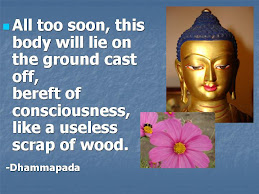
"This world is swept away by AGEING, by ILLNESS, by DEATH."
"With the world thus swept away by aging, illness, & death, any restraint of body, speech, & mind(intellect) practiced here will be one's shelter, cave, island, & refuge after death in the world beyond."


Saturday, June 26, 2010

The eighteen places (6X3) that the mind dwells...


1. Seeing a form via the eye, one explores a form that can act as the basis for pleasant feeling, one explores a form that can act as the basis for unpleasant feeling, one explores a form that can act as the basis for equanimity.

2. Hearing a sound via the ear one explores a sound that can act as the basis for pleasant feeling, one explores a sound that can act as the basis for unpleasant feeling, one explores a sound that can act as the basis for equanimity.

3. Smelling an aroma via the nose, one explores a aroma that can act as the basis for pleasant feeling, one explores a aroma that can act as the basis for unpleasant feeling, one explores a aroma that can act as the basis for equanimity.

4. Tasting a flavor via the tongue, one explores a flavor that can act as the basis for pleasant feeling, one explores a flavor that can act as the basis for unpleasant feeling, one explores a flavor that can act as the basis for equanimity.

5. Feeling a tactile sensation via the body, one explores a sensation that can act as the basis for pleasant feeling, one explores a sensation that can act as the basis for unpleasant feeling, one explores a sensation that can act as the basis for equanimity.

6. Cognizing an idea via the intellect, one explores an idea that can act as the basis for pleasant feeling, one explores an idea that can act as the basis for unpleasant feeling, one explores an idea that can act as the basis for equanimity.

(The idea taken from the sutta below)
Tittha Sutta: Sectarians
translated from the Pali by
Thanissaro Bhikkhu
http://www.accesstoinsight.org/tipitaka/an/an03/an03.061.than.html

Saturday, June 12, 2010

Just like a sappy piece of timber lying in the water...


Suppose there were a wet, sappy piece of timber lying in the water, and a man were to come along with an upper fire-stick, thinking, 'I'll light a fire. I'll produce heat.' Now what do you think? Would he be able to light a fire and produce heat by rubbing the upper fire-stick in the wet, sappy timber lying in the water?"

"No, Master Gotama. Why is that? Because the timber is wet & sappy, and besides it is lying in the water. Eventually the man would reap only his share of weariness & disappointment."


"So it is with any priest or contemplative who does not live withdrawn from sensuality* in body & mind, and whose desire, infatuation, urge, thirst, & fever for sensuality is not relinquished & stilled within** him: Whether or not he feels painful, racking, piercing feelings due to his striving [for Awakening], he is incapable of knowledge, vision, & unexcelled self-awakening."

Note:
* Indulgence in sensuality from out side is compared to water in this simile
** Desire within is compared to the wet sappy timber in this simile

Thursday, March 25, 2010

Cling no more to this "world"...


If you see an object just as an object, if you hear a sound just as a sound...(apply the same to the other senses) without "feeding" them to the mind too much...with practice the "grasp"* gets weaker and eventually you cling no more to this "world."** Then you are free. This is the end of suffering.


* grasping here is the craving (see lables)
**world here is the six senses (see labels)

Monday, March 1, 2010

The body you cannot recycle but the mind...


Our only refuge is the Buddha Dhamma.. Sooner or later we are all going to perish. That is the reality. Body you cannot recycle... But the mind "in good condition" (well trained) can be of good use.

Thursday, February 18, 2010

How does a monk know moderation in eating?


"There is the case where a monk, considering it appropriately, takes his food not playfully, nor for intoxication, nor for putting on bulk, nor for beautification, but simply for the survival & continuance of this body, for ending its afflictions, for the support of the holy life, thinking, 'I will destroy old feelings [of hunger] & not create new feelings [from overeating]. Thus I will maintain myself, be blameless, & live in comfort.' This is how a monk knows moderation in eating."

How does a monk guard the doors to his sense faculties?

"There is the case where a monk, on seeing a form with the eye, does not grasp at any theme or variations by which — if he were to dwell without restraint over the faculty of the eye — evil, unskillful qualities such as greed or distress might assail him. He practices with restraint. He guards the faculty of the eye. He achieves restraint with regard to the faculty of the eye.

"On hearing a sound with the ear...

"On smelling an aroma with the nose...

"On tasting a flavor with the tongue...

"On feeling a tactile sensation with the body...

"On cognizing an idea with the intellect, he does not grasp at any theme or variations by which — if he were to dwell without restraint over the faculty of the intellect — evil, unskillful qualities such as greed or distress might assail him. He practices with restraint. He guards the faculty of the intellect. He achieves restraint with regard to the faculty of the intellect. This is how a monk guards the doors to his sense faculties.

Aparihani Sutta: No Falling Away
translated from the Pali by
Thanissaro Bhikkhu

http://www.accesstoinsight.org/tipitaka/an/an04/an04.037.than.html

Sunday, February 7, 2010

All about the mind...


Like a fish pulled from its home in the water & thrown on land: this mind flips & flaps about to escape Mara's sway.


Hard to hold down, nimble, alighting wherever it likes: the mind. Its taming is good. The mind well-tamed brings ease.


So hard to see, so very, very subtle, alighting wherever it likes: the mind. The wise should guard it. The mind protected brings ease.


Wandering far, going alone, bodiless, lying in a cave: the mind. Those who restrain it: from Mara's bonds they'll be freed.
-Dhammapada

Thursday, December 10, 2009

It's all about coming to our senses..


Suffering is a result of clinging, clinging is a result of craving, craving is a result of feeling, and this all goes back to our senses. If we "come to our senses," our ignorance will be gone. So will be our craving and suffering. We then will be free.

Wednesday, October 7, 2009

Leave that sound alone....


Leave that sound alone...it is not disturbing you but you are disturbing the sound! Leave that object alone...the object is not distracting but you are distracting the object! The same goes to our other senses too.

Friday, August 21, 2009

There is pressure in what we see...


Sure...there is pressure in what we see. This is why we cling to it. This same clinging will lead to our own suffering... at the end. Same goes to our other senses.

Tuesday, August 18, 2009

Just as a man with good eyes.....


"Now how, Ananda, in the discipline of a noble one is there the unexcelled development of the faculties?

There is the case where, when seeing a form with the eye, there arises in a monk what is agreeable, what is disagreeable, what is agreeable & disagreeable. He discerns that 'This agreeable thing has arisen in me, this disagreeable thing... this agreeable & disagreeable thing has arisen in me. And that is compounded, gross, dependently co-arisen. But this is peaceful, this is exquisite, i.e., equanimity.' With that, the arisen agreeable thing... disagreeable thing... agreeable & disagreeable thing ceases, and equanimity takes its stance.

Just as a man with good eyes, having closed them, might open them; or having opened them, might close them, that is how quickly, how rapidly, how easily, no matter what it refers to, the arisen agreeable thing... disagreeable thing... agreeable & disagreeable thing ceases, and equanimity takes its stance. In the discipline of a noble one, this is called the unexcelled development of the faculties with regard to forms cognizable by the eye.


Wednesday, May 6, 2009

Just as a person who is skillful in dressing wounds in the cows...


One who is skillful in looking after a cow herd is also very skillful in dressing wounds in the cows to maintain a healthy cow herd (read the sutta for the other 10 methods and similes).

Just like that...

"How does a monk dress wounds?

There is the case where a monk, on seeing a form with the eye, does not grasp at any theme or details by which — if he were to dwell without restraint over the faculty of the eye — evil, unskillful qualities such as greed or distress might assail him. He practices with restraint. He guards the faculty of the eye. He achieves restraint with regard to the faculty of the eye.

On hearing a sound with the ear... On smelling an odor with the nose... On tasting a flavor with the tongue... On touching a tactile sensation with the body... (same as for the eye)

On cognizing an idea with the intellect, he does not grasp at any theme or details by which — if he were to dwell without restraint over the faculty of the intellect — evil, unskillful qualities such as greed or distress might assail him. He practices with restraint. He guards the faculty of the intellect. He achieves restraint with regard to the faculty of the intellect. This is how a monk dresses wounds.

To read the full sutta:
Gopalaka Sutta
The Cowherd

http://www.accesstoinsight.org/tipitaka/an/an11/an11.018.than.html#eggs