Showing posts with label Meditation. Show all posts

Thursday, September 29, 2011

How to fix your mind?


If your car is broken you cannot fix it unless you know how it works. To know how it works you need to stop the car first, examine and then learn. Working with the mind is the similar to this. You cannot fix your mind (to get rid of greed, hatred and delusion) unless you know how it works. This knowledge or wisdom comes from insight meditation. Stopping the car can be compared breath meditation. This is how you still (concentration) your mind.

Sunday, September 18, 2011

Just as when a carpenter...


"Just as when a carpenter or carpenter's apprentice sees the marks of his fingers or thumb on the handle of his adze but does not know, 'Today my adze handle wore down this much, or yesterday it wore down that much, or the day before yesterday it wore down this much,' still he knows it is worn through when it is worn through. In the same way, when a monk dwells devoting himself to development*, he does not know, 'Today my Taints (effluents) wore down this much, or yesterday they wore down that much, or the day before yesterday they wore down this much,' still he knows they are worn through when they are worn through."

Nava Sutta: The Ship
translated from the Pali by
Thanissaro Bhikkhu

*This is called abandoning taints by developing (bhāvanā pahātabbā) ( Sabbasava sutta).

Internal tranquility through breath meditation will prevent taints of sensuality from arising as there is no room for the senses to be engaged in other activities other than the perception, feeling and directed evaluation (applied and sustained thoughts) of breath. This happen specially after mindfulness of the breath becomes immersed in the body. The metaphor Buddha gave here was the six animals tied to a strong pole in Chappana sutta. In Jhana states too taints of sensuality are abandoned. However taints of becomingmay still exists.

The difference in insight meditation is that thoughts arrive in the mind from six senses but the mind does not give any value to them as seeing them as impermanent, suffering, and not-self. This will not allow thoughts to proliferate any further. Craving does not arise here. The thoughts die in the mind itself without mental proliferations (papañca) generating taints. This method of training finally abandons all taints.

Sunday, April 24, 2011

How meditation might ward off the effects of ageing A study at a US Buddhist retreat suggests eastern relaxation techniques can protect our chromosome


How meditation might ward off the effects of ageing
A study at a US Buddhist retreat suggests eastern relaxation techniques can protect our chromosomes from degenerating
http://www.guardian.co.uk/lifeandstyle/2011/apr/24/meditation-ageing-shamatha-project


How meditation might ward off the effects of ageing

A study at a US Buddhist retreat suggests eastern relaxation techniques can protect our chromosomes from degenerating

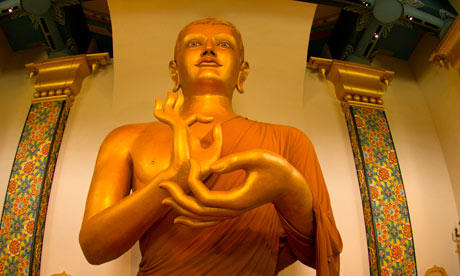
Interior of Great Stupa of Dharmakaya at Shambhala Mountain Center
The Shamatha project took place at Shambhala Mountain Centre in Colorado, USA. Photograph: Blaine Harrington III/Corbis

High in the mountains of northern Colorado, a 100-foot tall tower reaches up through the pinetops. Brightly coloured and strung with garlands, its ornate gold leaf glints in the sun. With a shape that symbolises a giant seated Buddha, this lofty stupa is intended to inspire those on the path to enlightenment.

Visitors here to the Shambhala Mountain Centre meditate in silence for up to 10 hours every day, emulating the lifestyle that monks have chosen for centuries in mountain refuges from India to Japan. But is it doing them any good? For two three-month retreats held in 2007, this haven for the eastern spiritual tradition opened its doors to western science. As attendees pondered the "four immeasurables" of love, compassion, joy and equanimity, a laboratory squeezed into the basement bristled with scientific equipment from brain and heart monitors to video cameras and centrifuges. The aim: to find out exactly what happens to people who meditate.

After several years of number-crunching, data from the so-called Shamatha project is finally starting to be published. So far the research has shown some not hugely surprising psychological and cognitive changes – improvements in perception and wellbeing, for example. But one result in particular has potentially stunning implications: that by protecting caps called telomeres on the ends of our chromosomes, meditation might help to delay the process of ageing.

It's the kind of claim more often associated with pseudoscience. Indeed, since researchers first started studying meditation, with its close links to religion and spirituality, they have had a tough time gaining scientific credibility. "A great danger in the field is that many researchers are also meditators, with a feeling about how powerful and useful these practices are," says Charles Raison, who studies mind-body interactions at Emory University in Atlanta. "There has been a tendency for people to be attempting to prove what they already know."

But a new generation of brain-imaging studies and robust clinical trials is helping to change that. Scientists from a range of fields are starting to compile evidence that rather than simply being a transient mental or spiritual experience, meditation may have long-term implications for physical health.

There are many kinds of meditation, including transcendental meditation, in which you focus on a repetitive mantra, and compassion meditation, which involves extending feelings of love and kindness to fellow living beings. One of the most studied practices is based on the Buddhist concept of mindfulness, or being aware of your own thoughts and surroundings. Buddhists believe it alleviates suffering by making you less caught up in everyday stresses – helping you to appreciate the present instead of continually worrying about the past or planning for the future.

"You pay attention to your own breath," explains Sara Lazar, a neuroscientist who studies the effects of meditation at Massachusetts general hospital in Boston. "If your mind wanders, you don't get discouraged, you notice the thought and think, 'OK'."

Small trials have suggested that such meditation creates more than spiritual calm. Reported physical effects include lowering blood pressure, helping psoriasis to heal, and boosting the immune response in vaccine recipients and cancer patients. In a pilot study in 2008, Willem Kuyken, head of the Mood Disorders Centre at Exeter University, showed that mindfulness meditation was more effective than drug treatment in preventing relapse in patients with recurrent depression. And in 2009, David Creswell of Carnegie Mellon University in Pittsburgh found that it slowed disease progression in patients with HIV.

Most of these trials have involved short courses of meditation aimed at treating specific conditions. The Shamatha project, by contrast, is an attempt to see what a longer, more intensive course of meditation might do for healthy people. The project was co-ordinated by neuroscientist Clifford Saron of the Centre for Mind and Brain at the University of California, Davis. His team advertised in Buddhist publications for people willing to spend three months in an intensive meditation retreat, and chose 60 participants. Half of them attended in the spring of 2007, while the other half acted as a control group before heading off for their own retreat in the autumn.

It sounds simple enough, but the project has taken eight years to organise and is likely to end up costing around $4m (partly funded by private organisations with an interest in meditation, including the Fetzer Institute and the Hershey Family Foundation). As well as shipping laptops all over the world to carry out cognitive tests on the volunteers before the study started, Saron's team built a hi-tech lab in a dorm room beneath the Shambhala centre's main hall, enabling them to subject participants and controls to tests at the beginning, middle and end of each retreat, and worked with "a village" of consulting scientists who each wanted to study different aspects of the meditators' performance. "It's a heroic effort," says neuroscientist Giuseppe Pagnoni, who studies meditation at the University of Modena and Reggio Emilia in Italy.

Many of the tests focused on changes in cognitive ability or regulation of emotions. Soft white caps trailing wires and electrodes measured the meditators' brain waves as they completed gruelling computerised tasks to test their powers of attention, and video recordings captured split-second changes in facial expressions as they watched images of suffering and war.

But psychologist Elissa Epel, from the University of California, San Francisco (UCSF), wanted to know what the retreat was doing to the participants' chromosomes, in particular their telomeres. Telomeres play a key role in the ageing of cells, acting like a clock that limits their lifespan. Every time a cell divides, its telomeres get shorter, unless an enzyme called telomerase builds them back up. When telomeres get too short, a cell can no longer replicate, and ultimately dies.

It's not just an abstract concept. People with shorter telomeres are at greater risk of heart disease, diabetes, obesity, depression and degenerative diseases such as osteoarthritis and osteoporosis. And they die younger.

Epel has been collaborating with UCSF's Elizabeth Blackburn, who shared the 2009 Nobel physiology or medicine prize for her work on telomeres, to investigate whether telomeres are affected by psychological factors. They found that at the end of the retreat, meditators had significantly higher telomerase activity than the control group, suggesting that their telomeres were better protected. The researchers are cautious, but say that in theory this might slow or even reverse cellular ageing. "If the increase in telomerase is sustained long enough," says Epel, "it's logical to infer that this group would develop more stable and possibly longer telomeres over time."

Pagnoni has previously used brain imaging to show that meditation may protect against the cognitive decline that occurs as we age. But the Shamatha project is the first to suggest that meditation plays a role in cellular ageing. If that link is confirmed, he says, "that would be groundbreaking".

So how could focusing on your thoughts have such impressive physical effects? The assumption that meditation simply induces a state of relaxation is "dead wrong", says Raison. Brain-imaging studies suggest that it triggers active processes within the brain, and can cause physical changes to the structure of regions involved in learning, memory, emotion regulation and cognitive processing.

The question of how the immaterial mind affects the material body remains a thorny philosophical problem, but on a practical level, "our understanding of the brain-body dialogue has made jaw-dropping advances in the last decade or two," says Raison. One of the most dramatic links between the mind and health is the physiological pathways that have evolved to respond to stress, and these can explain much about how meditation works.

When the brain detects a threat in our environment, it sends signals to spur the body into action. One example is the "fight or flight" response of the nervous system. When you sense danger, your heart beats faster, you breathe more rapidly, and your pupils dilate. Digestion slows, and fat and glucose are released into the bloodstream to fuel your next move. Another stress response pathway triggers a branch of the immune system known as the inflammatory response.

These responses might help us to run from a mammoth or fight off infection, but they also damage body tissues. In the past, the trade-off for short bursts of stress would have been worthwhile. But in the modern world, these ancient pathways are continually triggered by long-term threats for which they aren't any use, such as debt, work pressures or low social status. "Psychological stress activates these pathways in exactly the same way that infection does," says Raison.

Such chronic stress has devastating effects, putting us at greater risk of a host of diseases including diabetes, cancer, heart disease, depression – and death. It also affects our telomeres. Epel, Blackburn and their colleagues found in 2004 that stressed mothers caring for a chronically ill child had shorter telomeres than mothers with healthy children. Their stress had accelerated the ageing process.

Meditation seems to be effective in changing the way that we respond to external events. After short courses of mindfulness meditation, people produce less of the stress hormone cortisol, and mount a smaller inflammatory response to stress. One study linked meditators' lower stress to changes in the amygdala – a brain area involved in fear and the response to threat.

Some researchers think this is the whole story, because the diseases countered most by meditation are those in which stress plays a major role. But Epel believes that meditation might also trigger "pathways of restoration and enhancement", perhaps boosting the parasympathetic nervous system, which works in opposition to the fight or flight response, or triggering the production of growth hormone.

In terms of the psychological mechanisms involved, Raison thinks that meditation allows people to experience the world as less threatening. "You reinterpret the world as less dangerous, so you don't get as much of a stress reaction," he says. Compassion meditation, for example, may help us to view the world in a more socially connected way. Mindfulness might help people to distance themselves from negative or stressful thoughts.

The Shamatha project used a mix of mindfulness and compassion meditation. The researchers concluded that the meditation affected telomerase by changing the participants' psychological state, which they assessed using questionnaires. Three factors in particular predicted higher telomerase activity at the end of the retreat: increased sense of control (over circumstances or daily life); increased sense of purpose in life; and lower neuroticism (being tense, moody and anxious). The more these improved, the greater the effect on the meditators' telomerase.

For those of us who don't have time for retreats, Epel suggests "mini-meditations" – focusing on breathing or being aware of our surroundings – at regular points throughout the day. And though meditation seems to be a particularly effective route to reducing stress and protecting telomeres, it's not the only one. "Lots of people have no interest in meditation, and that's fine," says Creswell. Exercise has been shown to buffer the effects of stress on telomeres, for example, while stress management programmes and writing emotional diaries can help to delay the progression of HIV.

Indeed, Clifford Saron argues that the psychological changes caused by the Shamatha retreat – increased sense of control and purpose in life – are more important than the meditation itself. Simply doing something we love, whether meditating or gardening, may protect us from stress and maybe even help us to live longer. "The news from this paper is the profound impact of having the opportunity to live your life in a way that you find meaningful."

For a scientific conclusion it sounds scarily spiritual. But researchers warn that in our modern, work-obsessed society we are increasingly living on autopilot, reacting blindly to tweets and emails instead of taking the time to think about what really matters. If we don't give our minds a break from that treadmill, the physical effects can be scarily real.

Thursday, March 24, 2011

Are we really "multi tasking"or is it just another sophisticated function of the mind?


Have you ever wondered having driven the car somewhere, that you don't remember how you got there? While driving you may have listened to music and thought about work. You may have even been chatting on the cell phone. How can one person do all this and drive safely at the same time too? Some people call it ""multi tasking." Are we really multi tasking or is this just a sophisticated way of the function of the mind?

Let us explore this using the mind works model and try to elucidate a mechanism (see the video below)to see how this happens. We will take the eye as an example to keep this simple.


As we have discussed in previous posts when the eye meets an object eye conscious arises. With meeting of the three contact arises. However if we do not make eye consciousness we do not make eye contact. All three factors, the eye, the object and the eye consciousness have to be present to make eye contact.

When we make eye contact there is feeling, perception and mental formations that arises as a result (yellow arrows). The first mental formation (or thought) that arises is the primary cognition and is shown in purple arrows. This is the perception of the object. The thought* that arises as a result is fed back into the mind as a mental object. For example when driving it may be the thought that there is a car in front of you or change in the colour of the traffic light from green to red.

The primary cognition will immediately be followed by secondary cognition which is shown in yellow arrows. This will trigger the second thought.** This is a thought about the object. This is called the directed thought & evaluation. This could be a thought about the car that is stopped in front of you at the red traffic light.

This tertiary cognition that immediately follows the secondary cognition series is a result of an epiphenomenon of the primary cognitive series. Here the feeling about the object from the primary series will influence the perception of the object. This is shown in blue arrows. This thought*** therefore will have feelings about the object in addition to perception. In the driving example it could be an unpleasant feeling about the driver in the car in front, who stopped suddenly at the red light.

Next the quaternary series starts with the mind (green arrows) retrieving previous memory about the object triggered by the thoughts received by the mind. This will now give rise to a mind contact and trigger feeling, perception and mental formation. The resultant mental formation would give rise to another thought about the object. We now have perception, feeling and previous memory about the object. Therefore is a minimum of four cognitive series**** before one recognizes an object in full detail. Interestingly etymology of the word of recognition comes from re-cognizing. This series can follow the same sequence over and over again as long as we keep attention on that object. All thoughts that are generated may give rise to our speech and actions.

The above mechanism looks simple at a superficial level. In real life this is much more complex than this as all six senses bring in sensory information at different times. However it is important to note that only one sensory data of one of the six senses is processed at a given time through the cognitive series. The basic four step cognitive series explained above, taking the eye as an example will be exactly the same for other senses. However the mind is more complex as it receives copies of thoughts from all the other five senses.

So if we think about our six senses as "six channels" in a radio (see link to the previous post below) what we are really doing is like changing channels in a radio in a rapid fashion. These moments of cognition in a series happens at an extremely rapid speed. It has been estimated that there are approximately 8,125 moments in a second. This is a necessary function of the mind to gather information about the surrounding world. It is because of this rapid speed we are able to pick up easily from where we have left off in one channel. We then have a distorted view of a continuous process of events coming from multiple channels that are working at the same time. This we call "multi tasking."

Most of the times we use primary and secondary cognitive series when driving unless it is a complex task. That means we cognize and re-cognize (at least once) each and every event along the way. However we may not remember everything in detail as only the thoughts of primary and secondary cognitive series were used for this function. It is for more complex activities like calling somebody on the cell phone and thinking about the work while driving, we use multiple cognitive series beyond the minimum four cognitive series. In these activities we use multiple thought processes and therefore we remember better.

In mindfulness meditation with insight we train ourselves to be aware of all these channels (please read the post below). We can also examine them using our own mind as "the lab" how they really work. This mindfulness training will help us to be in the present moment with clear awareness. Mindful practice when applied correctly will help us not only to be skillful drivers but also to be skillful and efficient at home and work. We become very skillful in the activities we perform from our mind, body and speech. This will bring peace, contentment and happiness to to our lives.

Notes:

The three types of Sankharas

1. Bodily fabrications/mental formations(kaya sankhara)* The example given in sutta is in and out breathing. This is the thought when the mindfulness of breath is fully immersed in the body.

2. Verbal fabrications/mental formations (vachi sankhara).** This is vitakka-vicāra in Pali or translated to English as applied and sustained thought or directed thought & evaluation.

3. Mental fabrications/formations (citta sankhara).*** These are thoughts of perception and feeling.


The process of cognition**** (the cognitive series) is called citta-vîthi in Pali


Also see the post: Mind is like a "working of a radio".

Monday, March 1, 2010

The body you cannot recycle but the mind...


Our only refuge is the Buddha Dhamma.. Sooner or later we are all going to perish. That is the reality. Body you cannot recycle... But the mind "in good condition" (well trained) can be of good use.

Wednesday, September 9, 2009

Dhamma is like a "GPS" but....


DHAMMA* can be seen as a "GPS" in a car. Having GPS alone will not help us to arrive at the destination. We still have to DRIVE the car safely using "GPS" as our guide. Driving is similar to the PRACTICE of the Dhamma, mainly "Dana" (generosity or giving), "Sila" (morality) and "Bhavana" (meditation).

*DHAMMA: teachings of the Buddha

Sunday, January 18, 2009

Keep riding no matter what...


There is this question that come up again and again. Is attainment of Jhana necessary for enlightenment? Jhana is considered to provide "lubrication" for your vipassana practice.
Can you just practice vipassana ("dry" vipassana) without attainment of Jhana to attain liberation?

There is so much said about in support of both these methods.

This is how I see it.

I guess it does not matter whether your bicycle has lubrication or not the idea is to get on and ride it. May be there is enough lubrication in it from before. May be you may find some lubrication along the way. May be it is very dry but you still can ride it.  You need the right technique. The main thing is to have faith in it, ride it with right effort and mindfulness. You may be delighted to see the most amazing sights traveling along this path you have never seen before. This way you are sure to reach your "destination".

So keep riding no matter what...

In this simile:
ride the bicycle-meditation
lubrication - wet vipassana meditation ( starting with jhanas)
lubrication from before- previous jhana practice (this life or previous lives)
lubrication along the way- attaining stages of enlightenment (stream entry, etc.)
right technique- in accordance with satipattana sutta
1. faith, 2. effort, 3. mindfulness, 4. delighted (joy)/smadhi, 
5. mazing sights/wisdom- The five spiritual faculties
along the path- the noble eightfold path
destination- enlightenment 

Friday, April 11, 2008

The party is cancelled!

Imagine you invite people to a party in your house. Your house has six doors. Unfortunately for some reason you had to cancel the party last minute. You still have to be at the door to tell people the party is cancelled. If you get too involved in long conversations with your guests at one door, you might even get carried away and forget the purpose of meeting people at the door. Subsequently people may enter your house from the other five doors as well. They may not even be your friends you invited, they may overwhelm you and may even cause lots of problems. So what you have to do is to quickly greet the person at the door, explain the situation and swiftly move to the other guests as soon as they appear at that door. If you are very mindful and work hard you may be able to keep your house free from all the guests.

This is something like what you do in vipassana meditation. The house is your mind. The six doors are your six senses. Greeting people at the door is similar to the six senses meeting their respective stimuli. Talking to your guests at each door and not letting them in is like reflecting on the impermanence, suffering, and non-self nature of this process and letting them go. The same way you keep your house free from trouble as in the above metaphor, you can keep your mind free from suffering during meditation.

Note: This metaphor about the house was originally taken from one of Ajahn Chah's books. I have slightly modified it here.

Sunday, January 6, 2008

Train this monkey !"


"Imagine a room with five windows. There is a monkey in the middle of this room. This monkey is constantly jumping form one window to another, in order to communicate with the world outside. Train this monkey !"


Note:
This simile was originally taken from a Theragatha.
In this simile, the monkey is the mind (internal sense) and the five windows are the eyes, the ears, the nose, the tongue, and the body (external senses). Training the monkey is the practice of meditation.

Friday, November 23, 2007

How can meditation help you?


The benefits of meditation have been discussed in previous posts (see below). In this post I have attached two articles that may interest you.

How to Get Smarter, One Breath at a Time
Tuesday, Jan. 10, 2006 How to Get Smarter, One Breath at a TimeBy Lisa Takeuchi Cullen

At 4:30, when most of Wall Street is winding down, Walter Zimmermann begins a high-stakes, high-wire act conducted live before a paying audience. About 200 institutional investors—including airlines and oil companies—shell out up to $3,000 a month to catch his daily webcast on the volatile energy markets, a performance that can move hundreds of millions of dollars. "I'm not paid to be wrong—I can tell you that," Zimmermann says. But as he clicks through dozens of screens and graphics on three computers, he's the picture of focused calm. Zimmermann, 54, watched most of his peers in energy futures burn out long ago. He attributes his brain's enduring sharpness not to an intravenous espresso drip but to 40 minutes of meditation each morning and evening. The practice, he says, helps him maintain the clarity he needs for quick, insightful analysis—even approaching happy hour. "Meditation," he says, "is my secret weapon."Everyone around the water cooler knows that meditation reduces stress. But with the aid of advanced brainscanning technology, researchers are beginning to show that meditation directly affects the function and structure of the brain, changing it in ways that appear to increase attention span, sharpen focus and improve memory.One recent study found evidence that the daily practice of meditation thickened the parts of the brain's cerebral cortex responsible for decision making, attention and memory. Sara Lazar, a research scientist at Massachusetts General Hospital, presented preliminary results last November that showed that the gray matter of 20 men and women who meditated for just 40 minutes a day was thicker than that of people who did not. Unlike in previous studies focusing on Buddhist monks, the subjects were Boston-area workers practicing a Western-style of meditation called mindfulness or insight meditation. "We showed for the first time that you don't have to do it all day for similar results," says Lazar. What's more, her research suggests that meditation may slow the natural thinning of that section of the cortex that occurs with age.The forms of meditation Lazar and other scientists are studying involve focusing on an image or sound or on one's breathing. Though deceptively simple, the practice seems to exercise the parts of the brain that help us pay attention. "Attention is the key to learning, and meditation helps you voluntarily regulate it," says Richard Davidson, director of the Laboratory for Affective Neuroscience at the University of Wisconsin. Since 1992, he has collaborated with the Dalai Lama to study the brains of Tibetan monks, whom he calls "the Olympic athletes of meditation." Using caps with electrical sensors placed on the monks' heads, Davidson has picked up unusually powerful gamma waves that are better synchronized in the Tibetans than they are in novice meditators. Studies have linked this gamma-wave synchrony to increased awareness.Many people who meditate claim the practice restores their energy, allowing them to perform better at tasks that require attention and concentration. If so, wouldn't a midday nap work just as well? No, says Bruce O'Hara, associate professor of biology at the University of Kentucky. In a study to be published this year, he had college students either meditate, sleep or watch TV. Then he tested them for what psychologists call psychomotor vigilance, asking them to hit a button when a light flashed on a screen. Those who had been taught to meditate performed 10% better—"a huge jump, statistically speaking," says O'Hara. Those who snoozed did significantly worse. "What it means," O'Hara theorizes, "is that meditation may restore synapses, much like sleep but without the initial grogginess."Not surprisingly, given those results, a growing number of corporations—including Deutsche Bank, Google and Hughes Aircraft—offer meditation classes to their workers. Jeffrey Abramson, CEO of Tower Co., a Washington-based development firm, says 75% of his staff attend free classes in transcendental meditation. Making employees sharper is only one benefit; studies say meditation also improves productivity, in large part by preventing stress-related illness and reducing absenteeism.Another benefit for employers: meditation seems to help regulate emotions, which in turn helps people get along. "One of the most important domains meditation acts upon is emotional intelligence—a set of skills far more consequential for life success than cognitive intelligence," says Davidson. So, for a New Year's resolution that can pay big dividends at home and at the office, try this: just breathe.

Find this article at:http://www.time.com/time/magazine/article/0,9171,1147167,00.html


"The Biology of Joy"

Sunday, Jan. 09, 2005The Biology of JoyBy MICHAEL D. LEMONICK

Richard Davidson was in a lab observing a Buddhist Monk Sink deep into serene meditation when he noticed something that sent his own pulse racing. Davidson, a professor of psychology and psychiatry at the University of Wisconsin, hurriedly double-checked the data streaming to his computer from electrodes attached to the monk's skull, but there was no mistake. Electrical activity in the left prefrontal lobe of the monk's brain was shooting up at a tremendous rate. "It was exciting," Davidson recalls. "We didn't expect to see anything quite that dramatic."Davidson's excitement is all the more significant because he's known by colleagues as the king of happiness research. When he made the discovery five years ago, he had been studying the link between prefrontal-lobe activity and the sort of bliss deep meditators experience. But even for someone with his experience, watching the brain crackle with activity as a person entered a trancelike state was unprecedented. It made clear, says Davidson, who published the research study in the Proceedings of the National Academy of Sciences last fall, that happiness isn't just a vague, ineffable feeling; it's a physical state of the brain--one that you can induce deliberately.That's not all. As researchers have gained an understanding of the physical characteristics of a happy brain, they have come to see that those traitshave a powerful influence on the rest of the body. People who rate in the upper reaches of happiness on psychological tests develop about 50% more antibodies than average in response to flu vaccines, and that, says Davidson, "is a very large difference." Others have discovered that happiness or related mental states like hopefulness, optimism and contentment appear to reduce the risk or limit the severity of cardiovascular disease, pulmonary disease, diabetes, hypertension, colds and upper-respiratory infections as well. According to a Dutch study of elderly patients published in November, those upbeat mental states reduced an individual's risk of death 50% over the study's nine-year duration. Says Laura Kubzansky, a health psychologist at Harvard's School of Public Health, in a masterpiece of understatement: "There's clearly some kind of effect."It makes sense that there should be. Doctors have known for years that clinical depression--the extreme opposite of happiness--can worsen heart disease, diabetes and a host of other illnesses. But the neurochemistry of depression is much better known than that of happiness, mostly because the former has been studied more intensively and for much longer. Until about a decade ago, says Dacher Keltner, a psychologist at the University of California, Berkeley, "90% of emotion research focused on the negative, so there still are all of these interesting questions about the positive state."A growing number of researchers exploring the physiology and neurology of happiness are starting to answer those questions. Perhaps most fundamental of all is what happiness is, in a clinical sense. At this point, nobody can really say with precision. The word happiness, Davidson observes, "is kind of a placeholder for a constellation of positive emotional states. It's a state of well-being where individuals are typically not motivated to change their state. They're motivated to preserve it. It's associated with an active embracing of the world, but the precise characteristics and boundaries have really yet to be seriously characterized in scientific research."Still, subjects can reliably tell researchers when they're feeling good, and two brain-imaging technologies--functional magnetic resonance imaging (MRI), which maps blood flow to active parts of the brain, and electroencephalograms, which sense the electrical activity of neuronal circuits--consistently point to the left prefrontal cortex as a prime locus of happiness.That raises the chicken-and-egg question of whether the prefrontal cortex creates the sensation of happiness or whether it merely reflects one's more general emotional state. Davidson thinks the answer is both: "We're confident that this part of the brain is a proximal cause of at least certain kinds of happiness." That suggests some people are genetically predisposed to be happy by virtue of their busy prefrontal cortexes, and research in infants confirms it. Davidson measured left prefrontal activity in babies less than a year old and then subjected them to a test in which their mothers left the room briefly. "Some babies will just cry hysterically the instant the mom leaves," he says. "Others are more resilient." It turns out that the babies with the higher left prefrontal activity are the ones who don't cry. "We were actually able to predict which infants would cry in response to that brief but significant stress."In short, as parents know instinctively, some babies are just born happy. But neuroscientists have also learned over the past decade that the brain is highly plastic. It rewires itself in response to experience, and that's especially true before the age of puberty. One might naively assume, therefore, that negative experiences might destroy a happy personality--and if they're extreme and frequent enough, that might be true. Davidson has learned, however, that mild to moderate doses of negative experience are beneficial. (In animal studies, he compared groups that had been moderately stressed when young to those that never were and found the former better able to recover from stress as adults. In human studies, in which deliberately inducing stress on kids would be unethical, he based his conclusions on self-reported stories of stressful childhoods.) The reason, he believes, is that stressful events give us practice at bouncing back from unpleasant emotions. They're like an exercise to strengthen our happiness muscles or a vaccination against melancholy.Exactly what is the physical difference, though, between a left prefrontal cortex that is predisposed to happiness and one that isn't? It almost certainly has in part to do with neurotransmitters, the chemicals that ferry signals from one neuron to the next. And while the prefrontal cortex is awash in many neurotransmitters, including dopamine, serotonin, glutamate, GABA and more, Davidson believes dopamine may be especially important. Animal studies have shown that dopamine mediates the transfer of signals associated with positive emotions between the left prefrontal area and the emotional centers in the limbic area of the brain, such as the nucleus accumbens, situated within the ventral striatum. In humans, people with a sensitive version of the receptor that accepts dopamine tend to have better moods, and researchers are actively studying the relationship of dopamine levels to feelings of euphoria and depression.Dopamine pathways may be especially important in aspects of happiness associated with moving toward some sort of goal (monks achieving a meditative state as well as cigarette smokers allowed to light up after 24 hours of deprivation). But other neurochemicals may be more central to other kinds of happiness, including physical pleasure. "People have made progress differentiating the positive feeling you get when you approach a goal, which maps onto dopamine, and the sensory pleasure of enjoying something, which maps onto the opioid system," says Berkeley psychologist Keltner. "We're just beginning to apply a lens to all those parts of the nervous system in which the positive emotions are embodied. This is really neat territory."Among those exploring that territory is Brian Knutson, an assistant professor of psychology and neuroscience at Stanford, who, like Davidson, uses MRI to monitor the brains of test subjects. The mental mode he studies is anticipation. "When people think of happiness," says Knutson, "they think of feeling good, but a big part of happiness is also looking forward to something." Knutson's research was inspired by the classic work of Ivan Pavlov, who trained dogs to salivate at the sound of a bell, which they associated with mealtime.Instead of food, Knutson used money: a small cash payoff if subjects won a video game. "When we looked at their brains just before they got the reward," he says, "we saw this spark that clearly had to do with how positive the idea of making money was." The spark showed up not in the left prefrontal cortex but in what Knutson terms an old section, the nucleus accumbens, located in the subcortex, at the bottom of the brain. The bigger the prize, Knutson found, "the more activation." Knutson believes he is looking at the kind of happy feelings we experience as excitement. The primary focus of his work is to understand the neurophysiology of motivation and decision making--how emotion and reason work together as people make choices. But it could also be a key to mapping out the brain's broader happiness circuitry.Understanding the neurophysiology of feeling good is one aspect of happiness research; another is understanding how positive emotion affects the rest of the body. As with the brain studies, the term happiness is too broad for a rigorous approach, so researchers tend to focus on specific aspects. Harvard psychologist Kubzansky has chosen to study optimism. In a large study she tracked 1,300 men for 10 years and found that heart-disease rates among men who called themselves optimistic were half the rates for men who didn't."It was a much bigger effect than we expected," she says--as big as the difference between smokers and nonsmokers. "We also looked at pulmonary function, since poor pulmonary function is predictive of a whole range of bad outcomes, including premature mortality, cardiovascular disease and chronic obstructive pulmonary disease." Again, optimists did much better. "I'm an optimist," she says, "but I didn't expect results like this."In a separate study, meanwhile, which has been accepted by the journal Health Psychology, Kubzansky, working with Duke psychologist and lead researcher Laura Richman, looked at hopefulness and curiosity--mental states that overlap with optimism in some ways. "We found them to be protective against hypertension, diabetes and upper-respiratory infection," she says. Such protective effects may explain the longevity advantage found in that Dutch study of the elderly--an advantage for happy optimists that persisted even when researchers corrected for diet, education and other factors.Exactly how states of mind affect the body's biochemistry is still far from clear. "We can do some good speculation," says Kubzansky, "based on what we know about anxiety and depression, so there are a couple of places to look in terms of neuroendocrine function and immune inflammatory pathways." One clue: in addition to reporting a positive mood when their left prefrontal cortexes are active, subjects in Davidson's experiments have lower levels of cortisol, a hormone produced by the adrenal gland in response to stress--and cortisol is known to depress immune function. Optimists may simply feel less stress than pessimists and thereby avoid the noxious biochemical cascades that stress is known to trigger. Another likely factor: optimistic, happy types seem to take better care of themselves than sad sacks do. Numerous studies--as well as common sense--suggest that to be the case.In a series of studies begun in 1998, psychologist Robert Emmons of the University of California at Davis has found further evidence that happy people are better at health maintenance. Emmons randomly assigned 1,000 adults to one of three groups. The first group kept daily journals of their moods and rated them on a scale of 1 to 6. The second group did that and listed the things that annoyed or hassled them throughout their day. The third group kept a journal but added an activity that has repeatedly been shown to improve one's sense of satisfaction with life: they were asked to write down every day all the things for which they were grateful.Despite being assigned randomly, the last group not only had the predicted jump in their overall feelings of happiness, says Emmons, but were also found to spend more time exercising, be more likely to have regular medical checkups and routinely take preventive health actions like wearing sunscreen. Overall, the "gratitude" group were promoting better health. "They rate themselves as more energetic, more enthusiastic, more alert," Emmons reports. In short, keeping the diaries contributed to their physical and emotional well-being.Not surprisingly, the advantages were greatest when compared with the group that focused on life's hassles. "People who are grateful tend to view their body a certain way," says Emmons. "They see life as a gift, health as a gift. So they want to take certain measures to preserve it." Reminding yourself of what you're grateful for is a technique open to anyone, but more sophisticated methods of manipulating happiness are showing promise as well. Cognitive-behavior therapy and medication, for example, are used mostly to combat depression, but they may also be useful in enhancing happiness.Such positive results gratify happiness researchers, who haven't been very successful in attracting federal dollars. "I could easily see being spoofed on the Senate floor for whatever award they give for esoteric, needless research," says Keltner. "But as the findings trickle in showing that positive emotions and happiness make your immune system function better, or help you battle disease, or help you live longer, then you're into fundable territory." Thanks to Keltner, Davidson and others, those findings have gained the field a degree of respectability that's long overdue--and that ultimately could make all of us a whole lot happier. --Reported by Dan Cray/ Los AngelesWith reporting by Dan Cray/ Los Angeles
Find this article at: http://www.time.com/time/magazine/article/0,9171,1015863,00.html

Time Magazine Articles on Meditation:

The science of Meditation


Neurotheologist is one of Time Magazine’s 100 most influential people

Madison Magazine has named Dr. Davidson as their "Person of the Year" in the November 2007 issue.


Lab for affective Neuroscience, Research in the News


Mindfulness Research Update: 2008
Jeffrey M. Greeson, Ph.D., M.S.

Previous related posts:
How can mindfulness help?
Do like to be the happiest man on earth?
Do you want to increase your brain thickness?
Can Mindfulness Help Cancer Patients ?

Thursday, November 22, 2007

"Why are these two boots tied together"?

Today was the first snow fall in Toronto. It was really bad weather out there with snow and freezing rain. I had to get my new pair of boots out of the box which my wife got for me recently. I realized that the boots were tied together with two elastic bands. I tried to pull them apart but they were very strong and finally a pair of scissors came to my rescue. While I was struggling to remove the two elastic bands pulling the boots apart a beautiful simile came to my mind that was in one of the Buddhist suttas called Kotthita Sutta .


It is about the two cows, one black and the other white. These two cows were tied by a strong rope. They were both walking and pulling each other. It seemed like the white cow was pulling the black one, but at other times it seemed like the black cow was pulling the white one. The question was whether the white cow pulling black cow or the black cow pulling the white cow? The correct answer was, "neither." The rope is pulling both of them. If you cut the rope you can set them both free. Just the same way that I cut the rubber bands of my new boots!

Now what does it teach us? When you see a beautiful object, for example a beautiful car, is the eye attached to the car or the car attached to the eye? The correct answer here is the same as in the simile of two cows. It is neither. So what is this bond between the car and the eye? It is the craving (Taṇhā ), a conditioned concept of our mind. I like to consider this as some sort of mental "super glue." It is not physical bond like the rope as in the simile of the cows. However, if the eye was attached to the object or the object was attached to the eye there would be no chance of us getting enlightened or reaching the ultimate happiness (Nirvāṇa). In the same fashion the "super glue" or the craving will bind the other senses and their respective sensory stimuli. These are the ear to the sound, nose to the smell, tongue to the taste, body to the touch, mind to its mental objects. The six senses and how they work together were discussed in previous posts. (see below).

One might say,"who cares." "Let 'super glue' be there." For example if you see a beautiful car you might say "I like that car and I am going to buy it and enjoy it"! There is absolutely nothing wrong with that. The problem begins when things start to change. As we know all conditioned thing are impermanent, and are subject to change. If for example the car gets old, stolen or meets with an accident, suffering arises. The stronger the glue (attachment or craving) harder the pain and the suffering when things begin to change. This not only applies to objects but also to people or other things around you. You may have already experienced this numerous times in your life. Then you may ask, can I enjoy things and yet not get attached to it? It is almost impossible for us to do this, unless you are fully enlightened. Now the next question is how do we get there? Is it possible to be fully enlightened? Buddha very clearly told his disciples "I will not tell you anything that is not possible to achieve."

So what is enlightenment or Nirvāṇa? The most simple definition is "end of all cravings." This, Buddha said, is the ultimate happiness and end to all the suffering." So how do we get rid of this "super glue" or the craving which is preventing us achieving this goal? There is only one path to this. This is the Noble Eightfold Path, very clearly out lined by the Buddha. This is the path leading to full enlightenment. Now we have to find out how we can get rid of this craving. One way is to contemplate on how our six senses (eye, ear, nose, tongue,body and mind) work together with the external sense objects (object, sound, smell, taste, touch, mental object) and how and where this craving arise. Then you can contemplate on impermanence, suffering, and non-self of these six senses and their external sense objects (see the posts below). If this process is practiced diligently with mindfulness, it will help to slowly get rid of the cravings that arises in them. This is the basis of Vipassana meditation.

So is it possible to get rid of this "super glue" for ever? If you make the right effort and practice the Noble Eightfold Path, it will be within your reach. The fist step in this process is the right view(see the post below). Right view together with the right effort will help us travel this path (this will be discussed in detail in a later post) to reach this ultimate happiness. The beauty of Buddhist teachings is that you don't need to wait till you die to put an end to this suffering. You can reach the goal of ultimate happiness in this very life. One way of knowing that you are travelling that right path is when you get the sense of inner happiness and contentment. This is a good sign of melting of the "super glue!" Then results should be there at the end whether you like it or not, here and now, in this very life.

Related Suttas:
Kotthita Sutta
Salayatana-vibhanga Sutta -An Analysis of the Six Sense-media

Related previous posts: