Showing posts with label MBSR. Show all posts

Sunday, April 24, 2011

How meditation might ward off the effects of ageing A study at a US Buddhist retreat suggests eastern relaxation techniques can protect our chromosome


How meditation might ward off the effects of ageing
A study at a US Buddhist retreat suggests eastern relaxation techniques can protect our chromosomes from degenerating
http://www.guardian.co.uk/lifeandstyle/2011/apr/24/meditation-ageing-shamatha-project


How meditation might ward off the effects of ageing

A study at a US Buddhist retreat suggests eastern relaxation techniques can protect our chromosomes from degenerating

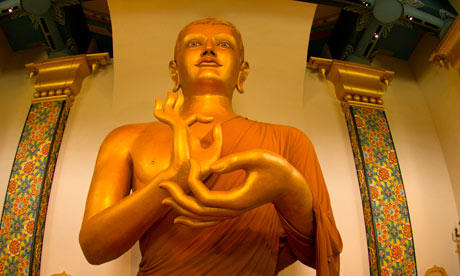
Interior of Great Stupa of Dharmakaya at Shambhala Mountain Center
The Shamatha project took place at Shambhala Mountain Centre in Colorado, USA. Photograph: Blaine Harrington III/Corbis

High in the mountains of northern Colorado, a 100-foot tall tower reaches up through the pinetops. Brightly coloured and strung with garlands, its ornate gold leaf glints in the sun. With a shape that symbolises a giant seated Buddha, this lofty stupa is intended to inspire those on the path to enlightenment.

Visitors here to the Shambhala Mountain Centre meditate in silence for up to 10 hours every day, emulating the lifestyle that monks have chosen for centuries in mountain refuges from India to Japan. But is it doing them any good? For two three-month retreats held in 2007, this haven for the eastern spiritual tradition opened its doors to western science. As attendees pondered the "four immeasurables" of love, compassion, joy and equanimity, a laboratory squeezed into the basement bristled with scientific equipment from brain and heart monitors to video cameras and centrifuges. The aim: to find out exactly what happens to people who meditate.

After several years of number-crunching, data from the so-called Shamatha project is finally starting to be published. So far the research has shown some not hugely surprising psychological and cognitive changes – improvements in perception and wellbeing, for example. But one result in particular has potentially stunning implications: that by protecting caps called telomeres on the ends of our chromosomes, meditation might help to delay the process of ageing.

It's the kind of claim more often associated with pseudoscience. Indeed, since researchers first started studying meditation, with its close links to religion and spirituality, they have had a tough time gaining scientific credibility. "A great danger in the field is that many researchers are also meditators, with a feeling about how powerful and useful these practices are," says Charles Raison, who studies mind-body interactions at Emory University in Atlanta. "There has been a tendency for people to be attempting to prove what they already know."

But a new generation of brain-imaging studies and robust clinical trials is helping to change that. Scientists from a range of fields are starting to compile evidence that rather than simply being a transient mental or spiritual experience, meditation may have long-term implications for physical health.

There are many kinds of meditation, including transcendental meditation, in which you focus on a repetitive mantra, and compassion meditation, which involves extending feelings of love and kindness to fellow living beings. One of the most studied practices is based on the Buddhist concept of mindfulness, or being aware of your own thoughts and surroundings. Buddhists believe it alleviates suffering by making you less caught up in everyday stresses – helping you to appreciate the present instead of continually worrying about the past or planning for the future.

"You pay attention to your own breath," explains Sara Lazar, a neuroscientist who studies the effects of meditation at Massachusetts general hospital in Boston. "If your mind wanders, you don't get discouraged, you notice the thought and think, 'OK'."

Small trials have suggested that such meditation creates more than spiritual calm. Reported physical effects include lowering blood pressure, helping psoriasis to heal, and boosting the immune response in vaccine recipients and cancer patients. In a pilot study in 2008, Willem Kuyken, head of the Mood Disorders Centre at Exeter University, showed that mindfulness meditation was more effective than drug treatment in preventing relapse in patients with recurrent depression. And in 2009, David Creswell of Carnegie Mellon University in Pittsburgh found that it slowed disease progression in patients with HIV.

Most of these trials have involved short courses of meditation aimed at treating specific conditions. The Shamatha project, by contrast, is an attempt to see what a longer, more intensive course of meditation might do for healthy people. The project was co-ordinated by neuroscientist Clifford Saron of the Centre for Mind and Brain at the University of California, Davis. His team advertised in Buddhist publications for people willing to spend three months in an intensive meditation retreat, and chose 60 participants. Half of them attended in the spring of 2007, while the other half acted as a control group before heading off for their own retreat in the autumn.

It sounds simple enough, but the project has taken eight years to organise and is likely to end up costing around $4m (partly funded by private organisations with an interest in meditation, including the Fetzer Institute and the Hershey Family Foundation). As well as shipping laptops all over the world to carry out cognitive tests on the volunteers before the study started, Saron's team built a hi-tech lab in a dorm room beneath the Shambhala centre's main hall, enabling them to subject participants and controls to tests at the beginning, middle and end of each retreat, and worked with "a village" of consulting scientists who each wanted to study different aspects of the meditators' performance. "It's a heroic effort," says neuroscientist Giuseppe Pagnoni, who studies meditation at the University of Modena and Reggio Emilia in Italy.

Many of the tests focused on changes in cognitive ability or regulation of emotions. Soft white caps trailing wires and electrodes measured the meditators' brain waves as they completed gruelling computerised tasks to test their powers of attention, and video recordings captured split-second changes in facial expressions as they watched images of suffering and war.

But psychologist Elissa Epel, from the University of California, San Francisco (UCSF), wanted to know what the retreat was doing to the participants' chromosomes, in particular their telomeres. Telomeres play a key role in the ageing of cells, acting like a clock that limits their lifespan. Every time a cell divides, its telomeres get shorter, unless an enzyme called telomerase builds them back up. When telomeres get too short, a cell can no longer replicate, and ultimately dies.

It's not just an abstract concept. People with shorter telomeres are at greater risk of heart disease, diabetes, obesity, depression and degenerative diseases such as osteoarthritis and osteoporosis. And they die younger.

Epel has been collaborating with UCSF's Elizabeth Blackburn, who shared the 2009 Nobel physiology or medicine prize for her work on telomeres, to investigate whether telomeres are affected by psychological factors. They found that at the end of the retreat, meditators had significantly higher telomerase activity than the control group, suggesting that their telomeres were better protected. The researchers are cautious, but say that in theory this might slow or even reverse cellular ageing. "If the increase in telomerase is sustained long enough," says Epel, "it's logical to infer that this group would develop more stable and possibly longer telomeres over time."

Pagnoni has previously used brain imaging to show that meditation may protect against the cognitive decline that occurs as we age. But the Shamatha project is the first to suggest that meditation plays a role in cellular ageing. If that link is confirmed, he says, "that would be groundbreaking".

So how could focusing on your thoughts have such impressive physical effects? The assumption that meditation simply induces a state of relaxation is "dead wrong", says Raison. Brain-imaging studies suggest that it triggers active processes within the brain, and can cause physical changes to the structure of regions involved in learning, memory, emotion regulation and cognitive processing.

The question of how the immaterial mind affects the material body remains a thorny philosophical problem, but on a practical level, "our understanding of the brain-body dialogue has made jaw-dropping advances in the last decade or two," says Raison. One of the most dramatic links between the mind and health is the physiological pathways that have evolved to respond to stress, and these can explain much about how meditation works.

When the brain detects a threat in our environment, it sends signals to spur the body into action. One example is the "fight or flight" response of the nervous system. When you sense danger, your heart beats faster, you breathe more rapidly, and your pupils dilate. Digestion slows, and fat and glucose are released into the bloodstream to fuel your next move. Another stress response pathway triggers a branch of the immune system known as the inflammatory response.

These responses might help us to run from a mammoth or fight off infection, but they also damage body tissues. In the past, the trade-off for short bursts of stress would have been worthwhile. But in the modern world, these ancient pathways are continually triggered by long-term threats for which they aren't any use, such as debt, work pressures or low social status. "Psychological stress activates these pathways in exactly the same way that infection does," says Raison.

Such chronic stress has devastating effects, putting us at greater risk of a host of diseases including diabetes, cancer, heart disease, depression – and death. It also affects our telomeres. Epel, Blackburn and their colleagues found in 2004 that stressed mothers caring for a chronically ill child had shorter telomeres than mothers with healthy children. Their stress had accelerated the ageing process.

Meditation seems to be effective in changing the way that we respond to external events. After short courses of mindfulness meditation, people produce less of the stress hormone cortisol, and mount a smaller inflammatory response to stress. One study linked meditators' lower stress to changes in the amygdala – a brain area involved in fear and the response to threat.

Some researchers think this is the whole story, because the diseases countered most by meditation are those in which stress plays a major role. But Epel believes that meditation might also trigger "pathways of restoration and enhancement", perhaps boosting the parasympathetic nervous system, which works in opposition to the fight or flight response, or triggering the production of growth hormone.

In terms of the psychological mechanisms involved, Raison thinks that meditation allows people to experience the world as less threatening. "You reinterpret the world as less dangerous, so you don't get as much of a stress reaction," he says. Compassion meditation, for example, may help us to view the world in a more socially connected way. Mindfulness might help people to distance themselves from negative or stressful thoughts.

The Shamatha project used a mix of mindfulness and compassion meditation. The researchers concluded that the meditation affected telomerase by changing the participants' psychological state, which they assessed using questionnaires. Three factors in particular predicted higher telomerase activity at the end of the retreat: increased sense of control (over circumstances or daily life); increased sense of purpose in life; and lower neuroticism (being tense, moody and anxious). The more these improved, the greater the effect on the meditators' telomerase.

For those of us who don't have time for retreats, Epel suggests "mini-meditations" – focusing on breathing or being aware of our surroundings – at regular points throughout the day. And though meditation seems to be a particularly effective route to reducing stress and protecting telomeres, it's not the only one. "Lots of people have no interest in meditation, and that's fine," says Creswell. Exercise has been shown to buffer the effects of stress on telomeres, for example, while stress management programmes and writing emotional diaries can help to delay the progression of HIV.

Indeed, Clifford Saron argues that the psychological changes caused by the Shamatha retreat – increased sense of control and purpose in life – are more important than the meditation itself. Simply doing something we love, whether meditating or gardening, may protect us from stress and maybe even help us to live longer. "The news from this paper is the profound impact of having the opportunity to live your life in a way that you find meaningful."

For a scientific conclusion it sounds scarily spiritual. But researchers warn that in our modern, work-obsessed society we are increasingly living on autopilot, reacting blindly to tweets and emails instead of taking the time to think about what really matters. If we don't give our minds a break from that treadmill, the physical effects can be scarily real.

Tuesday, November 16, 2010

Wandering mind not a happy mind. About 47% of waking hours spent thinking about what isn’t going on
People spend 46.9 percent of their waking hours thinking about something other than what they’re doing, and this mind-wandering typically makes them unhappy. So says a study that used an iPhone Web app to gather 250,000 data points on subjects’ thoughts, feelings, and actions as they went about their lives.

The research, by psychologists Matthew A. Killingsworth and Daniel T. Gilbert of Harvard University, is described this week in the journal Science.

http://news.harvard.edu/gazette/story/2010/11/wandering-mind-not-a-happy-mind/Harvard Gazette


Other news reports on the study:

The figure shows shows the path of mental proliferation. The numbers from 1-4 indicates the direction of the flow of this process. Also thoughts can be retrieved from the memory to add to this process.

About 2600 years ago Buddha discovered this phenomenon of the wandering mind stated above and he called it "papanca" in Parli. It is translated as Thought Proliferation or Conceptual Proliferation by some Buddhist scholars. In some forms of Buddhism it is called the "monkey mind."

Thanissaro Bhikkhu says "What one feels, one perceives (labels in the mind). What one perceives, one thinks about. What one thinks about, one "papaƱcizes." Through the process of papaƱca, the agent then becomes a victim of his/her own patterns of thinking: Based on what a person papaƱcizes, the perceptions & categories of papaƱca assail him/her with regard to past, present, & future forms cognizable via the eye [as with the remaining senses]".


To see the rest of the post follow the link below:

Unhappiness (stress or suffering) is caused by Mental Proliferation-it is like a 'cancer' in the mind


Not only Buddha discovered this process of mental proliferation (papanca) he also gave a solution to how to fix it. This is Mindfulness Meditation.

Mindfulness meditation has been adopted in modern medicine for the past 30 years as a secular form and has been used in treatment of depression, anxiety and many other forms mental disorders. It called now called Mindfulness Based Stress Reduction (MBSR) or Mindfulness Based Cognitive Therapy (MBCT) and has been used in many hospitals around the world. See the last two posts for more current clinical applications and research in this area.

Please see the links below:


Mindfulness and the Brain by Philippe Goldin

Mindfulness and the Brain by Philippe Goldin: Wisdom 2.0 Conference from Wisdom 2.0 Conference on Vimeo.

Monday, November 15, 2010

Cognitive Neuroscience of Mindfulness Meditation

Mindfulness meditation, one type of meditation technique, has been shown to
enhance emotional awareness and psychological flexibility as well as induce
well-being and emotional balance. Scientists have also begun to examine how
meditation may influence brain functions. This talk will examine the
effect of mindfulness meditation practice on the brain systems in which
psychological functions such as attention, emotional reactivity, emotion
regulation, and self-view are instantiated. We will also discuss how
different forms of meditation practices are being studied using
neuroscientific technologies and are being integrated into clinical
practice to address symptoms of anxiety, depression, and stress.

Speaker: Philippe Goldin
Philippe is a research
scientist and heads the Clinically Applied Affective Neuroscience group in
the Department of Psychology at Stanford University.

He spent 6 years in India and Nepal studying various languages,
Buddhist philosophy and debate at Namgyal Monastery and the Dialectic
Monastic Institute, and serving as an interpreter for various Tibetan
Buddhist lamas. He then returned to the U.S. to complete a Ph.D. in
Clinical Psychology at Rutgers University. His NIH-funded
clinical research focuses on (a) functional neuroimaging investigations of cognitive-affective mechanisms in adults with anxiety disorders, (b)
comparing the effects of mindfulness meditation and cognitive-behavioral
therapy on brain-behavior correlates of emotional reactivity and regulation, and (c) training children in family and elementary school settings in mindfulness skills to reduce anxiety and enhance compassion, self-esteem and quality of family interactions.


Thursday, October 28, 2010

Unhappiness (stress or suffering) is caused by Mental Proliferation-it is like a 'cancer' in the mind

Figure 1.
Figure 1 shows the path of mental proliferation. The numbers from 1-4 indicates the direction of the flow of this process. Also thoughts can be retrieved from the memory to add to this process.
Figure 2
Figure 2 shows where we can fix this problem of mental proliferation. It is mainly The Foundations of Mindfulness and insight meditation (yellow and green bubbles), taught by the Buddha about 2600 ago. Parts of mindfulness meditation is now used in many clinical applications as a secular form and it is now called Mindfulness Based Stress Reduction (MBSR) and Mindfulness Based Cognitive Therapy (MBCT).


A cancer is generally defined as "uninhibited proliferation of cells". As we all know this can cause all sorts of problems in the body. Similarly in the mind too uninhibited mental proliferation of thoughts can cause all sorts of problems in the mind. Thoughts about the past such as "I should not have done this or that..." may lead someone to depression. In the same way uncontrollable proliferation of thoughts about the future such "what if this happens..." may take someone to anxiety states. This the cause of our unhappy states of mind.

So can we understand how this "mental proliferation" work in the mind?

In Madhupindika Sutta: The Ball of Honey Buddha gives us great insights about this process of "mental proliferation" or term called "papaƱca" in Pali.

Thanissaro Bhikkhu says "What one feels, one perceives (labels in the mind). What one perceives, one thinks about. What one thinks about, one "papaƱcizes." Through the process of papaƱca, the agent then becomes a victim of his/her own patterns of thinking: Based on what a person papaƱcizes, the perceptions & categories of papaƱca assail him/her with regard to past, present, & future forms cognizable via the eye [as with the remaining senses]
contact > feeling > perception > thinking (mental formations) > the perceptions & categories of papaƱca (past, present and the future).
http://www.accesstoinsight.org/tipitaka/mn/mn.018.than.html

In the original sutta it says like this:

"Dependent on eye & forms, eye-consciousness arises. The meeting of the three is contact. With contact as a requisite condition, there is feeling. What one feels, one perceives (labels in the mind). What one perceives, one thinks about. What one thinks about, one objectifies. Based on what a person objectifies, the perceptions & categories of objectification assail him/her with regard to past, present, & future forms cognizable via the eye.

"Dependent on ear & sounds, ear-consciousness arises...

"Dependent on nose & aromas, nose-consciousness arises...

"Dependent on tongue & flavors, tongue-consciousness arises...

"Dependent on body & tactile sensations, body-consciousness arises...

"Dependent on intellect & ideas, intellect-consciousness arises*. The meeting of the three is contact. With contact as a requisite condition, there is feeling. What one feels, one perceives (labels in the mind). What one perceives, one thinks about. What one thinks about, one objectifies. Based on what a person objectifies, the perceptions & categories of objectification assail him/her with regard to past, present, & future ideas cognizable via the intellect."

*Please note: The term intellect & ideas are used for mind objects and intellect-consciousness used for mind-consciousness here compared to the mind works model (Figure 1 & Figure 2).

If you apply here my mind works model again you can see how this happens in the mind (Figure 1). Also thoughts can be retrieved from the memory to add to this process. Therefore this could happen without actual senses not being active in the process, like sort of "day dreaming".

Last weekend I attended a one day CME (continuing medical education) workshop organized by the Ontario College of Family Physicians in Toronto on "Mindfulness Based Cognitive Therapy" (MBCT). It was done very well and was well received by many Physicians. Here again they aknowledged they use a part of mindfulness meditation extracted from The Four Foundations of Mindfulness taught by the Buddha, about 2600 years ago. Here they mainly use the mindfulness /contemplation on perception (breath meditation/body scan/walking), mindfulness/contemplation on feelings (pleasant, unpleasant) and mindfulness/contemplation on consciousness or thoughts (emotions such as anger) which are shown in three of the four yellow bubbles. The mindfulness Bases Stress Reduction (MBSR) and MBCT is now used in many hospitals and medical centers around the world for the treatment of depression and many other illness (see labels) mindfulness teachings of the Buddha here are used in a "secular" form.

So where can we apply mindfulness methods to stop this thought proliferation in relation to the original teachings of the Buddha?

The mindfulness (The Foundations of Mindfulness: Satipatthana Sutta, Figure 2 in yellow bubbles) trains you to be in the present moment with the object you choose to contemplate. This will reduce the mind being "hijacked" to the past and the future and proliferating itself. This will then control or even get rid of this abnormal thought proliferation or the "cancer" in our mind. Practice of mindfulness will eventually help you gain wisdom and insight (vipassana) of the real nature of the working of the mind. The green bubble shows The Three Basic Facts of Existence (The Three Characteristics (ti-lakkha.na), Impermanence (Anicca),Suffering or Unsatisfactoriness (dukkha) and Not-self or Insubstantiality (anattaa). This is the final common pathway of contemplation to insight (vipassana).

Here is the full sutta:

translated from the Pali by

Thursday, December 11, 2008

How to deal with bullying? A sample of Buddhist wisdom.


If somebody calls you a name, in school, at work or even while you are on the road how would you react to it? Would you retaliate with a name, anger or even physical violence?

Is there another way ? Can we RESPOND to it rather than REACT to it?

Buddha showed this amazing way how you can deal with it. It is the training of the mind thorough a process called insight (Vipassana) meditation.

For example, somebody tells you a stupid idiot! You know it is just a “sound”. It is impermanent and subject to change. You have to contemplate “if I hold on this will lead to suffering, and does not belong to me anyway. Bingo! The “sound” is gone!...in a flash. No anger arises in you. You are peaceful and you are ready for your next encounter.

Sounds fun isn’t it? It is not easy but it can be done. It needs a little bit of work. This is where insight (Vipassana) meditation comes in to play. This training can be put into practice in our day to day life to save us from suffering. Mindfulness plays a big role in here.

In essence we create our own suffering. We receive the sound, interpret it, keep thinking about it, making thought after thought…you become a “kamma machine.” You need to switch off that kamma machine. This is the only way.

The path to final freedom from suffering! The ultimate happiness.

Want to lean more?

Please click on the labels below:

Thursday, September 6, 2007

The Ultimate Psychotherapy -Through Buddhism

"All the delightful things of the world--sweet sounds, lovely forms, all the pleasant tastes and touches and thoughts--these are all agreed to bring happiness if they are not grasped and possessed. But if you regard them merely as pleasures for your own use and satisfaction and do not see them as passing wonders, they will bring suffering." - Buddha, Sutta Nipata


Buddhist teachings can be regarded as the ultimate psychotherapy to the mind. Some people call Buddhism the "science of the mind". It is also a therapeutic means of getting answers to life's difficult problems. Buddhism gives you the blueprint on how to get rid of life's suffering for ever. This is called the "The Four Noble Truths". This is the final pathway to get rid of all the difficulties and sufferings we endure in daily life. Buddha very clearly showed the path to reach this goal, the freedom from all suffering, called the enlightenment. He gave us all the tools and very clear instructions on how to attain this state of mind, the ultimate happiness. In his own words Buddha called this "the supreme bliss of Nirvana". He emphasised that this can only be achieved with our own diligent effort. No other person, not even Buddha himself can do it for you. It is essentially a "do it yourself project".

Now let us examine how psychotherapy is related to the history of Buddhism. Theravada Buddhism is the oldest surviving school of Buddhism today. If you look up the origin of word "Thera", it says in 1846, "medical treatment of disease," from Mod.L. therapia, from Gk. therapeia "curing, healing," from therapeuein "to cure, treat." Therapist formed 1886; earlier therapeutist (1816), especially of psychotherapy practitioners from c.1930s. The word "Veda" means knowledge. Therefore Theravada may mean "Therapeutic-Knowledge". Theravada Buddhists are found over 100 million worldwide. In recent years Theravada has begun to take root in the West.
How does Buddhism become an effective psychotheraputic tool? Basically Buddha teaches you to become your "own therapist". He teaches you very clearly how to examine your own mind step by step. It is like shining a flashlight on to your own mind and examining everything that is happening in your mind. He explains how these six senses, the eye, ear, nose, tongue, body and the mind (the sixth sense) connect you to the outside world. Then he explains and how to contemplate on the nature and the mechanism each of these sense bases. This is the basis of Insight or Vipassana meditation.

The best metaphor for this was one told by Ajahn Brahm, the abbot of Buddhist Society of Western Australia, in one of his meditation talks. He said when people watch movies you get caught up in all sorts of emotions. If the movie is sad you cry or if the movie is funny you laugh and have a good time. In past when people use to smoke in movie theaters if you look up you could see a cone of light going from the screen to the projector. If you look back and examine further you can see it is only a plastic film tape going through a lens and a powerful light. In real life this is similar to what happens. We get caught up in all sorts of emotions like greed, hatred, etc, but we really do not understand where and how it all starts. Insight (Vipassana) meditation teaches you how to examine the real "projector" in life instead focusing on the "big screen". I will discuss this in detail in a different posting.
Vipassana meditation, a Buddhist mindfulness-based practice, provides an alternative for individuals who do not wish to attend or have not succeeded with traditional addiction treatments. One study evaluated the effectiveness of a Vipassana meditation course on substance use and psychosocial outcomes in an incarcerated population (see the abstract below). Results indicate that after release from jail, participants in the Vipassana meditation course, as compared with those in a treatment-as-usual control condition, showed significant reductions in alcohol, marijuana, and crack cocaine use. Vipassana meditation participants showed decreases in alcohol-related problems and psychiatric symptoms as well as increases in positive psychosocial outcomes.

Principle of Buddhist mindfulness is used in Mindfulness-based Cognitive Therapy and Mindfulness Based Stress Reduction (MBSR) programmes. These methods of psychotherapy are now used in evidence based medical practice for treating depression, anxiety and other related disorders. Current Canadian Clinical Practice Guidelines states, meditation as the third line of treatment for depression. Other principles of mindfulness meditation in Buddhist practice may be used in mainstream medical practice in the near future.


To read previous related posts click the following links:
Other Links:
Video about Vipassana Meditation in maximum-security prison Birmingham, Alabama, USA.
Staring at Death, and Finding Their Bliss
Vipassana Meditation in Northern Rehabilitation Facility, a minimum-security jail in Shoreline, USA

Learn about Mindfulness-based psychotherapy:
Mindfulness-based_Cognitive_Therapy


Wednesday, September 5, 2007

Can Mindfulness Help Cancer Patients ?


Studies have shown that mindfulness interventions can help improve psychological functioning, sleep better, reduce stress stress levels, enhance coping skills and well -being in cancer patients. These studies were conducted mainly in breast and prostate cancer patients. The reason for this may be a result of possible changes in hypothalamic-pituitary-adrenal (HPA) axis functioning.


One study showed improvement in quality of life that were associated with decreases in afternoon cortisol levels. Another study, showed possible changes in immune function, for example, increase in T cell production of IL-4 (Interleukin -4), that may cause a shift in immune profile from one associated with depressive symptoms to a more normal profile. A different study showed that MBSR programme was effective in decreasing mood disturbance and stress symptoms for up to 6 months in both male and female patients with a wide variety of cancer diagnoses and at different stages of the illness. If you want to read more about this please click the following links.


Buddha Lessons
A technique called 'mindfulness' teaches how to step back from pain and the worries of life


Adjunctive Psychological Therapy for Cancer:
What We Know and What We Need to Know